The Medicare appeals process gives providers, suppliers and beneficiaries five levels of review when Original Medicare denies or reduces a claim or demands an overpayment back. Each level has its own decision maker, filing deadline and, at the upper levels, a minimum dollar amount. This guide walks through all five levels, the amount in controversy thresholds for 2026 and 2027, and the tactics that win.
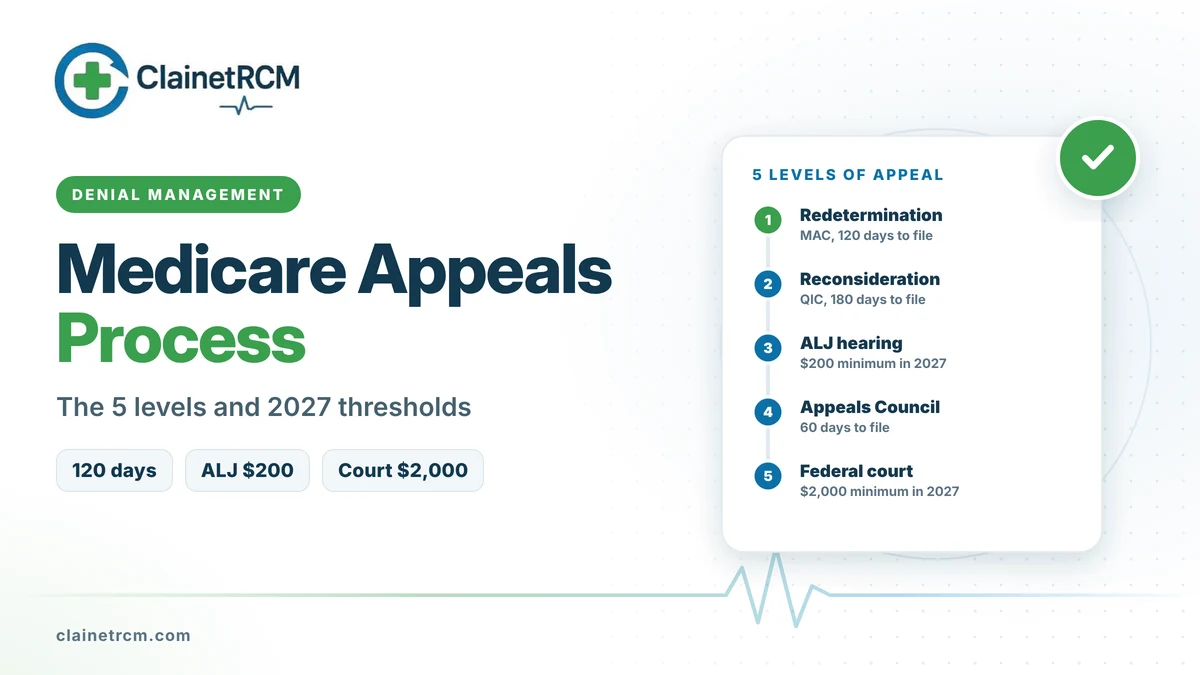
Quick answer: Level 1 is a redetermination by your Medicare Administrative Contractor (MAC), filed within 120 days. Level 2 is a reconsideration by a Qualified Independent Contractor (QIC), filed within 180 days. Level 3 is a hearing before an Administrative Law Judge (ALJ), filed within 60 days, with a $200 minimum amount in controversy in both 2026 and 2027. Level 4 is review by the Medicare Appeals Council, filed within 60 days. Level 5 is judicial review in federal district court, filed within 60 days, with a minimum of $1,960 in 2026 and $2,000 for requests filed on or after January 1, 2027.
The 5 Levels of the Medicare Appeals Process
| Level | Who decides | Deadline to file | Decision time frame | Minimum amount |
|---|---|---|---|---|
| 1. Redetermination | Medicare Administrative Contractor (MAC) | 120 days from receipt of the initial determination | 60 days | None |
| 2. Reconsideration | Qualified Independent Contractor (QIC) | 180 days from receipt of the redetermination | 60 days | None |
| 3. ALJ hearing | Office of Medicare Hearings and Appeals (OMHA) | 60 days from receipt of the reconsideration | 90 days | $200 in 2026 and 2027 |
| 4. Council review | Medicare Appeals Council | 60 days from receipt of the ALJ decision | 90 days | None |
| 5. Judicial review | Federal district court | 60 days from receipt of the Council decision | No set limit | $1,960 in 2026; $2,000 in 2027 |
Medicare presumes you received a notice five days after the date on it. Count your deadline from that point, but file well before the last day.
Level 1: Redetermination
A redetermination is a fresh review of the claim by the MAC that processed it, done by staff who were not involved in the first decision.
- How to file: Use Form CMS-20027, your MAC’s online portal, or a signed letter that includes the beneficiary’s name, Medicare number, the item or service, the date of service and why you disagree.
- What to send: Records that answer the denial reason, such as progress notes, orders, test results and signed attestations.
- Clerical errors are different. Wrong codes, missing modifiers and similar mistakes are fixed through a reopening, often by phone or portal, rather than a redetermination. Medicare allows reopenings within one year for any reason and up to four years with good cause.
- Overpayments and recoupment: If you appeal an overpayment demand, file the redetermination within 30 days of the demand letter to stop recoupment during Level 1. After an unfavorable decision, file the reconsideration within 60 days to keep recoupment on hold. Interest can still accrue if you lose.
- Late filing: A MAC can extend the deadline when you show good cause, such as a serious illness or records destroyed in a disaster.
Level 2: Reconsideration
A reconsideration is an independent review by a QIC, a contractor separate from your MAC.
- How to file: Use Form CMS-20033 or a written request with the same identifying details, plus a copy of the redetermination notice.
- Put all evidence in now. Providers and suppliers must present their evidence at this level. Evidence first offered at the ALJ level can be excluded unless you show good cause, so treat Level 2 as your last chance to complete the record.
- Escalation: If the QIC does not decide within 60 days, you can ask it to escalate the case to the ALJ level.
Level 3: Administrative Law Judge Hearing
The ALJ hearing is the first level with a dollar threshold and the first chance to explain your case to a decision maker, usually by phone or video.
- How to file: File Form OMHA-100 or a written request with the Office of Medicare Hearings and Appeals, by mail or through the OMHA e-Appeal portal.
- Amount in controversy: At least $200 must remain in dispute for requests filed in 2026, and the threshold stays at $200 for 2027. You can combine claims to reach the threshold when they meet Medicare’s aggregation rules.
- Timing: OMHA aims to decide within 90 days. If it does not, you can escalate to the Medicare Appeals Council. Some cases are decided on the record by an attorney adjudicator without a hearing.
Level 4: Medicare Appeals Council
The Medicare Appeals Council, part of the Departmental Appeals Board, reviews the ALJ decision.
- How to file: Use Form DAB-101 or a written request within 60 days of receiving the ALJ decision.
- No minimum amount applies at this level.
- Timing and escalation: The Council generally has 90 days to decide. If it does not, you can ask to escalate the case to federal district court.
Level 5: Federal District Court
Judicial review is the final level. You must file within 60 days of receiving the Council’s decision, and the amount in controversy must be at least $1,960 for requests filed in 2026 and $2,000 for requests filed on or after January 1, 2027. At this stage most providers work with health care counsel.
Amount in Controversy Thresholds
| Calendar year | ALJ hearing | Federal district court |
|---|---|---|
| 2025 | $190 | $1,900 |
| 2026 | $200 | $1,960 |
| 2027 | $200 | $2,000 |
CMS adjusts these thresholds each year using the medical care component of the consumer price index and rounds them to the nearest $10. To figure your amount in controversy, start with the amount charged, subtract what Medicare has already paid, then subtract any deductible and coinsurance that could still be collected for the items in dispute.
Medicare Advantage Appeals Work Differently
Medicare Advantage plans run their own first level. An enrollee, or a non-contracted provider who signs a waiver of liability, asks the plan for a reconsideration, and current Medicare rules give enrollees 65 days from the plan’s notice to file. If the plan upholds a denial, it forwards the case to an independent review entity. Later levels follow the same ALJ, Council and court path as Original Medicare. Payment disputes between a plan and its contracted providers follow the dispute process in the provider contract, not the Medicare appeals process.
Tips for Winning Medicare Appeals
- Answer the specific denial reason shown on the remittance advice or decision letter.
- Cite the rule, including the LCD, national coverage determination or the Medicare manual section that supports payment.
- Complete the record early. A clean Level 1 or Level 2 file wins most cases without a hearing.
- Track deadlines from receipt and keep proof of every filing.
- Use MAC portals for faster submission and status checks.
- Weigh value and effort on small claims, and combine claims with common issues when you go to the ALJ level.
- Look for patterns. Repeated denials, targeted probe and educate reviews or audit findings point to a documentation or coding gap you can fix.
Frequently Asked Questions
The first two levels usually take about 60 days each once filed. ALJ hearings and Council reviews have 90-day goals, though backlogs can stretch them. A case that goes all the way to court can take years.
Not by choice. You can escalate to the next level only when the current reviewer misses its deadline, such as a QIC that does not decide within 60 days.
For requests filed on or after January 1, 2027, the amount in controversy is $200 for an ALJ hearing and $2,000 for federal district court review.
A reopening fixes clerical or minor errors without a formal appeal. A redetermination is the first level of the Medicare appeals process for decisions you disagree with.
Medicare limits recoupment during the first two levels if you file the redetermination within 30 days of the demand letter and the reconsideration within 60 days of the redetermination decision. After that, recoupment can begin even if you appeal further.
The upper levels are the same, but the first level is a plan reconsideration with its own deadline, and contracted providers use the plan’s dispute process for payment disagreements.
Final Thoughts
The Medicare appeals process rewards providers who file early, answer the exact denial reason and put complete evidence in the record by Level 2. Most winnable claims are won at the first two levels. If your team needs help building appeal files or tracking deadlines, explore our denial management services. New to Medicare billing? Start with our guide on how to bill Medicare as a provider.
Get Denied Medicare Claims Paid
We file redeterminations and reconsiderations with complete evidence, track every deadline and stop recoupment when an overpayment is wrong.
Get Medicare Appeal Help
Written by
ClainetRCM Billing Team
ClainetRCM is a Boston-based revenue cycle management company specializing in medical billing, coding, credentialing and denial management for healthcare providers across all 50 states. Our AAPC and AHIMA certified team works inside your existing EHR, files claims within 24 to 48 hours and reviews every AR bucket on a 14-day cycle.