A medical appeal letter is a written request asking a health plan to reverse a claim denial, a reduced payment or a prior authorization decision. Strong letters do three things well. They identify the claim exactly, they show why the decision is wrong using the payer’s own rules, and they prove it with records. Below you will find a ready-to-use template, what reviewers need to see, and the filing deadlines by appeal level.
Quick answer: Open with the identifiers: patient name, member ID, claim number, date of service, codes and billed amount. State the decision you are appealing and the outcome you want. Explain in a few short paragraphs why the service meets the payer’s policy, citing the policy, coverage criteria or contract section. Attach the denial notice, the relevant medical records and any supporting documents. File before the deadline. For Original Medicare, a redetermination must be filed within 120 days of receiving the initial determination. Most commercial plans covered by federal appeal rules give members 180 days to file an internal appeal. Contracted provider disputes follow the timeline in your agreement or provider manual.
What a Medical Appeal Letter Must Include
| Element | What to include | Why it matters |
|---|---|---|
| Claim identifiers | Patient name, date of birth, member ID, claim number, date of service, codes, billed amount | The reviewer can pull the right claim fast |
| The decision you are appealing | Denial date, reason codes (CARC and RARC) and the denial wording | Keeps the review focused on one issue |
| Your argument | Why the service meets coverage, coding or contract rules | Reviewers decide on policy, not on sympathy |
| Evidence | Office notes, operative or test reports, authorization numbers, policy excerpts | Proves the facts you state |
| Requested outcome | Pay as billed, or reprocess at the contracted rate | Gives the reviewer a clear action |
| Contact and signature | Name, title, phone, fax and address | Lets the payer follow up with questions |
Appeal or Corrected Claim? Decide First
Not every denial needs a letter. If the problem was your own data or coding error, such as a wrong modifier, a missing NPI or a typo in the date of birth, send a corrected claim instead. For Original Medicare, minor clerical errors are fixed through a reopening rather than an appeal. Save appeals for decisions you believe are wrong: medical necessity denials, non-covered determinations, bundling disputes, authorization denials and timely filing denials where you have proof of on-time submission.
Check who holds the appeal right. Under employer plans governed by ERISA, the right to appeal belongs to the member. Unless the plan offers a separate provider appeal process, you may need the patient to sign an authorized representative form so you can appeal on their behalf.
Medical Appeal Letter Template
Copy these sections in order and replace the bracketed text. Keep the letter to one or two pages.
- Letterhead: Practice name, address, phone, fax, NPI and tax ID.
- Date and payer address: Use the appeals address or portal named on the denial notice, not the general claims address.
- Subject line: “Request for appeal: [patient name], member ID [number], claim number [number], date of service [date].”
- Opening: “We request [a first-level appeal / reconsideration] of the [denial / reduced payment] dated [date] for the services listed below. The claim was denied with reason code [code] and the explanation ‘[denial wording]’.”
- Service summary: “[CPT or HCPCS code with modifiers] for [ICD-10-CM code and description], billed at $[amount].”
- Argument: “This service meets [policy name and number, LCD number or contract section] because [specific clinical facts tied to each criterion]. The enclosed records show [key findings, failed conservative treatment, test results].”
- Request: “We ask that you overturn the denial and process this claim for payment [at the contracted rate].”
- Enclosures: “Denial notice or remittance, office notes dated [dates], [operative report or test results], authorization number [number], [policy excerpt].”
- Signature: “[Name, credentials or title], [phone], [email].”
Send one claim per letter unless the payer accepts batched appeals for the same issue.
Appeal Deadlines by Level
| Payer type | Appeal level | Typical filing deadline |
|---|---|---|
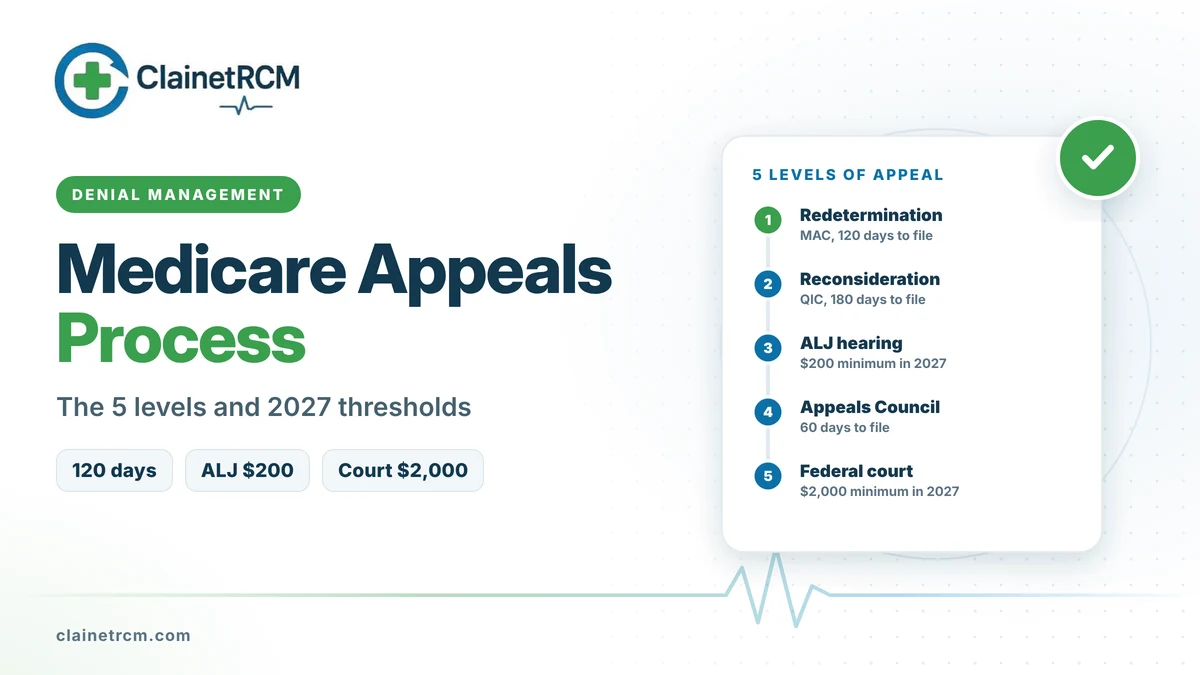
| Original Medicare | Redetermination by the MAC | 120 days from receipt of the initial determination |
| Original Medicare | Reconsideration by the QIC | 180 days from receipt of the redetermination decision |
| Original Medicare | Administrative Law Judge hearing | 60 days from receipt of the reconsideration; $200 minimum in controversy in 2026 and 2027 |
| Medicare Advantage | Plan reconsideration | 65 days from the plan’s notice for enrollee appeals; contracted providers use the plan’s dispute process |
| Medicaid managed care | Plan appeal | 60 days from the notice of adverse benefit determination; providers may file with the member’s written consent |
| Commercial plans under federal rules | Internal appeal | 180 days from receipt of the denial |
| Commercial plans under federal rules | External review | 4 months after the final internal denial |
| Contracted provider disputes | Per contract | Set by your agreement or provider manual; log each payer’s window |
Deadlines run from the date you receive the notice, and payers usually presume receipt a few days after the notice date. Do not count on that cushion. Log the deadline the day the denial posts.
Tips That Win Appeals
- Answer the actual denial reason. Read the CARC and RARC codes and build the letter around that reason only.
- Quote the rule. Cite the payer’s medical policy, the Medicare LCD or national coverage determination, NCCI edits or CPT guidelines, with section numbers.
- Point the reviewer to the evidence. Reference page numbers or highlight the lines in the medical records that meet each criterion. Send the relevant records, not the whole chart.
- Use the payer’s form or portal when required. Many payers reject appeals that arrive on the wrong form or at the wrong address.
- Ask for a peer-to-peer review on medical necessity and authorization denials. Many plans offer one before or during the formal appeal, and a short physician conversation often settles the case.
- Keep proof of submission. Save fax confirmations, certified mail receipts and portal confirmation numbers.
- Follow up and escalate. If the payer misses its decision window, call. If the appeal is upheld, move to the next level or request external review.
- Fix the pattern. If the same denial keeps coming back, correct the front-end process that causes it.
Example: A Medical Necessity Appeal
Here is an illustrative case. A lumbar spine MRI (CPT 72148) is denied with CO-50 for lack of medical necessity. The patient’s records show six weeks of physical therapy and medications without relief, plus new leg weakness on exam. The letter quotes the plan’s imaging policy criteria for persistent radicular symptoms after conservative care, lists each criterion with the matching record page, and encloses the therapy notes and exam findings. The plan overturns the denial on first-level appeal.
Frequently Asked Questions
Identify the claim, state the decision you dispute, explain why it is wrong using the payer’s own policy, attach supporting records and ask for a specific outcome. Keep it short, factual and organized around the denial reason.
It depends on the payer and the type of claim. Medicare contractors generally decide redeterminations within 60 days. Under federal rules for group health plans, appeals of claims for services already provided are generally decided within 60 days, and pre-service appeals within 30 days.
The treating provider signs when the argument depends on clinical judgment. A billing manager can sign appeals about coding, timely filing or contract terms. Follow the payer’s instructions if it requires a specific signer.
Often yes. Medicare lets providers appeal claims they submitted. Many commercial plans require an authorized representative designation signed by the patient before a provider can pursue the member’s appeal.
Move to the next level. Original Medicare has five levels, and most commercial plans offer a second internal appeal or external review by an independent reviewer. Each level has its own deadline.
No. Send the records that support the service and the denial reason, and point the reviewer to the key pages. Extra pages slow the review and can bury the evidence that matters.
Final Thoughts
A winning medical appeal letter is specific, short and built on the payer’s own rules. Pair every letter with the right records, file it well before the deadline and keep proof of every submission. If denials are piling up faster than your team can answer them, our denial management services can take over the appeals. To stop denials before they start, read our guide on how to reduce claim denials.
Turn Denials Into Payments
Our denial management team writes payer-specific appeal letters, attaches the right records and tracks every deadline until the claim is paid.
Get Appeal Help
Written by
ClainetRCM Billing Team
ClainetRCM is a Boston-based revenue cycle management company specializing in medical billing, coding, credentialing and denial management for healthcare providers across all 50 states. Our AAPC and AHIMA certified team works inside your existing EHR, files claims within 24 to 48 hours and reviews every AR bucket on a 14-day cycle.