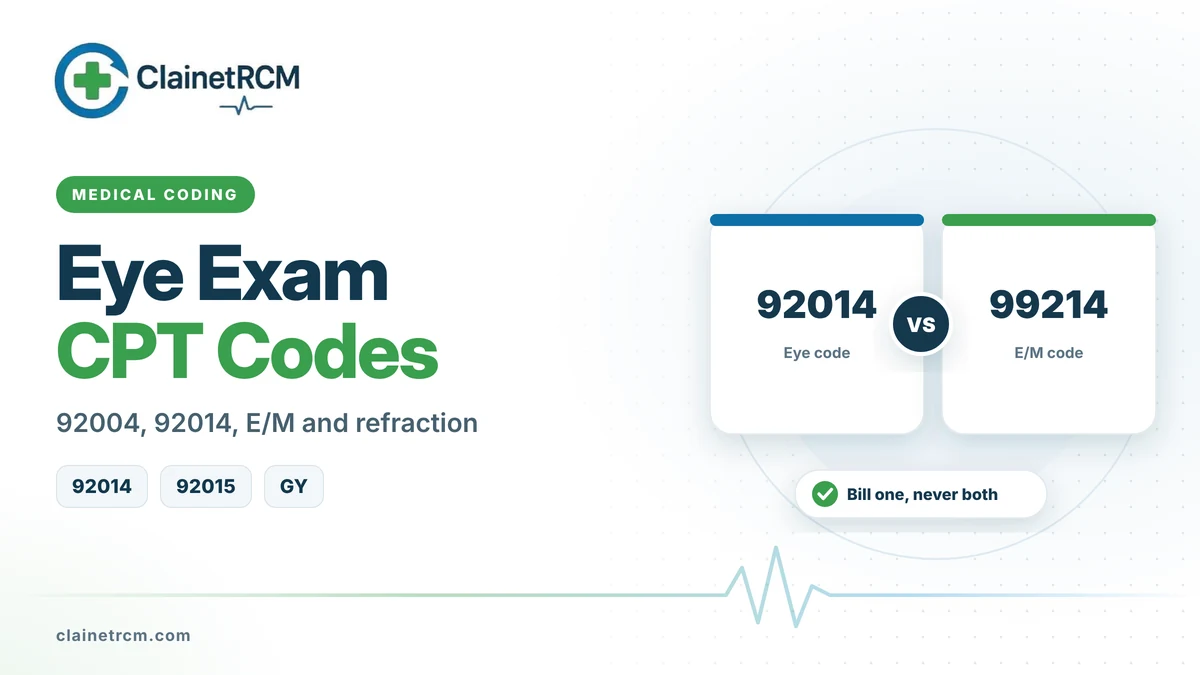
Eye exam CPT codes give ophthalmologists and optometrists a choice most specialties do not have: bill the visit with the ophthalmological service codes (92002 to 92014) or with the standard E/M codes (99202 to 99215). The right choice depends on the work performed, the payer and the documentation. Add refraction, which Medicare never covers, and the split between routine vision and medical eye care, and eye exam billing becomes one of the trickier areas in a practice.
Quick answer: Use 92002 or 92004 for new patients and 92012 or 92014 for established patients, choosing intermediate (92002, 92012) or comprehensive (92004, 92014) based on the exam. You may bill an E/M code instead when it better reflects the visit, but never both for the same encounter. Refraction (92015) is billed separately; Medicare excludes it, so the patient pays or a vision plan covers it, and modifier GY can be added if a Medicare denial is needed. The reason for the visit and the diagnosis decide whether the exam goes to medical insurance or a vision plan.
Eye Exam CPT Codes
| Code | Patient | Level |
|---|---|---|
| 92002 | New | Intermediate |
| 92004 | New | Comprehensive, one or more visits |
| 92012 | Established | Intermediate |
| 92014 | Established | Comprehensive, one or more visits |
A new patient is one who has not received professional services from the physician, or another physician of the same specialty in the same group, within the past three years, the same rule used for E/M codes.
Intermediate vs Comprehensive
- Intermediate services evaluate a new or existing condition, often complicated by a new problem, and include the history, a general medical observation, an external exam and other diagnostic procedures as indicated.
- Comprehensive services are a general evaluation of the complete visual system. They include the history, general medical observation, external and ophthalmoscopic exams, gross visual fields and basic sensorimotor exam, and they always include initiating or continuing diagnostic and treatment programs. Dilation is often part of the exam when clinically indicated.
Eye Codes vs E/M Codes
The eye codes are leveled by the exam, while office E/M codes are leveled by medical decision-making or total time. That difference changes which code pays more.
| Code | 2026 Medicare national, non-facility |
|---|---|
| 92002 | $84.84 |
| 92004 | $149.64 |
| 92012 | $90.52 |
| 92014 | $127.26 |
| 99213 | $95.19 |
| 99214 | $135.61 |
| 99204 | $177.36 |
A stable patient with a comprehensive exam but low-complexity decision-making may be better described by 92014 than 99213. A new patient with a complex acute problem may support 99204, which pays more than 92004. Choose the code the documentation supports best, check payer frequency limits for eye codes and remember that the 2027 Medicare conversion factor drops by about 2.3%, so these amounts will change.
Refraction and Modifier GY
Refraction (92015) determines the lens prescription. Medicare excludes it by law, whatever the reason it is performed, so it is billed to the patient or a vision plan. If a secondary payer needs a Medicare denial, bill 92015 with modifier GY. Commercial medical plans often bundle refraction into the exam, while vision plans usually pay for it.
Medical vs Routine Vision Exams
| Situation | Usually billed to | Typical diagnosis |
|---|---|---|
| Routine exam for glasses or contacts | Vision plan or patient | Refractive error or routine eye exam codes (Z01.0-) |
| Cataract, glaucoma, dry eye, red eye | Medical insurance | The medical condition, such as H25.- or H40.- |
| Diabetic eye exam | Medical insurance | Diabetes with or without ophthalmic complications |
| Glaucoma screening for high-risk Medicare patients | Medicare, once every 12 months | Screening codes G0117 or G0118 |
Vision plans may require their own codes, such as S0620 and S0621 for routine exams with refraction. Medicare does not cover routine eye exams for glasses, but it does cover medically necessary exams, annual diabetic eye exams, glaucoma screening for high-risk patients and one pair of eyeglasses or contact lenses after cataract surgery with an intraocular lens.
Diagnostic Testing
Diagnostic tests are billed in addition to the exam when medically necessary, such as fundus photography (92250), optical coherence tomography of the optic nerve or retina (92133, 92134) and visual fields (92083). Each test needs its own order, interpretation and supporting diagnosis, and some combinations are limited by NCCI edits or coverage policies.
Example
An established Medicare patient with primary open-angle glaucoma has a comprehensive exam with dilation, IOP check and an OCT of the optic nerve, and asks for an updated glasses prescription.
- Exam: 92014 with the glaucoma diagnosis
- Testing: 92133 with its interpretation
- Refraction: 92015 billed to the patient, with GY if a denial is needed for secondary coverage
Common Errors
- Billing an eye code and an E/M code for the same encounter
- Billing refraction to Medicare without GY when a denial is needed for secondary coverage
- Sending a routine vision exam to medical insurance with only a refractive error diagnosis
- Billing comprehensive codes more often than the payer allows
- Billing diagnostic tests without a separate order and interpretation
Frequently Asked Questions
No. Choose either the eye code or the E/M code for the encounter, based on which one the documentation supports best.
No. Refraction (92015) is excluded from Medicare coverage. The patient or a vision plan pays for it, and GY can be added if a Medicare denial is needed.
A comprehensive exam evaluates the complete visual system and always includes initiating or continuing a diagnostic and treatment program. An intermediate exam focuses on a specific new or existing condition.
When the visit is for a medical problem or condition, such as glaucoma, cataract, diabetic eye disease or an eye injury. Routine exams for glasses or contacts go to the vision plan.
Some payers limit how often comprehensive eye codes can be billed, such as once per year. Check each payer’s policy before choosing between eye codes and E/M.
Final Thoughts
Eye exam CPT codes reward a deliberate choice between eye codes and E/M, and clear routing of medical and routine services. Learn how we support eye care practices on our ophthalmology billing page, or read our specialty medical billing guide.
Pick the Right Eye Code Every Visit
Our eye care billing team chooses between eye codes and E/M, routes routine and medical exams to the right payer and handles refraction and testing correctly.
Get Eye Care Billing Help
Written by
ClainetRCM Billing Team
ClainetRCM is a Boston-based revenue cycle management company specializing in medical billing, coding, credentialing and denial management for healthcare providers across all 50 states. Our AAPC and AHIMA certified team works inside your existing EHR, files claims within 24 to 48 hours and reviews every AR bucket on a 14-day cycle.