Nurse practitioner credentialing follows the same basic path as physician credentialing, with a few important differences: state practice authority rules, Medicare’s NP qualification requirements, payer policies that do not always treat NPs like physicians, and billing choices that change what each visit pays. Getting these right up front keeps an NP’s schedule full and their claims clean.
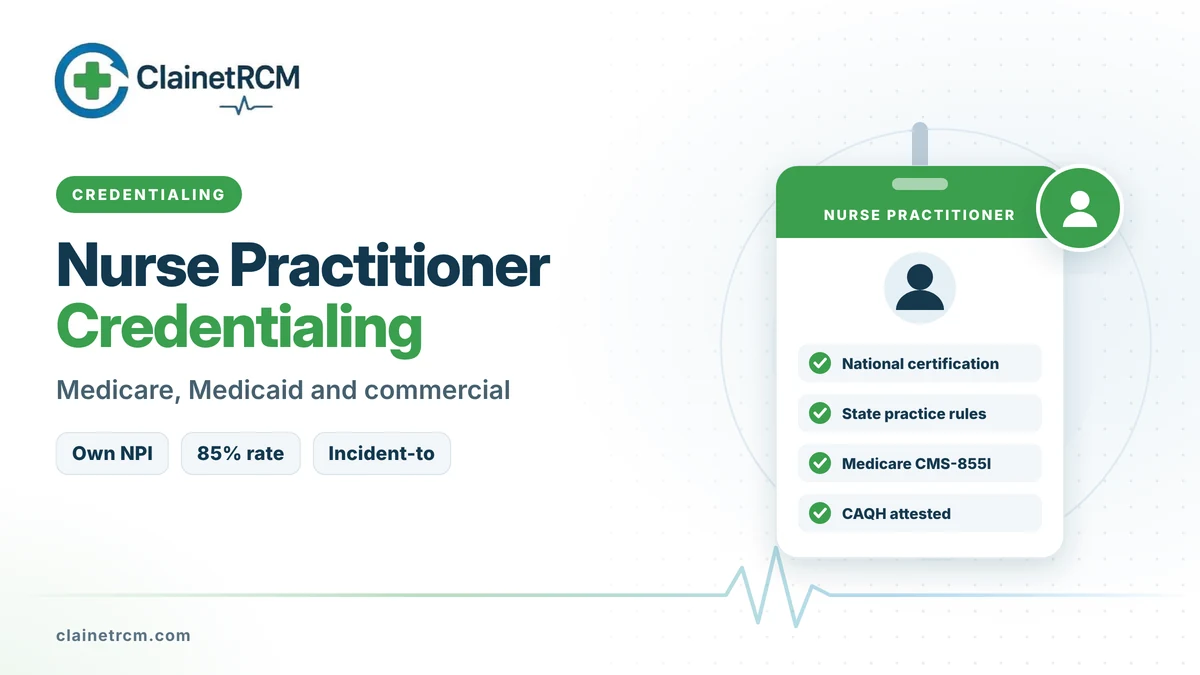
Quick answer: An NP needs a Type 1 NPI, a state NP license (and RN license), national certification, DEA and state controlled substance registrations if prescribing, malpractice coverage and a complete CAQH profile. Enroll in Medicare with the CMS-855I (reassigning benefits to the employer when applicable), then Medicaid and commercial plans. Medicare pays NPs 85% of the physician fee schedule when they bill under their own NPI. In office settings, incident-to billing under a supervising physician pays 100%, but only when strict rules are met.
Nurse Practitioner Credentialing Requirements for Medicare
Medicare enrolls NPs as non-physician practitioners. To qualify today, an NP generally must:
- Be a registered nurse authorized by the state to practice as a nurse practitioner
- Hold national certification as an NP from a recognized certifying body
- Have a master’s degree in nursing or a Doctor of Nursing Practice degree
Older grandfathering rules cover some NPs who first billed Medicare years ago. Medicare also requires NPs to work in collaboration with a physician to the extent state law requires. Where state law has no collaboration requirement, the NP documents their scope of practice and how they handle issues outside it.
State Practice Authority Shapes the Paperwork
State law decides whether an NP needs a physician agreement at all. The American Association of Nurse Practitioners groups states into three categories:
| Practice environment | What it means | Credentialing impact |
|---|---|---|
| Full practice authority | NPs evaluate, diagnose, treat and prescribe under the board of nursing without required physician oversight | No collaborative agreement to submit; some states require a transition-to-practice period for new NPs |
| Reduced practice | At least one element of practice requires a collaborative agreement | Payers may ask for the collaborative agreement and the physician’s details |
| Restricted practice | Physician supervision or delegation is required for at least one element of practice | Supervising physician information is required on applications |
AANP’s 2026 count lists 27 states plus Washington, D.C. with full practice authority, and several states expanded NP authority during 2026. Because the map keeps changing, check the current rules with your state board of nursing before you file applications, and keep any collaborative agreement current and signed.
Medicare Enrollment for NPs, Step by Step
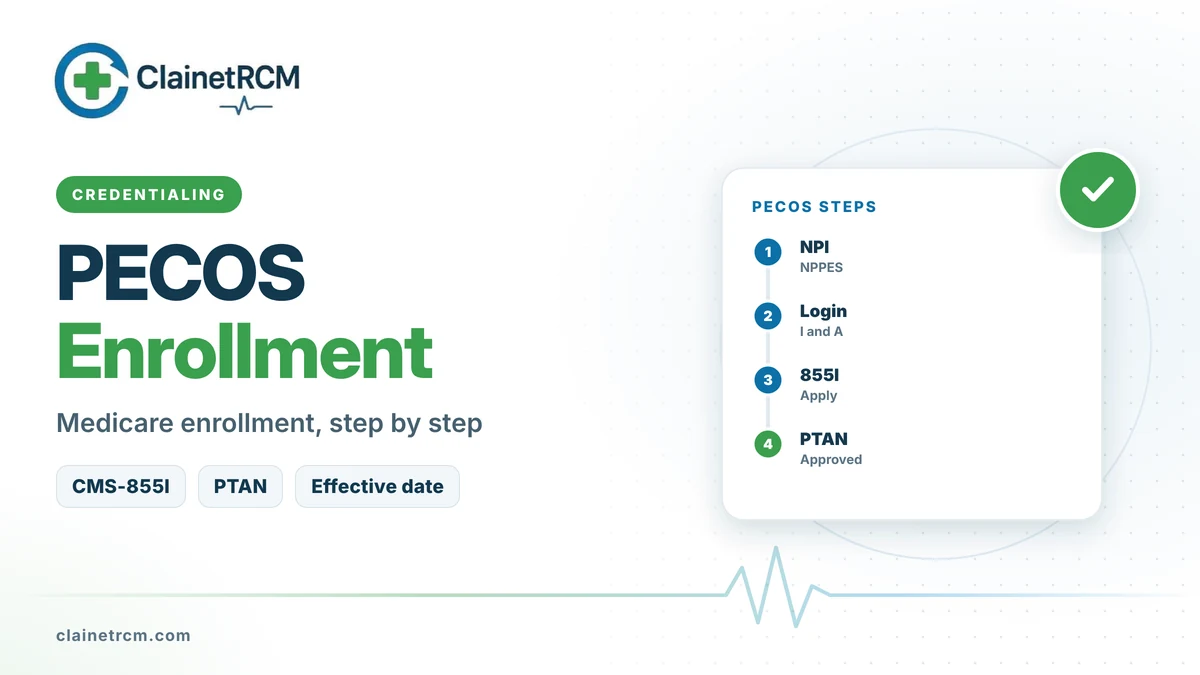
- Confirm NPPES. The NP’s Type 1 NPI should list the correct NP taxonomy, such as 363LF0000X for a family NP or 363LP0808X for a psychiatric-mental health NP.
- File the CMS-855I in PECOS. Include the reassignment section if an employer or group will bill for the NP’s services.
- Have both parties sign. The NP signs, and the group’s authorized or delegated official signs the reassignment.
- Answer development requests within 30 days.
- Record the PTAN and effective date and link the NP to the group in your billing system.
Our PECOS enrollment guide covers each screen in more detail.
Billing Under the NP’s Own NPI vs Incident-To
| Billing method | Medicare payment | Key requirements |
|---|---|---|
| NP’s own NPI | 85% of the physician fee schedule amount | NP is enrolled and acts within state scope of practice |
| Incident-to (office setting) | 100% under the physician’s NPI | Established patient, physician-initiated plan of care, physician direct supervision, and the NP is not addressing a new problem |
| Split/shared visit (facility setting) | 100% under the practitioner who performs the substantive portion | Hospital or facility setting; append modifier FS; substantive portion based on more than half the time or the substantive part of medical decision making |
Incident-to rules are where audits find problems. New patients and new problems must be seen by the physician first, and the physician must be immediately available as Medicare defines direct supervision. If any element is missing, bill under the NP’s own NPI. Incident-to billing does not apply in hospital settings at all, which is why split/shared rules exist.
Medicaid Credentialing for NPs
Every state Medicaid program enrolls NPs, but payment rates and rules vary. Some states pay NPs the full physician rate; others pay a percentage. Many states require the NP’s taxonomy code on claims, and some require the collaborating physician to be enrolled as well. After the state approves enrollment, credential separately with each Medicaid managed care plan.
Commercial Payers and NPs
Commercial plans differ more than government programs:
- Panel status. Some plans credential NPs as primary care providers with their own patient panels; others allow NPs only within a group or under a physician.
- Payment. Some pay NPs the same as physicians; many pay a reduced percentage.
- Modifiers. A few payers ask for modifiers that identify NP services, such as SA for an NP rendering a service in collaboration with a physician.
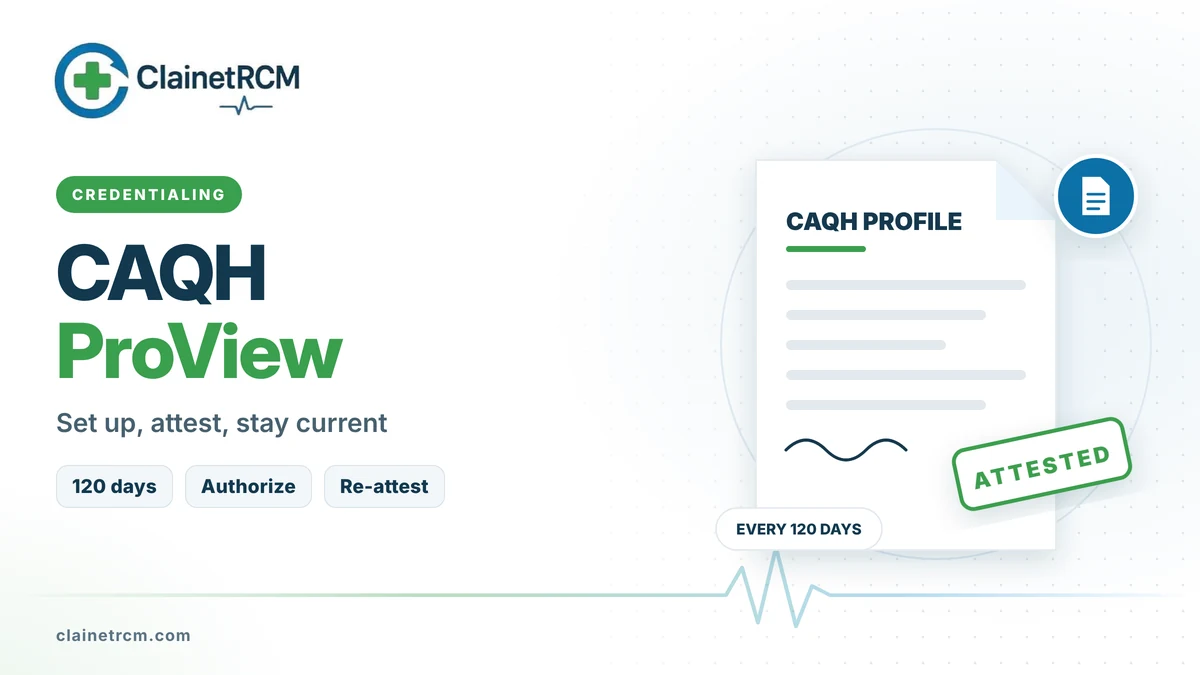
- CAQH. Nearly all of them use CAQH, so a complete, attested profile is essential. See our CAQH ProView guide.
Ask each payer for its NP policy in writing before you set up billing.
Prescribing: DEA and State Registrations
An NP who prescribes controlled substances needs a DEA registration for each state where they prescribe, and many states also require a state controlled substance registration. Payers verify both during credentialing, so renew them well before they expire. Our guide to DEA registration explains the process.
Frequently Asked Questions
Yes. Medicare, Medicaid and most commercial plans enroll NPs as billing or rendering providers. Medicare pays 85% of the physician fee schedule for services billed under the NP’s NPI.
Only to the extent state law requires collaboration. In full practice authority states, no collaborative agreement is required.
Only when every incident-to requirement is met in an office setting. If in doubt, bill under the NP’s own NPI to avoid overpayment risk.
Many plans allow it, especially in full practice states, but policies vary. Confirm each plan’s NP panel policy before applying.
About the same as physician credentialing: Medicare often within weeks for a clean application, commercial plans commonly 90 to 120 days.
Final Thoughts
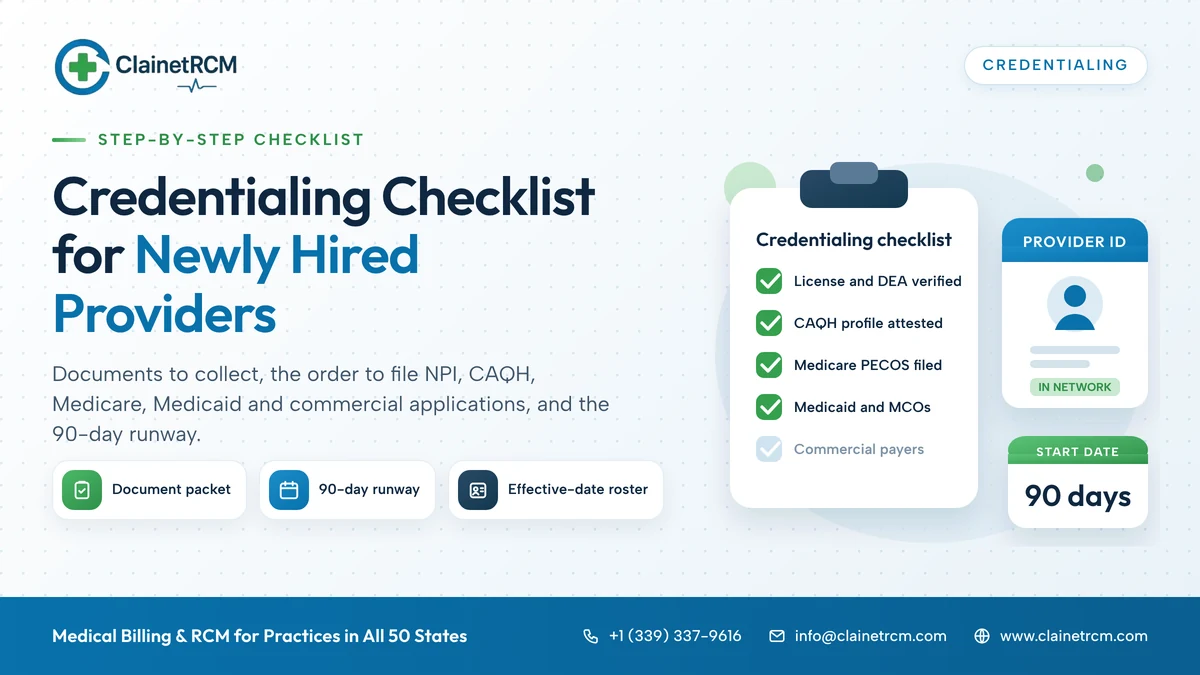
Nurse practitioner credentialing goes smoothly when you match the paperwork to state practice rules, enroll in the right order and choose the correct billing method for each setting. Our credentialing services team handles NP enrollment with every major payer, and our credentialing checklist for new providers helps you gather documents. For NPs practicing in more than one state, our provider licensing team can help with additional licenses.
Get Your Nurse Practitioners Credentialed Faster
We enroll NPs with Medicare, Medicaid and commercial plans, track state collaboration requirements and set up billing so every visit is paid correctly.
Credential My NPs
Written by
ClainetRCM Billing Team
ClainetRCM is a Boston-based revenue cycle management company specializing in medical billing, coding, credentialing and denial management for healthcare providers across all 50 states. Our AAPC and AHIMA certified team works inside your existing EHR, files claims within 24 to 48 hours and reviews every AR bucket on a 14-day cycle.