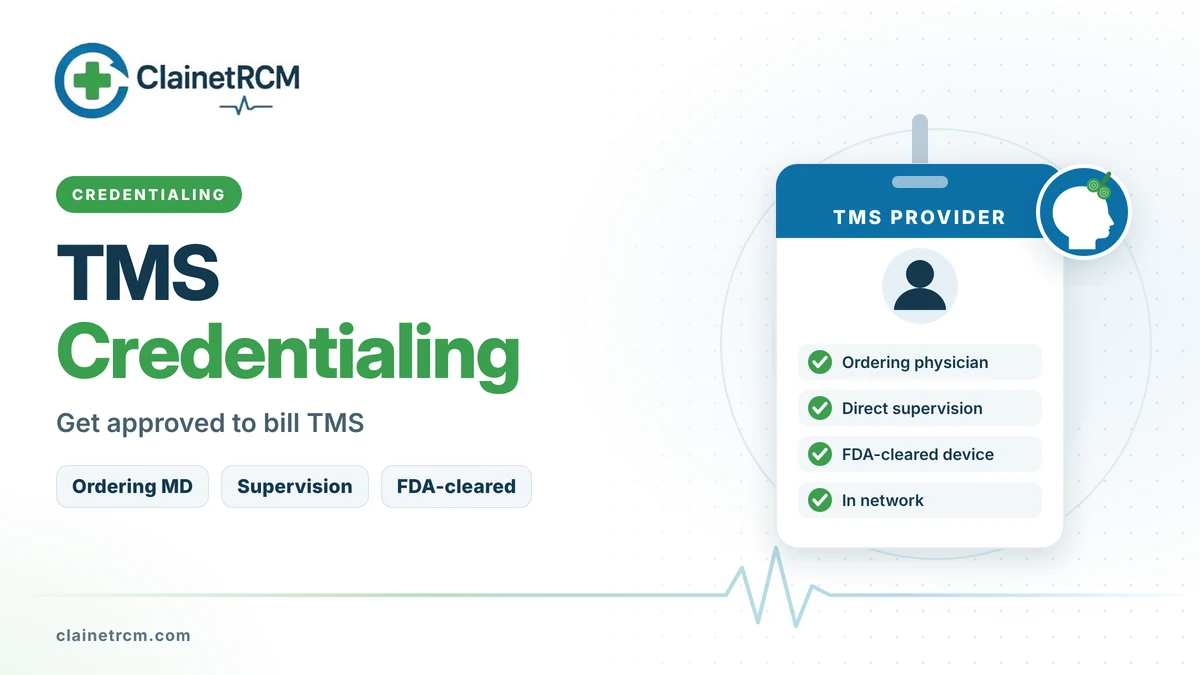
Buying a TMS device is the easy part of launching a TMS program. Getting paid for it depends on TMS credentialing: a file that convinces each payer your practice can deliver TMS safely, with the right ordering physician, a supervision plan, an FDA-cleared device, trained staff and a network contract that lists the TMS codes.
Quick answer: TMS credentialing means four things. Credential your ordering and supervising providers with every payer, usually a psychiatrist, and psychiatric nurse practitioners where the plan and your state allow it. Enroll the treatment location with each plan. Document your FDA-cleared device, training and supervision model for payers that review TMS separately. Then make sure your contract and fee schedule include 90867, 90868 and 90869. Medicare adds its own rules through each contractor’s local coverage determination.
This guide covers who can order and deliver TMS, what payers ask to see, how long it takes and how to keep your TMS credentials from lapsing.
TMS Credentialing Checklist
| Item | What payers look for | Tip |
|---|---|---|
| Ordering provider | A physician who examined the patient and has TMS experience. Some plans require a psychiatrist | Keep training certificates in the credentialing file |
| Supervising provider | Direct supervision during treatment sessions | Document who supervises each session |
| Treatment technicians | Trained by the device maker or an accredited course | Keep training logs current |
| Device | FDA clearance for each indication you treat | Keep the device clearance documentation on file |
| Location | Listed on each payer enrollment | Add new sites before the first session |
| Contract | TMS codes included in the agreement and fee schedule | Confirm before scheduling patients |
| Outcome tracking | Standardized depression rating scales | PHQ-9, HAM-D and similar scales support every authorization |
Who Can Order, Supervise and Deliver TMS
Medicare. Medicare’s TMS policies are set by each Medicare Administrative Contractor, but they share a common structure. Wellpoint Federal’s LCD, for example, requires the treatment order to come from a physician who has examined the patient, reviewed the record and has experience administering TMS. Treatment is given under that physician’s direct supervision, meaning the physician is present in the area but does not have to deliver the treatment personally. The same LCD allows a non-physician practitioner to order treatment when it is within the practitioner’s state scope of practice.
Commercial plans. Requirements vary more than they do in Medicare. Some plans require the order to come from a psychiatrist. Others are widening the pool: Optum Behavioral Health added psychiatric mental health nurse practitioners to the providers who can provide TMS, effective March 17, 2026, where state law allows it.
Medicaid. State programs set their own rules. Montana Medicaid, for example, limits TMS to licensed physicians and psychiatrists with the training and equipment to provide it, and requires providers to track outcome measures.
Technicians. Trained technicians usually deliver the sessions. Payers rarely credential technicians individually, but they expect the supervising provider and the practice to document technician training.
What Payers Ask to See
Many behavioral health plans review TMS programs separately from routine psychiatry and publish their own TMS provider requirements. Magellan, for example, publishes TMS privileging criteria that cover the device, supervision and outcome monitoring. Expect to provide some or all of the following:
- The device make and model, and its FDA clearance for the condition you plan to treat.
- Training certificates for the ordering and supervising providers.
- The supervision plan, including who is on site during treatment hours.
- Your safety protocols, including seizure management and contraindication screening.
- The rating scales you use and how often you repeat them.
- Proof of professional liability coverage that includes TMS.
If you treat obsessive-compulsive disorder with deep TMS, confirm separately that the plan covers that indication and that your device is cleared for it.
Enrolling the Practice and the Location
Credential every provider with every plan. Each ordering and supervising provider needs to be credentialed with the commercial plans, Medicare Advantage plans and Medicaid programs you bill. Keep each CAQH profile complete and attested every 120 days.
Enroll with Medicare correctly. Medicare enrollment comes first: each provider must be enrolled in Medicare and reassigned to the billing group, and the TMS address must appear as a practice location. Because most sessions are delivered by technicians under direct supervision, the supervising provider must be enrolled and present.
Add every location. If TMS is delivered at a satellite office, add that address to every payer enrollment before the first session. Claims from an address that is not on file can reject even when the provider is credentialed.
Load the TMS codes into the contract. Some agreements only list routine psychiatric services. Confirm that 90867, 90868 and 90869 are in the contract and on the fee schedule. Medicare does not set a national rate for these codes, so each contractor publishes its own fee.
Our article on CMS credentialing requirements covers the Medicare side in more depth, and our guide to Medicare and Medicaid enrollment delays explains where applications usually stall.
Why Network Status Matters More in 2026
Being in network has always meant lower patient costs and smoother claims. In 2026 it also means fewer authorizations. Cigna and Evernorth removed prior authorization for TMS for their contracted, in-network providers on March 6, 2026. Out-of-network providers do not get that relief, so a practice that finishes credentialing with these plans saves administrative time on every new patient.
Questions to Ask Each Payer Before You Treat
A short call with each plan’s provider services team can save months of denials. Ask:
- Does the plan credential TMS separately, or is it covered under our existing behavioral health agreement?
- Which provider types can order TMS, and which can supervise it?
- Which devices and protocols does the plan cover, including deep TMS and theta burst?
- Does the plan require prior authorization for our network status, and how many sessions does a typical approval cover?
- Which diagnosis codes does the plan accept for TMS, and does it cover OCD?
- What fee does the contract list for 90867, 90868 and 90869?
Write the answers into a payer grid and share it with your front desk, your authorization team and your billers, so everyone works from the same rules.
How Long TMS Credentialing Takes
Payer credentialing usually takes three to four months, and some Medicaid plans take longer. TMS-specific reviews can add time if a plan asks for device or training documentation after the initial application.
A practical sequence:
- Start payer credentialing for the ordering and supervising providers as soon as the device purchase is final.
- Add the treatment location to each enrollment while the room is being set up.
- Gather the device clearance, training certificates and safety protocols into one file.
- Confirm the TMS codes on each contract and fee schedule.
- Start prior authorizations for the first patients once effective dates are confirmed.
Do not start covered treatment before the effective date. Our guide to seeing patients before credentialing explains why retroactive coverage is never guaranteed.
Keeping TMS Credentials Current
- Complete commercial recredentialing, usually every three years.
- Revalidate with Medicare, usually every five years.
- Notify payers when a supervising provider leaves or a new one joins.
- Update payers when you replace or add a TMS device, especially if the new device adds an indication.
- Report every new location before treatment starts there.
- Keep CAQH attested and training records current.
Common TMS Credentialing Mistakes
| Mistake | What happens | How to avoid it |
|---|---|---|
| Ordering provider not credentialed with the plan | Authorization or claim denial | Credential every ordering provider, not just the practice owner |
| No supervising provider on site | Sessions fail medical review | Schedule supervision for every treatment hour |
| TMS codes missing from the contract | Claims pay at out-of-network rates or deny | Confirm the codes on each fee schedule |
| Treating at an unlisted location | Claims reject | Add every address before the first session |
| Nurse practitioner orders under a plan that does not allow it | Authorization denied | Check each plan’s provider rules first |
| Device not cleared for the indication billed | Medical necessity denial | Match the device clearance to the diagnosis |
Frequently Asked Questions
Most payers require a physician who has examined the patient and has TMS experience, and some require a psychiatrist. Medicare allows non-physician practitioners to order under some contractors’ policies when it is within state scope, and some commercial plans now allow psychiatric nurse practitioners.
Medicare requires direct supervision, which means the physician is present in the area and immediately available but does not have to deliver the treatment personally. Commercial plans usually follow a similar standard.
Payers rarely credential technicians individually, but they expect documented training and supervision for everyone who delivers treatment.
Usually three to four months for payer credentialing, longer for some Medicaid plans, plus any extra time for TMS-specific reviews.
It can. Cigna and Evernorth removed prior authorization for TMS for in-network contracted providers in March 2026, so network status now affects how much paperwork each patient requires.
Final Thoughts
TMS credentialing succeeds when it is treated as a project with a clear owner and a timeline. Credential every ordering and supervising provider, enroll every location, keep the device and training file ready and confirm the TMS codes on every contract. With that foundation, our TMS billing guide shows how to turn each course into clean claims.
Get Credentialed for TMS Faster
From payer applications to TMS-specific attestations, we manage the whole process so you can start treating covered patients sooner.
Start Your TMS Credentialing
Written by
ClainetRCM Billing Team
ClainetRCM is a Boston-based revenue cycle management company specializing in medical billing, coding, credentialing and denial management for healthcare providers across all 50 states. Our AAPC and AHIMA certified team works inside your existing EHR, files claims within 24 to 48 hours and reviews every AR bucket on a 14-day cycle.