Adding Spravato to a psychiatric practice is mostly an operational project, and Spravato credentialing is where the timeline usually slips. A practice can have trained staff, a monitoring room and patients waiting, and still be unable to bill a single session because the location is not certified, the drug cannot be stored legally or the prescriber is not in network with the patient’s plan.
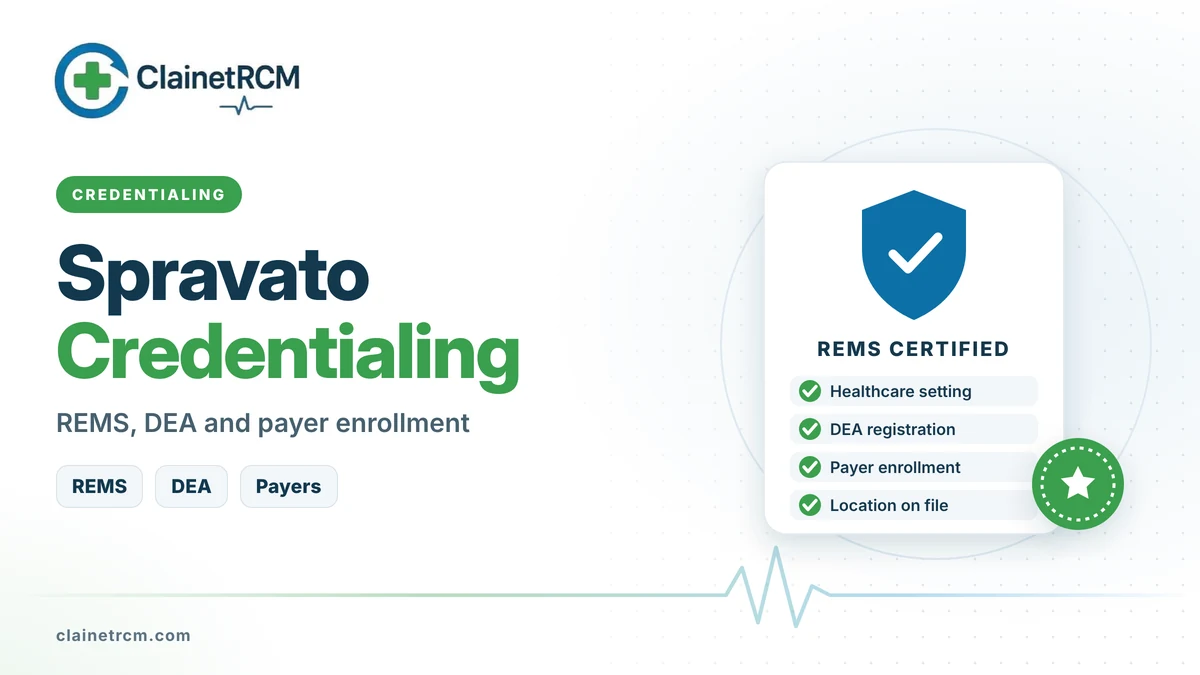
Quick answer: Spravato credentialing has four layers. First, the treatment location must be certified in the Spravato REMS, and every outpatient must be enrolled before the first dose. Second, any site that stores the drug needs a DEA registration for Schedule III substances, plus any state controlled substance license. Third, every prescriber and the treatment location must be credentialed and enrolled with each payer you plan to bill. Fourth, you must meet each payer’s Spravato-specific rules, such as prior authorization and site-of-care requirements.
Miss any one of those layers and the claim fails, no matter how well the session was coded.
Spravato Credentialing Checklist
| Requirement | Who completes it | When | Why it matters for billing |
|---|---|---|---|
| REMS healthcare setting certification | The site’s authorized representative | Before ordering or treating | Payers verify certification, and uncertified sessions are not payable |
| REMS patient enrollment | The prescriber with the patient | Before the first dose | Missing enrollment blocks treatment and fails audits |
| DEA registration for the site | The registrant for that address | Before the drug is stored | Required to buy-and-bill a Schedule III drug |
| State controlled substance license | The practice or prescriber, if your state requires one | Before storing or prescribing | Rules vary by state |
| Payer credentialing for each prescriber | Your credentialing team | 90 to 120 days before launch | Out-of-network sessions deny or cost patients more |
| Treatment location added to each payer enrollment | Your credentialing team | Before the first claim | Claims from an unlisted address can reject |
| Specialty pharmacy or distributor accounts | Practice operations | Before the first order | Determines who bills the drug |
Layer 1: Spravato REMS Certification
Spravato is distributed only through a Risk Evaluation and Mitigation Strategy that the FDA requires because of the risks of sedation, dissociation, respiratory depression and misuse. The REMS has three moving parts: certified healthcare settings, certified pharmacies and enrolled patients.
Certifying the setting. Each treatment location designates an authorized representative who reviews the program materials and submits the outpatient or inpatient healthcare setting enrollment form. If that person leaves, a new authorized representative has to enroll again. Practices with more than one treatment address should confirm that each address is covered by a certification.
What the setting must be able to do. Certified outpatient settings agree to:
- Have a prescriber on site while Spravato is administered and while patients are monitored.
- Have a healthcare provider monitor every patient for at least two hours after each dose, including pulse oximetry and other vital signs, until the patient is ready to leave.
- Never dispense Spravato to a patient to take home.
- Enroll each outpatient in the REMS before the first dose, using the Patient Enrollment Form.
- Submit a Patient Monitoring Form for every patient within seven days of each dose.
Delegates. Staff delegates can submit Patient Monitoring Forms, but they cannot enroll new patients or add other delegates. Assign those tasks to the right people before launch, because a late monitoring form is a compliance problem for every session it covers.
Recent changes. The REMS has been updated several times since 2024. A pulse oximeter became a monitoring requirement, consent statements were added to the Patient Enrollment Form in 2025, and 2026 updates added Spanish-language materials and website changes. The core rules above did not change, but your forms and workflows should match the current versions.
Layer 2: DEA and State Controlled Substance Registrations
Esketamine is a Schedule III controlled substance. If your practice uses buy-and-bill, you are receiving, storing and administering a controlled drug, and that brings DEA rules into play.
- Site registration. Each physical location where the drug is stored needs its own DEA registration at that address. A prescriber’s registration at another address does not cover the treatment site.
- Prescriber registration. Every prescriber needs an active DEA registration that includes Schedule III authority, plus the state authority to prescribe it.
- State rules. Some states require a separate state controlled substance license or registration, and prescription monitoring program reporting rules differ by state.
- Storage and records. Keep the drug secured and maintain receiving, administration and inventory records that reconcile with every billed session.
DEA registrations renew every three years. Put each expiration date on the same calendar as your payer recredentialing dates.
Layer 3: Payer Credentialing and Enrollment
REMS certification proves the site can administer Spravato. It does not make your providers in network. Payer credentialing is a separate process, and it is the one that most often delays launch.
Credential every prescriber. Psychiatrists and, where state law and payer policy allow, psychiatric nurse practitioners and physician assistants must be credentialed with each commercial plan, Medicaid managed care organization and Medicare Advantage plan you intend to bill. Keep each CAQH profile current and attested every 120 days.
Enroll the treatment location. If Spravato is delivered at a new address, add that address as a practice location with Medicare, Medicaid and every contracted plan. A claim billed from a location that is not on file can reject even when the provider is credentialed.
Understand supervision rules. First Coast, a Medicare contractor, describes Spravato administration as an incident-to service performed under the direct supervision of a provider in a certified setting. Make sure your supervising providers are enrolled and that supervision is documented for every session.
Use the directories. Some plans let you flag the service in their directories. Magellan, for example, allows DEA-licensed Spravato prescribers to add a medication-assisted treatment for depression specialty to their directory listing, which helps referral sources find you.
Plan the timeline. Payer credentialing often takes three to four months and can run longer with some Medicaid plans. Start it before your REMS certification and room build-out are finished, and avoid treating covered patients before the effective date. Our guide to seeing patients before credentialing explains the risks, and the credentialing checklist for new providers covers the documents you will need.
Layer 4: Payer-Specific Spravato Requirements
Even fully credentialed practices hit payer rules that are unique to Spravato.
- Prior authorization. Most plans require it, and many ask for proof that the patient is enrolled in the REMS and that the site is certified.
- Benefit type. Many plans cover Spravato only under the medical benefit as a provider-administered drug.
- Purchase model. Some plans limit how you obtain the drug. TRICARE, for example, allows buy-and-bill only, and Blue Cross Blue Shield of Michigan allows assignment of benefits for commercial members but not for its Medicare Advantage members.
- Approved codes. Each payer decides whether it pays J0013 with visit codes or the G2082 and G2083 bundles. Our Spravato billing guide maps those choices by payer type.
A Realistic Launch Timeline
| Weeks before launch | Task |
|---|---|
| 16 to 12 | Start payer credentialing for prescribers and add the treatment location to each payer enrollment |
| 12 to 8 | Apply for the site’s DEA registration and any state license. Set up the distributor or specialty pharmacy accounts |
| 8 to 4 | Complete REMS setting certification, train staff and set up the monitoring room and equipment |
| 4 to 0 | Confirm payer effective dates, load fee schedules and code maps, and run prior authorizations for the first patients |
The order matters. Credentialing has the longest lead time, so it should start first even though it feels like the last step.
Keeping Your Credentials Current
Credentialing is not a one-time event. Build reminders for:
- Commercial recredentialing, usually every three years.
- Medicare revalidation, usually every five years.
- DEA renewal every three years for each registration.
- CAQH attestation every 120 days.
- REMS updates whenever the authorized representative, the address or the staff delegates change.
- Payer notifications whenever a prescriber joins or leaves the program.
A lapse in any of these can turn months of good claims into denials. Our article on the revenue impact of credentialing shows how quickly gaps add up.
Common Spravato Credentialing Mistakes
| Mistake | What happens | How to avoid it |
|---|---|---|
| Treating at a new address before it is enrolled | Claims reject for an invalid service location | Add the address to every payer before the first session |
| Relying on the prescriber’s DEA registration at another site | Storage at the treatment site is not covered | Register each storage location |
| Authorized representative leaves | Certification issues and audit findings | Re-enroll a new representative promptly |
| Prescriber not credentialed with the patient’s plan | Out-of-network denial or a large patient bill | Check network status at scheduling |
| Monitoring forms submitted late | REMS noncompliance for every affected session | Assign an owner and track the seven-day deadline |
| Supervising provider not documented | Incident-to claims fail review | Record the supervising and monitoring provider each session |
Frequently Asked Questions
Certify your treatment location in the Spravato REMS through an authorized representative, register the site with the DEA if you will store the drug, credential your prescribers with each payer, add the location to each payer enrollment and set up a REMS-certified drug source.
The REMS certifies healthcare settings and pharmacies and enrolls patients. Prescribers complete patient enrollment within a certified setting, so make sure each prescriber is linked to your setting in the REMS portal and follows its requirements.
Yes, if the drug is stored there. Each location where a controlled substance is stored needs its own DEA registration, and some states also require a state controlled substance license.
It depends on state scope of practice and payer policy. Many plans credential psychiatric nurse practitioners, but confirm both the state rules for Schedule III prescribing and each plan’s supervision requirements.
REMS certification can be completed quickly. Payer credentialing usually takes three to four months, so start it first.
A new authorized representative must complete the healthcare setting enrollment again. Do it promptly so your certification and your audit trail stay current.
Final Thoughts
The practices that launch Spravato smoothly treat credentialing as the first workstream, not the last. Certify the setting, register every storage location, credential every prescriber and enroll every address with every payer before the first patient walks in. With those layers in place, each session becomes a clean, payable claim.
Launch Your Spravato Program Without Credentialing Delays
We handle payer enrollment, location adds and the documentation trail payers ask for, so your first Spravato claims go out clean and get paid.
Start Your Credentialing Today
Written by
ClainetRCM Billing Team
ClainetRCM is a Boston-based revenue cycle management company specializing in medical billing, coding, credentialing and denial management for healthcare providers across all 50 states. Our AAPC and AHIMA certified team works inside your existing EHR, files claims within 24 to 48 hours and reviews every AR bucket on a 14-day cycle.