Spravato billing looks simple on paper. A patient arrives, self-administers esketamine nasal spray under supervision, stays for at least two hours of monitoring and leaves with a ride. The claim behind that visit is where practices lose money. The right code depends on the payer, the drug may or may not be yours to bill, and 2026 brought a code change that many payer systems were slow to absorb.
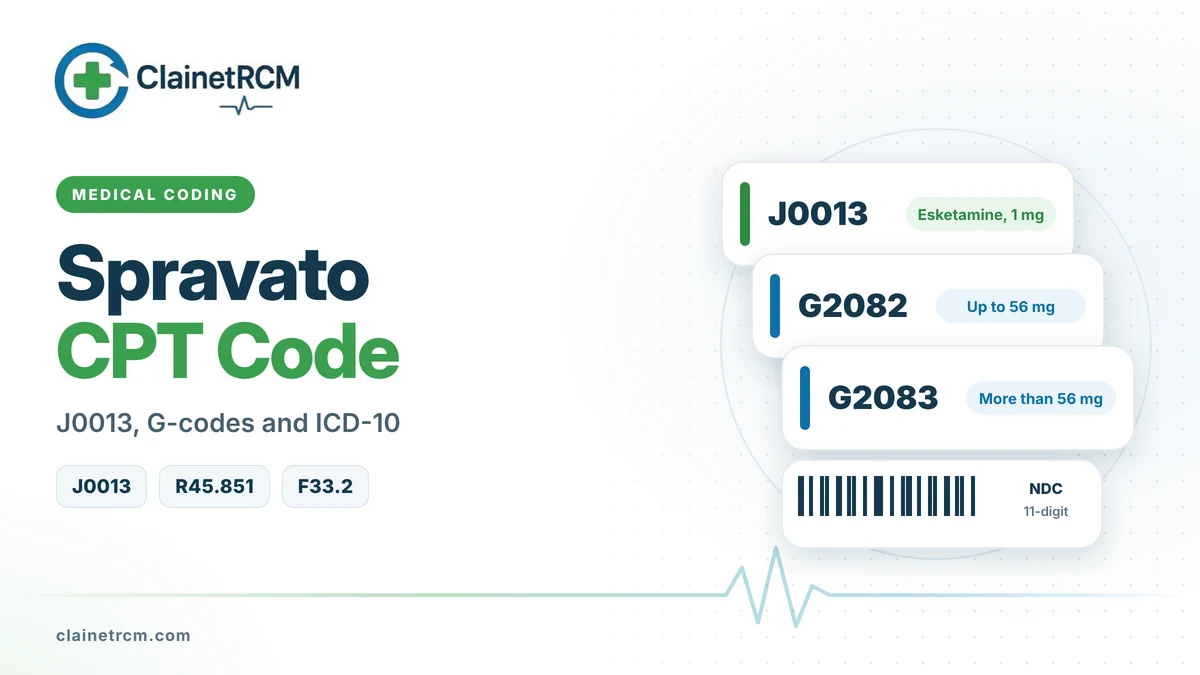
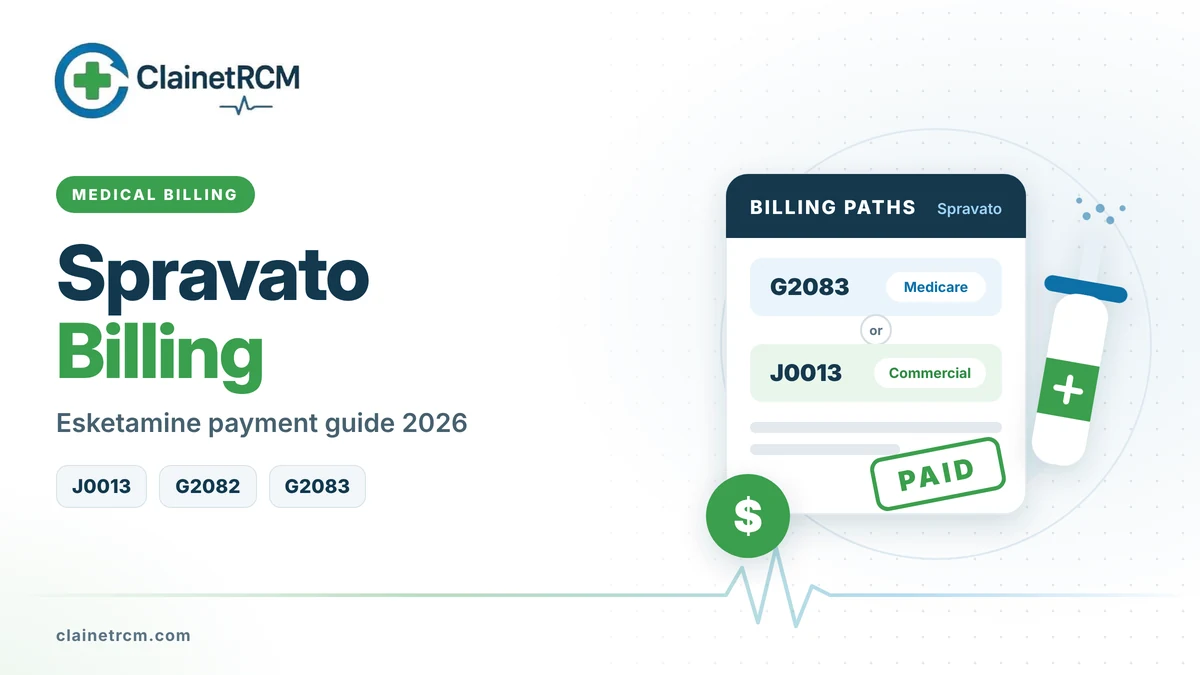
Quick answer: For Medicare patients, bill one unit of G2082 (up to 56 mg) or G2083 (more than 56 mg). Those codes bundle the drug, the supervision and the two-hour observation, so you do not add a separate drug line or visit code. For most commercial plans and Medicaid programs, bill the drug with J0013 (esketamine, nasal spray, 1 mg) at one unit per milligram, plus whatever visit codes the plan’s policy allows. J0013 replaced S0013 on January 1, 2026.
The rest of this guide walks through Spravato billing from purchase to payment, the rules that change by payer, and the denials that cost practices the most.
Spravato Billing at a Glance
| Payer | What you bill | Units | Watch for |
|---|---|---|---|
| Original Medicare | G2082 or G2083 | 1 per session | Established patients only. No separate E/M or J0013 on the same date |
| Medicare Advantage | Usually G2082 or G2083 | 1 per session | Plan-specific policy and prior authorization |
| Commercial plans | J0013 plus the visit codes the plan allows | 56 or 84 (1 per mg) | Some plans use the G-codes instead, so read each policy |
| Medicaid | J0013 or the G-codes, depending on the state | Varies | Medicare crossover claims usually keep the G-codes |
| TRICARE | G2082 or G2083, buy-and-bill only | 1 per session | The drug is not paid as a separate line |
How Spravato Billing Works
Spravato is only available through the FDA’s Spravato REMS program. The drug is never dispensed to a patient for home use. It is self-administered in a REMS-certified healthcare setting under the direct observation of a healthcare provider, and the patient is monitored for at least two hours afterward for sedation, dissociation, breathing problems and changes in vital signs.
In esketamine billing, every claim has two pieces of value: the drug itself and the professional work of supervising and monitoring the session. Depending on the payer, those pieces are billed together in one bundled code or separately as a drug line plus a visit. Most billing errors come from mixing the two approaches on the wrong claim.
A clean session usually follows this order:
- Verify the patient’s benefits, confirm prior authorization and check that the authorization covers the session date.
- Confirm the patient is enrolled in the REMS and that your site’s certification is current.
- Administer, monitor for at least two hours and document vital signs, including pulse oximetry.
- Submit the REMS Patient Monitoring Form within seven days of the session.
- Code the claim for that patient’s payer and submit it with the correct units and NDC.
For the code-level detail behind each claim line, see our Spravato CPT code guide.
Buy-and-Bill vs. Specialty Pharmacy: Who Bills the Drug?
Before you can bill anything, you have to know who owns the drug for that patient. There are two common models.
| Model | Who buys the drug | What your practice bills | Main risk |
|---|---|---|---|
| Buy-and-bill | Your practice, from a REMS-certified source | The drug (J0013) and visit, or the bundled G-code | You carry the drug cost until the claim pays |
| Specialty pharmacy (assignment of benefits) | A REMS-certified pharmacy that bills the patient’s plan | Only your professional services, as the plan allows | Delivery timing and patient-specific supply |
Buy-and-bill gives you control of supply and the margin on the drug, but every denial now includes the cost of a drug you already paid for. When a specialty pharmacy supplies the drug, you cannot bill G2082 or G2083, because both codes include the provision of the esketamine itself.
Payers also limit which model you may use. Blue Cross Blue Shield of Michigan, for example, allows both models for its commercial members but only buy-and-bill for its Medicare Advantage members. TRICARE allows buy-and-bill only, billed with the G-codes.
Medicare: Billing G2082 and G2083
CMS created two bundled codes for Spravato sessions:
- G2082 covers an established patient visit with supervision and provision of up to 56 mg of esketamine, including two hours of post-administration observation.
- G2083 is the same service with more than 56 mg, which in practice means an 84 mg session.
Bill one unit per session. Because the code already includes the drug and the visit, do not add an E/M code, a prolonged service code or J0013 for the same date of service. Both codes are limited to established patients, so a new patient evaluation is billed as its own E/M visit before treatment begins.
2026 payment. The national, non-facility Medicare amounts for 2026 are $952.59 for G2082 and $1,356.08 for G2083, up from $825.81 and $1,171.27 in 2025. Your actual payment depends on your locality, so check the CMS Physician Fee Schedule look-up for your MAC before you build a budget.
2027 outlook. CMS released its 2027 Physician Fee Schedule final rule on November 4, 2026. It lowers the standard conversion factor by about 2.3 percent starting January 1, 2027, so expect slightly lower G-code payments next year unless Congress acts.
MAC guidance. The Novitas and First Coast “Billing and Coding: Esketamine” articles were retired in December 2025. First Coast now publishes a Spravato place of service and REMS requirements page that describes the administration as an incident-to service under direct supervision and expects the Patient Monitoring Form in the medical record. If you are new to Medicare billing in general, start with our guide on how to bill Medicare as a provider.
Commercial and Medicaid: Billing J0013
Most commercial plans and many Medicaid programs pay the drug and the visit separately.
The drug line. Report J0013 at one unit per milligram: 56 units for a 56 mg session and 84 units for an 84 mg session. Add the 11-digit NDC for the kit you used, either 50458-0028-02 for the 56 mg kit or 50458-0028-03 for the 84 mg kit. Payers run edits that compare the units to the NDC, and a 56-unit line billed with the 84 mg kit NDC will deny.
The visit line. Plans that pay J0013 usually let you bill an office E/M code for the administration and monitoring. Some base the level on total time, and some prohibit prolonged service codes such as 99417. Blue Cross Blue Shield of Michigan’s 2026 guidance, for instance, tells commercial providers to bill J0013 with time-based office E/M codes and not to use G2082, G2083 or 99417. Other commercial plans pay the G-codes. There is no safe default, so map each payer before you bill.
The 2026 transition. CMS discontinued S0013 at the end of 2025. Claims with S0013 for 2026 dates of service reject, and payers updated their systems at different speeds. Some plans briefly asked for the unlisted drug code J3490, and some required new prior authorizations under J0013. If your 2026 Spravato claims stalled early in the year, check for authorizations still tied to the old code.
Medicaid. Rules vary by state. Iowa Medicaid, for example, requires J0013 for dates of service from January 1, 2026, but keeps the G-codes for Medicare crossover claims.
Hospital outpatient departments. Facility claims go on the UB-04 with revenue code 0636, J0013 and the NDC. Our revenue code 636 guide explains how drug lines work on facility claims.
Prior Authorization and Benefits Verification
Almost every payer requires prior authorization for Spravato, and most cover it under the medical benefit rather than the pharmacy benefit. Typical criteria include:
- An adult patient with a documented major depressive disorder diagnosis.
- For treatment-resistant depression, an inadequate response to at least two antidepressants of adequate dose and duration in the current episode. Some plans now require the two trials to come from different drug classes.
- For depressive symptoms with acute suicidal ideation or behavior, both a major depressive disorder code and R45.851 on the request.
- Treatment in a REMS-certified setting with at least two hours of monitoring.
Approval periods are short. Initial authorizations often run one to three months, and renewals usually require documented improvement on a standard rating scale. Track the authorization end date and the approved session count, because induction runs twice weekly and burns through visits quickly.
Verify that both the prescriber and the treatment location are in network before the first session. Our prior authorization and benefits verification teams handle this step for practices that run high Spravato volume.
Documentation That Supports Payment
Spravato claims are audited against the REMS paperwork as well as the clinical note. Each session record should show:
- The dose administered and the kit used.
- The time of administration and the start and end of the monitoring period, covering at least two hours.
- Vital signs before and after dosing, including blood pressure and pulse oximetry.
- The assessment of sedation and dissociation and the decision that the patient was ready to leave.
- The name of the healthcare provider who monitored the patient.
- A copy of the Patient Monitoring Form and the date it was submitted.
- Rating scale scores at regular intervals to support reauthorization.
Common Spravato Billing Denials and How to Fix Them
| Denial | Likely cause | Fix |
|---|---|---|
| Invalid or deleted code | S0013 billed for a 2026 date of service | Rebill with J0013 and the correct units |
| Code not payable for this plan | G-code sent to a plan that pays J0013, or the reverse | Build payer-specific code maps in your billing system |
| Units or NDC mismatch | 56 units billed with the 84 mg kit NDC | Match the units and the NDC to the kit used |
| Service bundled | E/M or prolonged service billed with G2082 or G2083 | Bill the G-code alone |
| Not payable for new patient | A G-code billed on the first visit | Bill the new patient E/M and start G-codes at the next session |
| No valid authorization | The authorization expired between induction and maintenance | Track end dates and session counts every week |
| Medical necessity | Suicidal ideation indication billed without R45.851 | Code the depression diagnosis and R45.851 when documented |
| Records request failed | Missing monitoring form or vital signs | Keep REMS forms and monitoring notes with the chart |
When denials do land, a structured denial management process recovers most of them, and our guide to claim denials prevention covers the upstream fixes.
A Worked Example
Medicare patient, maintenance session, 84 mg. The practice bought the drug. Bill G2083 × 1 unit with place of service 11 and the documented depression diagnosis. Do not add an E/M code or J0013.
Commercial patient, induction session, 56 mg. The plan’s policy pays the drug and a time-based visit. Bill J0013 × 56 units with NDC 50458-0028-02, plus the office E/M level supported by the documented time, following that plan’s rules.
Commercial patient, drug from a specialty pharmacy. The pharmacy bills the drug. Your practice bills only the visit codes the plan allows, never J0013 and never a G-code.
Protecting Cash Flow in a Spravato Program
- Know your acquisition cost per kit. With buy-and-bill, you pay for the drug long before the payer pays you.
- Order to your scheduled volume and track inventory by lot and expiration date.
- Do not administer until the authorization is confirmed for that date.
- Compare every payment to your contract. Drug lines are easy to underpay without anyone noticing.
- Rebuild your 2027 budget once the new Medicare rates post in January.
Spravato billing works best as part of a broader mental health billing workflow, where eligibility, authorization, coding and follow-up are owned by the same team.
Frequently Asked Questions
For Medicare, bill G2082 for sessions up to 56 mg and G2083 for sessions above 56 mg. Most commercial plans and many Medicaid programs use J0013, which replaced S0013 on January 1, 2026, billed at one unit per milligram.
Generally no. The G-codes already include the evaluation, supervision and observation, so a separate E/M or prolonged service code on the same date is treated as bundled. A new patient evaluation is billed as its own visit.
Bill 84 units, one for each milligram, with the NDC for the 84 mg kit. A 56 mg session is 56 units with the 56 mg kit NDC.
Medicare pays for Spravato through G2082 and G2083, which include the drug. Use the G-codes for Medicare patients and J0013 for the payers whose policies call for it.
The 2026 national non-facility amount is $1,356.08, and G2082 is $952.59. Local payment varies by locality, and the 2027 conversion factor cut will lower both amounts slightly from January 1, 2027.
No. G2082 and G2083 include the provision of the drug, so they only apply when your practice supplies it. With pharmacy-supplied drug, bill only the services the plan allows.
Almost always. Expect to document the depression diagnosis, prior antidepressant trials, REMS enrollment and a monitoring plan, and to resubmit with rating scale results when the authorization ends.
Final Thoughts
Spravato pays well when every claim matches the payer it is going to. Know who owns the drug, bill G2082 or G2083 for Medicare, bill J0013 with matching units and NDCs for the plans that want it, and keep your REMS paperwork as tight as your clinical notes. Get those habits right and esketamine becomes one of the most reliable service lines in your practice.
Get Every Spravato Session Paid
From J0013 units to Medicare G-code bundles, our team codes, submits and follows up on every Spravato claim so your esketamine program stays profitable.
Talk to a Spravato Billing Expert
Written by
ClainetRCM Billing Team
ClainetRCM is a Boston-based revenue cycle management company specializing in medical billing, coding, credentialing and denial management for healthcare providers across all 50 states. Our AAPC and AHIMA certified team works inside your existing EHR, files claims within 24 to 48 hours and reviews every AR bucket on a 14-day cycle.