A course of transcranial magnetic stimulation is one of the most predictable revenue streams in psychiatry, which makes TMS billing look easy. Patients come in five days a week for six weeks or more, the codes are few, and most payers cover it for treatment-resistant depression. The problems with transcranial magnetic stimulation billing show up at the edges: an authorization that runs out at session 30, a mapping session billed twice, a payer that prices TMS differently from the next one.
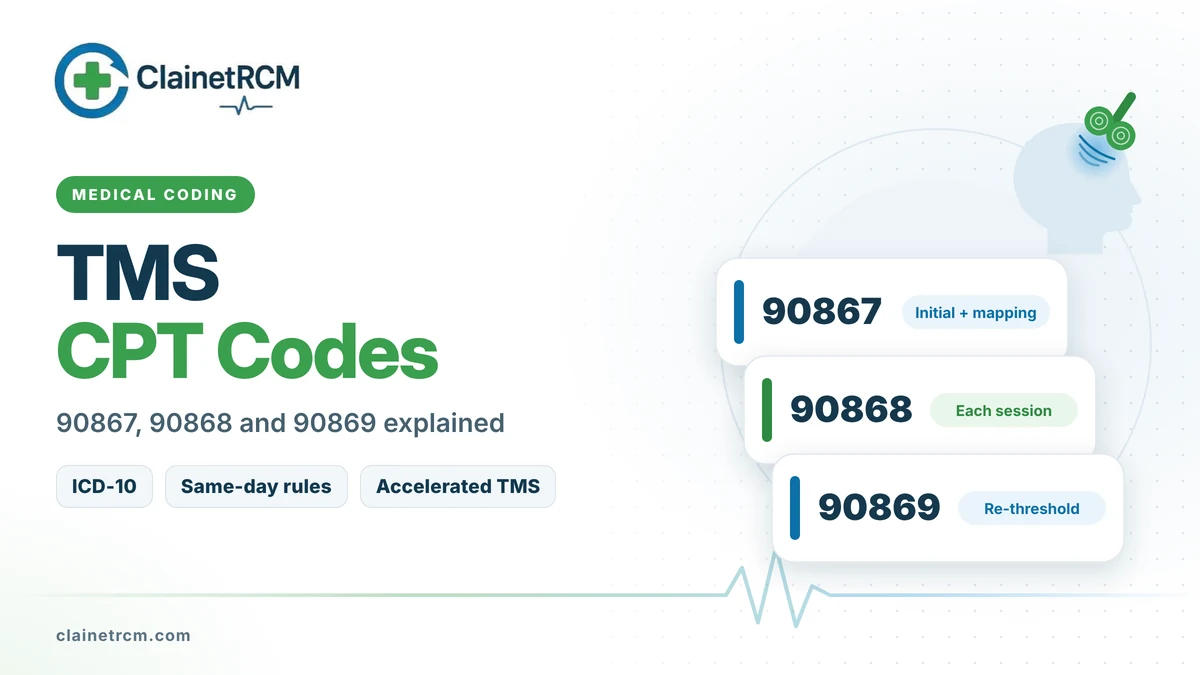
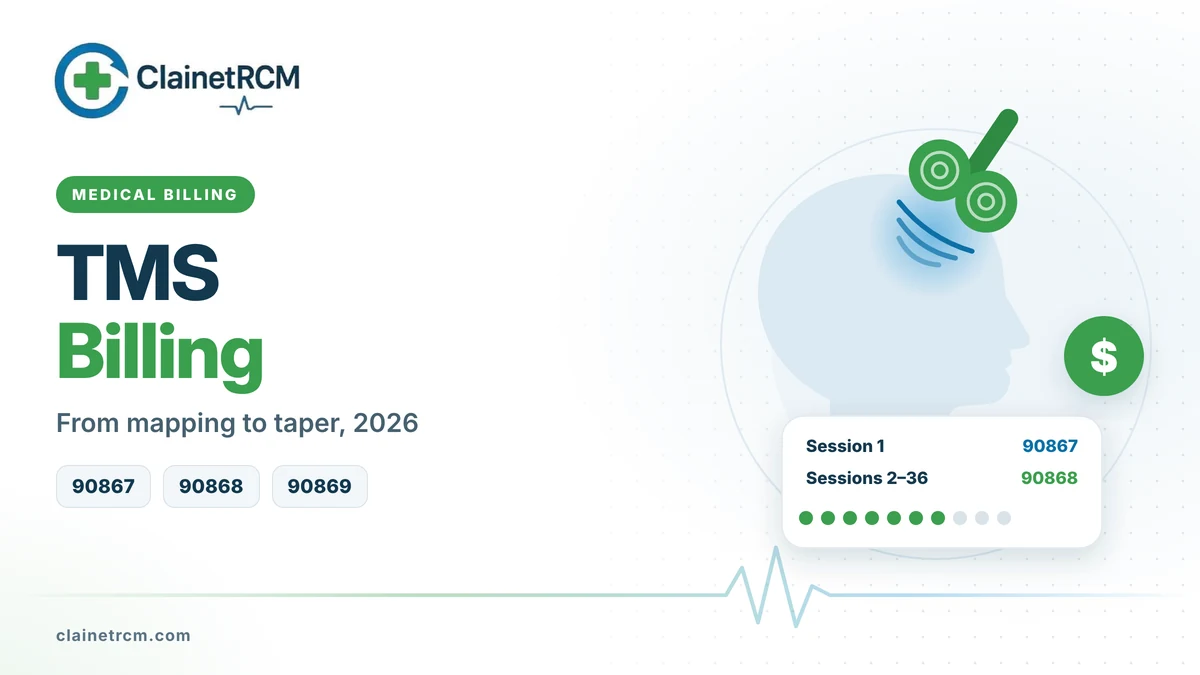
Quick answer: TMS billing uses three CPT codes. Bill 90867 once at the start of a course for the initial session, which includes cortical mapping and motor threshold determination. Bill 90868 for each later treatment session, and 90869 instead of 90868 on any day the motor threshold is re-determined. Medicare covers TMS through local coverage determinations that differ by contractor, pays one TMS code per day, and leaves the fee to each Medicare Administrative Contractor. A typical course is up to 30 treatment sessions followed by up to six taper sessions.
This guide explains how to bill a TMS course from the first session to the last, what Medicare and commercial plans require, and how to stop the denials that interrupt a course midway.
How a TMS Course Is Billed
| Session | Code | Notes |
|---|---|---|
| Session 1 | 90867 | Initial session with cortical mapping, motor threshold determination and treatment |
| Sessions 2 onward | 90868 | One unit per treatment session |
| A day the motor threshold is re-determined | 90869 | Replaces 90868 for that session |
| Taper sessions | 90868 | Usually up to six after the acute phase, if authorized |
Bill one TMS code per date of service. Medicare contractors do not pay 90867 or 90869 with 90868 on the same day, and in 2025 CMS declined a request to allow those combinations. For deeper coding rules, see our TMS CPT codes guide.
What TMS Pays
Medicare. Medicare does not set a national relative value for 90867, 90868 or 90869. They are contractor-priced codes, which means each Medicare Administrative Contractor publishes its own fee. Look up your MAC’s contractor-priced fee schedule before you build a forecast, and expect the amounts to differ between regions.
Commercial plans. Rates vary widely by payer and region, and contracted rates can differ a lot between plans in the same market. Because the course is so predictable, a small difference in the 90868 rate adds up across 30 or more sessions. Negotiate the TMS codes as a group when you contract.
Medicaid. Coverage and rates vary by state. California’s Medi-Cal, for example, has covered 90867, 90868 and 90869 since August 1, 2024 for patients 15 and older, with a treatment authorization request required before starting.
Medicare Coverage: Know Your MAC’s LCD
There is no national coverage determination for TMS. Each MAC has its own local coverage determination and billing article.
| MAC | LCD | Billing article |
|---|---|---|
| CGS | L36469 | A57047 |
| First Coast | L34522 | A57647 |
| Noridian (JE and JF) | L37086 | A57692 |
| Novitas | L34998 | A57072 |
| Palmetto GBA | L34869 | A57813 |
| Wellpoint Federal | L33398 | A57528 |
| WPS | L34641 | A57598 |
The details differ, but most Medicare TMS policies share these requirements:
- An adult with a confirmed diagnosis of major depressive disorder, single or recurrent episode. Several MACs limit coverage to severe episodes.
- Failure of, or intolerance to, antidepressant medication in the current episode. The required number of trials differs by MAC.
- A trial of evidence-based psychotherapy without significant improvement, measured with standardized rating scales.
- An order from a physician who has examined the patient and has experience with TMS, with treatment given under that physician’s direct supervision.
- An FDA-cleared device used according to its cleared protocol.
Medicare does not cover maintenance TMS. Retreatment may be covered for a patient who relapses after responding to a prior course, usually defined as more than 50 percent improvement on a standard depression rating scale.
Some MACs also set checkpoints within the course. Noridian’s billing article, for example, allows the course to continue past the initial weeks only for patients who show at least 25 percent improvement on standard depression scales.
Prior Authorization for Commercial Plans
Most commercial plans and Medicaid programs require prior authorization for TMS, although that is changing. Cigna and Evernorth removed prior authorization for TMS for their contracted, in-network providers on March 6, 2026, which makes network status worth more than ever. Typical commercial criteria include:
- A major depressive disorder diagnosis, usually moderate or severe, confirmed with a rating scale such as the PHQ-9 or HAM-D.
- Two to four failed antidepressant trials, often from at least two different classes.
- A trial of psychotherapy, or documented reasons it was not appropriate.
- No contraindications, such as implanted metal near the coil or an uncontrolled seizure disorder.
Most plans authorize the full acute course plus a taper, often 36 sessions in total. Track the session count against the authorization every week. When a patient misses sessions, the course can run past the authorization’s end date even though sessions remain. Our prior authorization team manages extensions before they become denials.
Deep TMS, Theta Burst and Accelerated Protocols
Deep TMS uses the same CPT codes as standard TMS. Coverage for obsessive-compulsive disorder depends on the payer. Palmetto’s Medicare billing article lists the OCD codes F42.2 and F42.8, while Wellpoint Federal’s LCD states that deep TMS is not reasonable and necessary for OCD.
Theta burst stimulation delivered as one session per day is generally billed with the same codes. Confirm that the plan’s policy covers the theta burst protocol your device uses, because some policies treat it differently from standard TMS.
Accelerated protocols such as SAINT deliver many sessions over a few days and use Category III codes 0889T through 0892T. CMS assigned SAINT to new technology payment categories for hospital outpatient departments, but many commercial plans still treat accelerated protocols as investigational. Cigna and Evernorth’s 2026 TMS policy, for example, lists accelerated protocols as experimental. Get written confirmation of coverage before you schedule an accelerated course.
Same-Day Services
A psychiatric evaluation or medication management visit on a treatment day is billable only when it is significant and separately identifiable from the TMS session. Document it as its own service, and append modifier 25 to the E/M code when the payer requires it. Routine check-ins during treatment are part of the TMS session and should not be billed separately.
Documentation That Supports Every Session
- Baseline rating scale scores and repeat scores at regular intervals, often weekly and at the end of the course.
- The motor threshold, the stimulation intensity and the treatment location for every session.
- The number of pulses delivered and any interruptions.
- The supervising physician’s name and presence.
- Any side effects and how they were managed.
- The session number in the course, matched to the authorization.
Strong documentation also supports retreatment requests later, because payers usually require proof that the first course worked.
Common TMS Billing Denials and How to Fix Them
| Denial | Likely cause | Fix |
|---|---|---|
| 90867 denied | Billed more than once in a course, or within six weeks of a prior 90867 | Bill 90867 only at the start of a new course |
| Same-day code conflict | 90869 or 90867 billed with 90868 on one date | Bill a single TMS code per day |
| Authorization exhausted | Sessions billed past the approved count or end date | Request an extension before the final authorized session |
| Diagnosis not covered | Moderate or unspecified depression code under a severe-only policy | Code the documented severity, and check the payer’s code list |
| Maintenance not covered | Ongoing sessions after the course ended | Bill retreatment only when the policy’s relapse criteria are met |
| Out-of-network | Provider or site not credentialed with the plan | Complete payer credentialing before treating |
A structured denial management process recovers most TMS denials, and our guide to claim denials prevention covers the upstream fixes.
A Worked Example
A Medicare patient starts a 36-session course for severe recurrent depression. Session 1 is billed as 90867. The motor threshold is re-checked twice during the course, so two sessions are billed as 90869. The remaining 33 sessions, including the six taper sessions, are billed as 90868. Each claim carries the documented diagnosis, such as F33.2, and one TMS code per date.
Frequently Asked Questions
90867 for the initial session with mapping and motor threshold determination, 90868 for each subsequent treatment session, and 90869 for a subsequent session that includes motor threshold re-determination.
Most plans authorize up to 30 treatment sessions followed by up to six taper sessions, 36 in total. Some require a progress check partway through the course.
No. Bill one TMS code per date of service. On a day the motor threshold is re-determined, bill 90869 instead of 90868.
Yes, for treatment-resistant major depressive disorder that meets your MAC’s LCD criteria. The fee is set by each MAC because the codes are contractor-priced.
Medicare does not cover maintenance TMS, and most commercial plans do not either. Retreatment after a relapse may be covered when the patient responded to a prior course.
No. Deep TMS uses 90867, 90868 and 90869. Coverage for conditions other than depression, such as OCD, depends on the payer.
Final Thoughts
TMS rewards practices that bill it like a course, not a string of visits. Bill 90867 once, use 90868 and 90869 one per day, match your diagnosis to your MAC’s policy and track every session against the authorization. Do that consistently and a TMS program delivers steady, predictable revenue. For broader help, our mental health billing team runs TMS programs alongside medication management and therapy.
Keep Every TMS Session Billable
We track authorizations, session counts and payer rules across the full treatment course, so no session goes unpaid.
Talk to a TMS Billing Expert
Written by
ClainetRCM Billing Team
ClainetRCM is a Boston-based revenue cycle management company specializing in medical billing, coding, credentialing and denial management for healthcare providers across all 50 states. Our AAPC and AHIMA certified team works inside your existing EHR, files claims within 24 to 48 hours and reviews every AR bucket on a 14-day cycle.