TMS CPT codes make up one of the smallest code sets in psychiatry, and they still produce a steady stream of denials. Most come from the same few mistakes: billing the initial code twice, combining codes on one date or pairing the sessions with a diagnosis the payer does not cover.
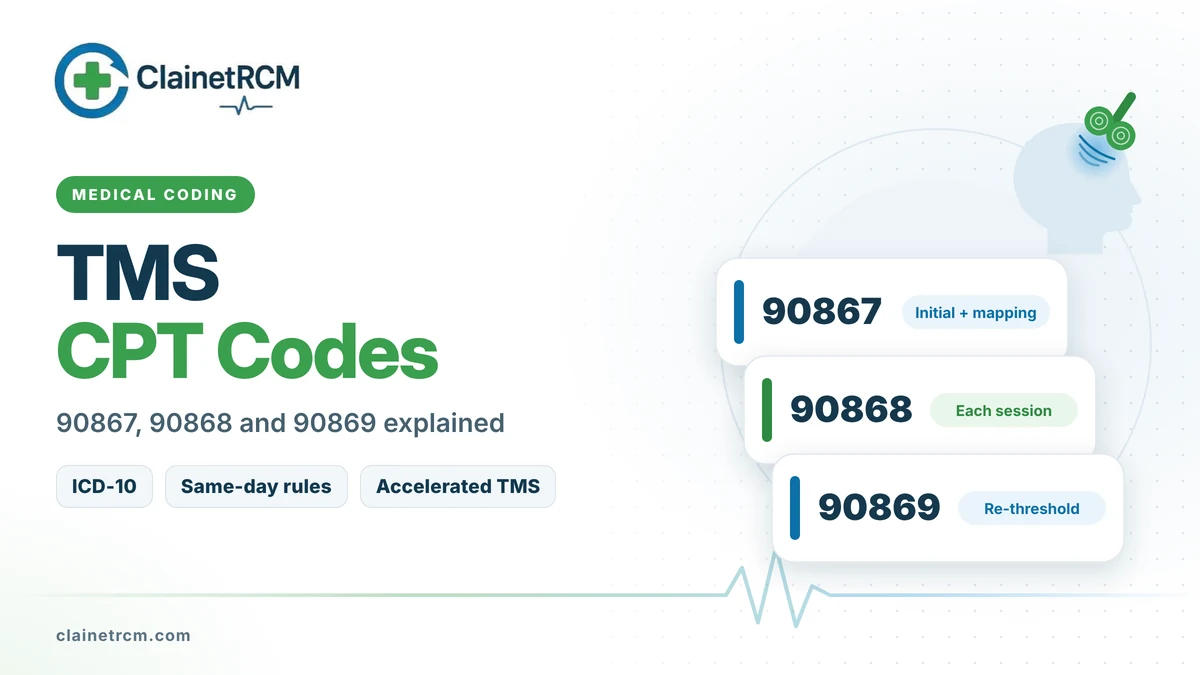
Quick answer: There are three TMS CPT codes. 90867 reports the initial treatment session, including cortical mapping, motor threshold determination, delivery and management. 90868 reports each subsequent treatment session. 90869 reports a subsequent session that includes motor threshold re-determination along with delivery and management. Report one TMS code per day. Accelerated MRI-guided theta burst treatment, such as SAINT, uses Category III codes 0889T through 0892T instead.
This guide covers each code, the bundling rules, the ICD-10 codes that support coverage and the coding errors to avoid.
TMS CPT Codes at a Glance
| Code | What it covers | How often |
|---|---|---|
| 90867 | Initial session: cortical mapping, motor threshold determination, treatment delivery and management | Once at the start of a course |
| 90868 | Subsequent treatment delivery and management | Once per treatment session |
| 90869 | Subsequent motor threshold re-determination with treatment delivery and management | On days the threshold is re-checked, in place of 90868 |
| 0889T | Personalized target development from structural and functional MRI for accelerated theta burst treatment | Once, before an accelerated course |
| 0890T | Accelerated MRI-guided theta burst treatment, initial treatment day | Per treatment day |
| 0891T | Accelerated MRI-guided theta burst treatment, subsequent treatment day | Per treatment day |
| 0892T | Accelerated MRI-guided theta burst treatment, subsequent day with motor threshold re-determination | Per treatment day |
90867: The Initial Session
90867 covers the work of setting up a course: finding the treatment location through cortical mapping, determining the motor threshold, and delivering and managing the first treatment.
- Report it once per course of treatment.
- Novitas, a Medicare contractor, says not to report 90867 more than once within a six-week period.
- CPT instructs not to report 90867 with 90868 or 90869, or with certain EMG and evoked potential codes (95860 through 95870, 95928, 95929 and 95939).
- A new course after a relapse can start with 90867 again, if the payer’s retreatment criteria are met.
90868: Each Subsequent Session
90868 is the workhorse code. It reports one treatment session after the initial one, including delivery and management.
- Report one unit per session, and one TMS code per date of service.
- Taper sessions at the end of the course are also 90868.
- Some plans cap the units per course. PacificSource, for example, allows up to 36 units of 90868 and up to two units of 90869 per course.
90869: Motor Threshold Re-Determination
The motor threshold can change during a course, often because of medication changes. On the day it is re-determined, report 90869 instead of 90868, because the code includes the treatment delivered that day.
- Never report 90869 with 90867 or 90868 on the same date.
- Document why the threshold was re-checked and the new value.
- Expect payers to limit how many times 90869 is allowed per course.
Same-Day Rules and Bundling
One TMS code per day. Medicare contractors do not pay two TMS codes for the same date, and CMS declined a 2025 request to allow combinations such as 90869 with 90868. If an accelerated protocol delivers more than one session in a day, do not stack 90868 units unless the payer’s policy explicitly allows it.
Evaluation and management visits. A separate psychiatric evaluation or medication management visit on a treatment day can be billed when it is significant and separately identifiable. Report the E/M with modifier 25 when the payer requires it. Our CPT code 99213 guide explains how to choose the level.
Psychotherapy. Psychotherapy on the same day is a separate service when it is documented as one, with its own time and content.
ICD-10 Codes That Support TMS
Medicare coverage depends on each contractor’s LCD and billing article, and commercial plans publish their own lists. In most cases, coverage is for a confirmed major depressive disorder diagnosis that meets the policy’s severity requirement.
| Code | Description | Coverage notes |
|---|---|---|
| F32.2 | Major depressive disorder, single episode, severe without psychotic features | Covered under Medicare TMS policies |
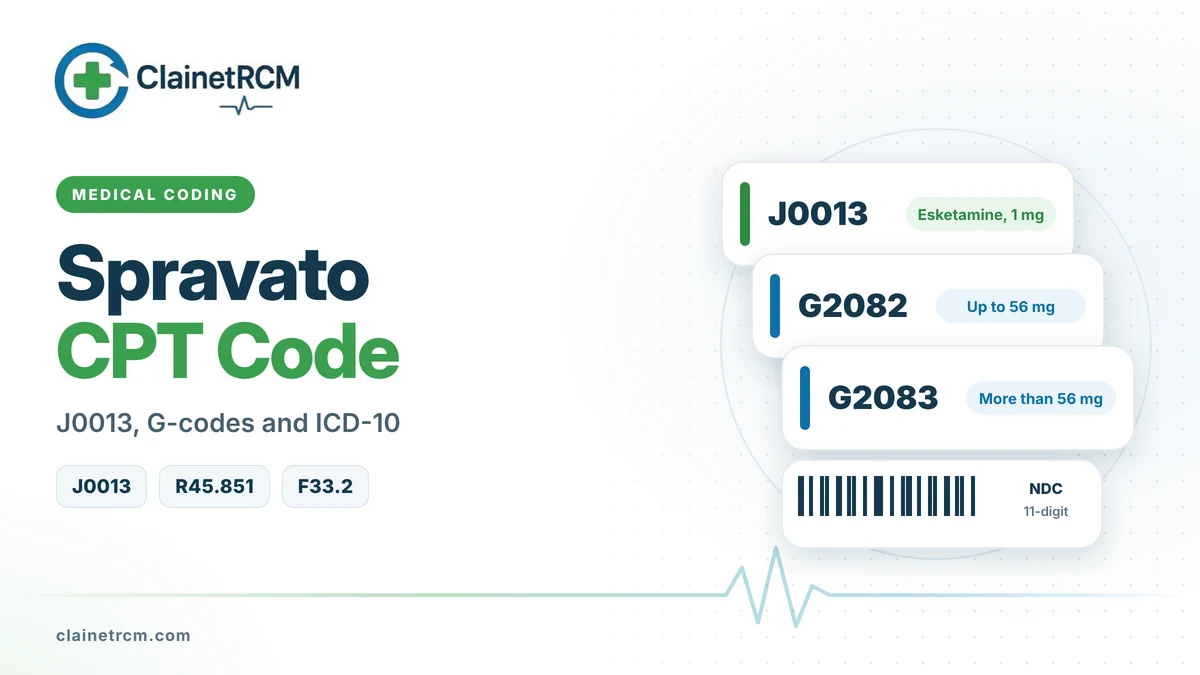
| F33.2 | Major depressive disorder, recurrent severe without psychotic features | Covered under Medicare TMS policies |
| F32.1 / F33.1 | Major depressive disorder, moderate | Accepted by some commercial plans |
| F42.2 | Mixed obsessional thoughts and acts | Deep TMS for OCD, covered by some payers only |
| F42.8 | Other obsessive-compulsive disorder | Deep TMS for OCD, covered by some payers only |
Palmetto GBA’s Medicare billing article, for example, lists exactly four codes: F32.2, F33.2, F42.2 and F42.8. Wellpoint Federal’s LCD, by contrast, states that deep TMS is not reasonable and necessary for OCD. Always check the article for your MAC.
Codes that usually fail. Unspecified depression codes such as F32.9 and F32.A rarely support TMS. Depression with psychotic features is often excluded or treated with caution in policies. Code the episode and severity exactly as documented.
Documentation behind the diagnosis. Payers expect standardized rating scale scores, such as PHQ-9, HAM-D or BDI, at baseline and during the course, along with the medication and psychotherapy history that shows treatment resistance.
Deep TMS, Theta Burst and Accelerated TMS
Deep TMS. Deep TMS uses the same CPT codes as standard TMS. The code does not change with the coil type, but coverage can change with the indication.
Theta burst stimulation. A single daily theta burst session is generally reported with the same codes. Check that the payer covers the theta burst protocol before you start.
Accelerated MRI-guided theta burst. SAINT and similar protocols use Category III codes 0889T through 0892T, which took effect July 1, 2024. CMS placed them in new technology payment categories for hospital outpatient departments, but coverage by commercial plans is limited. Cigna and Evernorth’s 2026 policy, for example, considers accelerated protocols experimental. Get written coverage confirmation before treatment.
Place of Service and Claim Forms
- Office. CMS-1500 with place of service 11.
- Hospital outpatient department. UB-04 under the hospital’s outpatient rules, with the professional component billed separately where applicable.
- Supervision. Medicare TMS policies call for direct supervision, with the physician present in the area and immediately available during the session. Follow your MAC’s exact wording.
Coding Scenarios
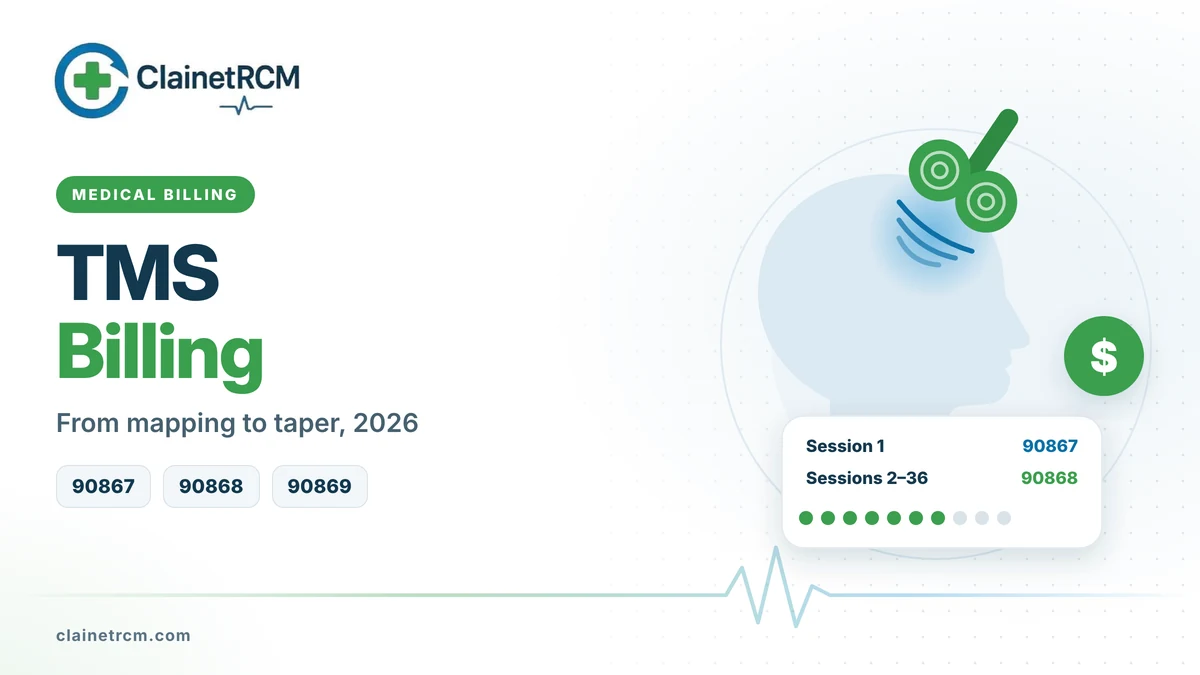
1. Standard course. Session 1 is 90867. Sessions 2 through 36 are 90868, except for the two sessions where the motor threshold was re-determined, which are 90869. Each date has one TMS code.
2. Medication change mid-course. The patient starts a new medication, and the motor threshold is re-checked the next session. Report 90869 for that session, and document the reason and the new threshold.
3. Separate medication management visit. The psychiatrist adjusts the antidepressant on a treatment day and documents a separate visit. Report the treatment code, plus the E/M with modifier 25 if the payer requires it.
4. Retreatment after relapse. A patient who responded to a course a year ago relapses. If the plan’s retreatment criteria are met, the new course starts with 90867.
Common TMS Coding Errors
| Error | Result | Fix |
|---|---|---|
| 90867 billed twice in one course | Denial | Bill 90867 once per course |
| 90869 and 90868 on the same date | The second code denies | Bill only 90869 that day |
| Multiple 90868 units on one date | Denial under most policies | One TMS code per date unless the payer allows more |
| F32.9 or F32.A as the diagnosis | Medical necessity denial | Code the documented episode and severity |
| OCD codes under a depression-only policy | Not covered | Confirm OCD coverage before treating |
| E/M without a separate note | E/M denied as bundled | Document a separately identifiable service |
Small coding errors repeated across 36 sessions become large revenue losses. Our clean claims guide shows how to build checks into your workflow, and our medical coding services review TMS claims before they go out.
Frequently Asked Questions
90867 for the initial session with mapping and motor threshold determination, 90868 for each subsequent treatment session, and 90869 for a subsequent session that includes motor threshold re-determination.
Once per course of treatment. Some Medicare contractors also say not more than once in six weeks. A new course after a relapse can use 90867 again if retreatment criteria are met.
Generally no. Report one TMS code per date of service unless the payer’s written policy allows multiple sessions per day.
Most policies cover severe major depressive disorder, such as F32.2 and F33.2. Some plans accept moderate depression codes, and a few cover OCD codes F42.2 and F42.8 for deep TMS.
Yes. Accelerated MRI-guided theta burst treatment uses Category III codes 0889T through 0892T, which took effect July 1, 2024. Coverage varies widely.
No. Deep TMS uses 90867, 90868 and 90869. Only the coverage rules can differ by indication.
Final Thoughts
TMS coding comes down to discipline: one initial code per course, one treatment code per day, 90869 only when the threshold is re-checked and a diagnosis that matches the payer’s policy. Build those rules into your charge entry, and every session in the course becomes a clean claim. For the payment side, see our TMS billing guide.
Code TMS Right the First Time
Our certified coders check every TMS claim for the right code, diagnosis and same-day rules before it goes out, so your course gets paid session by session.
Get a Free Coding Review
Written by
ClainetRCM Billing Team
ClainetRCM is a Boston-based revenue cycle management company specializing in medical billing, coding, credentialing and denial management for healthcare providers across all 50 states. Our AAPC and AHIMA certified team works inside your existing EHR, files claims within 24 to 48 hours and reviews every AR bucket on a 14-day cycle.