Search for “Spravato CPT code” and you will find a lot of outdated answers. The short version is that Spravato does not have a single CPT code. It is reported with HCPCS Level II codes, sometimes alongside CPT evaluation and management codes, and the drug code itself changed on January 1, 2026.
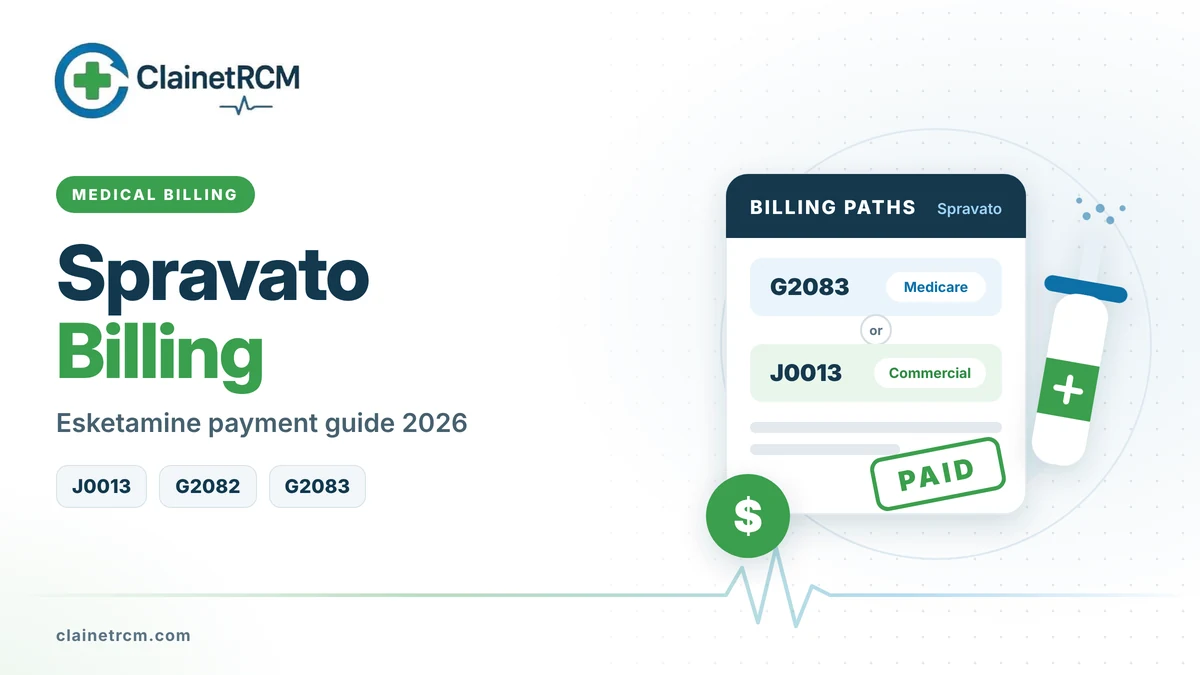
Quick answer: The esketamine drug code is J0013 (esketamine, nasal spray, 1 mg), which replaced S0013 on January 1, 2026. Medicare uses two bundled codes instead: G2082 for a session with up to 56 mg and G2083 for more than 56 mg. Commercial plans that pay J0013 usually let you add a CPT office E/M code for the visit. The diagnosis is a major depressive disorder code, and R45.851 is added when the indication is depressive symptoms with acute suicidal ideation or behavior.
This guide covers each code, the units and NDCs, the visit codes payers accept, the ICD-10 codes that support medical necessity and the coding errors that trigger denials.
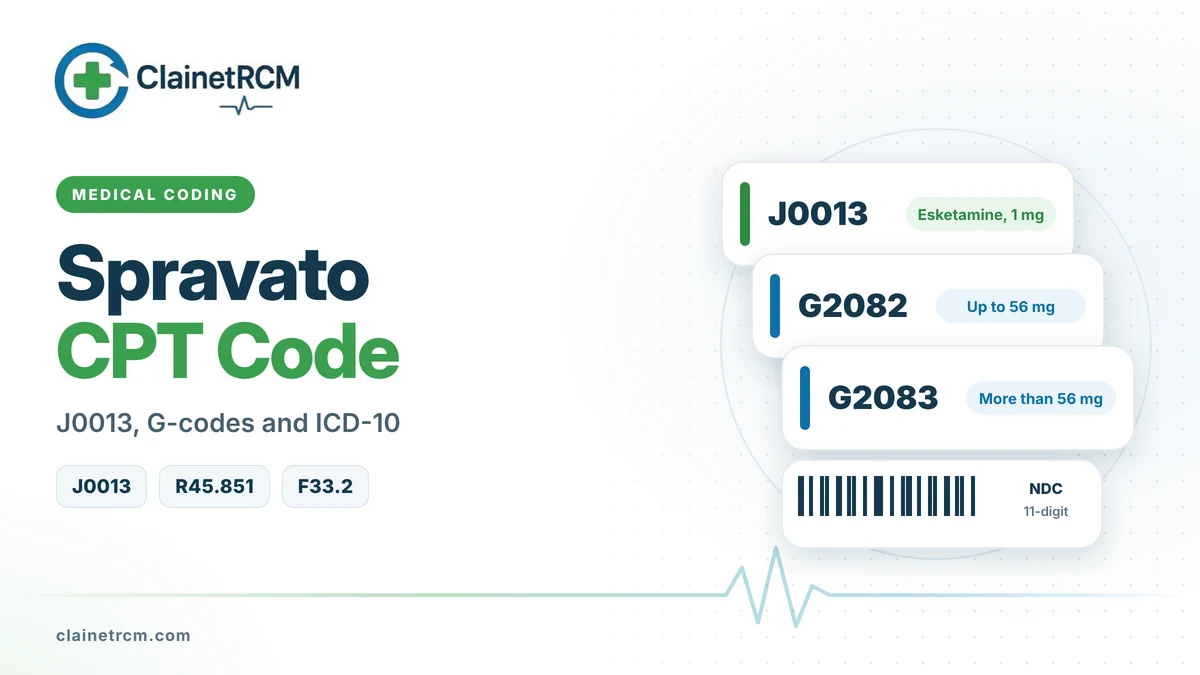
Spravato CPT Code and HCPCS Codes at a Glance
| Code | What it reports | Who uses it | Units |
|---|---|---|---|
| J0013 | Esketamine, nasal spray, 1 mg | Most commercial plans and many Medicaid programs | 1 per mg (56 or 84) |
| G2082 | Established patient visit with supervision and up to 56 mg of esketamine, including 2 hours of observation | Medicare and plans that follow Medicare | 1 per session |
| G2083 | Same service with more than 56 mg of esketamine | Medicare and plans that follow Medicare | 1 per session |
| 99202-99205, 99212-99215 | Office E/M visits | Plans that pay J0013 plus a visit | 1 per visit |
| S0013 | Former esketamine drug code | Deleted after December 31, 2025 | Do not use |
J0013: The Esketamine Drug Code
J0013 is the esketamine HCPCS code for the drug itself. CMS established it in the January 2026 HCPCS update and discontinued the temporary S-code S0013 at the same time. The descriptor is “Esketamine, nasal spray, 1 mg,” so one unit equals one milligram.
Spravato is supplied in single-use nasal spray devices that each deliver 28 mg. A 56 mg session uses two devices and an 84 mg session uses three, so the J0013 units should always be 56 or 84 for a single session.
NDCs. Report the 11-digit NDC for the kit you administered:
- 50458-0028-02 for the 56 mg kit (two devices).
- 50458-0028-03 for the 84 mg kit (three devices).
Payers run edits that compare the J0013 units to the NDC. Billing 56 units with the 84 mg kit NDC, or the reverse, is a common reason for automatic denials. Follow each payer’s format for the NDC quantity and unit qualifier.
Unlisted codes. During the transition, a few plans briefly asked for J3490. Once a specific code exists, an unlisted code is usually rejected, so move every payer to J0013 unless its written policy says otherwise. Our HCPCS J3490 guide explains when unlisted drug codes still apply.
G2082 and G2083: The Medicare Bundles
CMS created G2082 and G2083 so that one line captures the whole session: the visit, the supervision, the drug and two hours of observation after self-administration.
- Choose G2082 when the session uses 56 mg or less, and G2083 when it uses more than 56 mg.
- Report one unit per session.
- Both codes describe an established patient, so the first evaluation is coded as its own new patient E/M visit.
- Because the drug is included, the codes only fit when your practice supplied the esketamine. If a specialty pharmacy supplied it, the G-codes do not apply.
- Do not report J0013, an E/M code or a prolonged service code for the same session.
Medicare’s national non-facility amounts for 2026 are $952.59 for G2082 and $1,356.08 for G2083. For the payment side of these codes, see our Spravato billing guide.
E/M and Prolonged Service Codes
When a plan pays J0013 separately, it usually expects an office E/M code for the administration and monitoring visit. Policies differ on three points:
- How the level is chosen. Some plans tie the E/M level to the total time on the date of service. Others accept medical decision making. Read the policy, because a two-hour monitoring session can support a high time-based level.
- Prolonged services. Some plans prohibit 99417 with Spravato visits. Blue Cross Blue Shield of Michigan’s 2026 guidance, for example, tells commercial providers to bill J0013 with office E/M codes and not to use G2082, G2083 or 99417.
- Who performs the work. Time spent by staff monitoring the patient does not always count toward a physician’s time-based E/M level. Check how each plan treats monitoring time.
If you need a refresher on office visit levels, our guide to CPT code 99213 walks through how time and decision making select the level.
ICD-10 Codes for Spravato
Spravato has two FDA-approved uses in adults: treatment-resistant depression, either alone or with an oral antidepressant, and depressive symptoms in major depressive disorder with acute suicidal ideation or behavior, given with an oral antidepressant. There is no ICD-10-CM code for “treatment-resistant depression,” so the diagnosis is a major depressive disorder code supported by documentation of the failed treatment trials.
| Code | Description | Notes |
|---|---|---|
| F32.1 | Major depressive disorder, single episode, moderate | Accepted by some plans |
| F32.2 | Major depressive disorder, single episode, severe without psychotic features | Commonly accepted |
| F33.1 | Major depressive disorder, recurrent, moderate | Commonly accepted for treatment-resistant depression |
| F33.2 | Major depressive disorder, recurrent severe without psychotic features | Commonly accepted |
| F33.41 / F33.42 | Recurrent major depressive disorder in partial or full remission | Some plans accept these during maintenance |
| R45.851 | Suicidal ideations | Add for the suicidal ideation indication, together with a depression code |
Accepted code lists vary. Blue Shield of California’s 2026 policy, for example, accepts a broad range of F32 and F33 codes and requires both a depression code and R45.851 for the suicidal ideation indication. Regence lists F33.1 and F33.2 for treatment-resistant depression. Medicare contractors retired their esketamine billing articles in December 2025, so use your contractor’s current guidance and the FDA-approved indications for Medicare claims.
Documentation that supports the diagnosis:
- The current episode, its severity and whether psychotic features are present.
- Each antidepressant tried, with dose, duration and response.
- Rating scale scores, such as PHQ-9 or MADRS, at baseline and over time.
- For the suicidal ideation indication, a documented assessment of the ideation or behavior.
Place of Service, Claim Forms and Modifiers
- Office or clinic. Bill on the CMS-1500 with place of service 11.
- Hospital outpatient department. Bill on the UB-04 with revenue code 0636, J0013 and the NDC, following the payer’s facility rules. Our revenue code 636 guide explains drug lines on facility claims.
- Drug waste modifiers. Because the kits match the 56 mg and 84 mg doses exactly, there is normally no discarded drug. Follow any payer instruction on drug waste modifiers rather than adding them by default.
Coding Scenarios
1. Medicare, established patient, 56 mg induction session. Practice-supplied drug. Code G2082 × 1, place of service 11, with the documented depression diagnosis.
2. Commercial plan that follows J0013 plus a visit, 84 mg session. Code J0013 × 84 with NDC 50458-0028-03, plus the office E/M level supported under that plan’s rules.
3. Suicidal ideation indication, commercial plan. Code the major depressive disorder diagnosis first and R45.851 as an additional diagnosis, with J0013 × 84 and the E/M the plan allows.
4. New patient evaluation, then first dose the following week. Code the evaluation as a new patient E/M. Start J0013 or the G-codes at the treatment session, once the patient is established.
Coding Errors That Cause Denials
| Error | Result | Fix |
|---|---|---|
| S0013 on a 2026 claim | Rejection for an invalid code | Use J0013 |
| G-code plus E/M on the same date | The E/M is denied as bundled | Remove the E/M |
| J0013 units do not match the kit NDC | Automatic denial | Match 56 or 84 units to the kit used |
| G-code with pharmacy-supplied drug | Overpayment risk and recoupment | Bill only the services the plan allows |
| Suicidal ideation indication without R45.851 | Medical necessity denial | Add R45.851 when documented |
| Unspecified depression codes | Denial under plans that require specificity | Code severity and episode from the note |
Clean coding prevents most of these, and our clean claims guide shows how to build the checks into your workflow.
Frequently Asked Questions
Spravato does not have its own CPT code. The drug is reported with HCPCS code J0013, Medicare uses the bundled HCPCS codes G2082 and G2083, and CPT office E/M codes are added only when the payer pays the drug and the visit separately.
No. S0013 was discontinued after December 31, 2025, and J0013 replaced it for dates of service from January 1, 2026.
One unit per milligram: 56 units for a 56 mg session and 84 units for an 84 mg session.
Use 50458-0028-02 for the 56 mg kit and 50458-0028-03 for the 84 mg kit, in the 11-digit format.
There is no specific code. Report the major depressive disorder code that matches the documented episode and severity, such as F33.2, and document the failed antidepressant trials.
Add R45.851 when Spravato is given for depressive symptoms in a patient with major depressive disorder and acute suicidal ideation or behavior, alongside the depression code.
Final Thoughts
Spravato coding comes down to three questions: who supplied the drug, which payer is paying and which indication you are treating. Answer those, use J0013 or the G-codes accordingly, match units to the kit NDC and code the depression diagnosis to its full specificity. That combination keeps your Spravato claims clean from the first session to the last.
Stop Spravato Coding Denials Before They Start
Our certified coders match every Spravato claim to the payer’s code set, units and diagnosis rules before it leaves your office.
Get a Free Coding Review
Written by
ClainetRCM Billing Team
ClainetRCM is a Boston-based revenue cycle management company specializing in medical billing, coding, credentialing and denial management for healthcare providers across all 50 states. Our AAPC and AHIMA certified team works inside your existing EHR, files claims within 24 to 48 hours and reviews every AR bucket on a 14-day cycle.