Skin biopsy CPT codes are organized by technique, not by size or location. Since 2019, providers choose among three methods—tangential, punch and incisional—each with its own primary code and add-on code. The rules for combining methods, counting lesions and separating a biopsy from an excision or shave removal are where most claims go wrong.
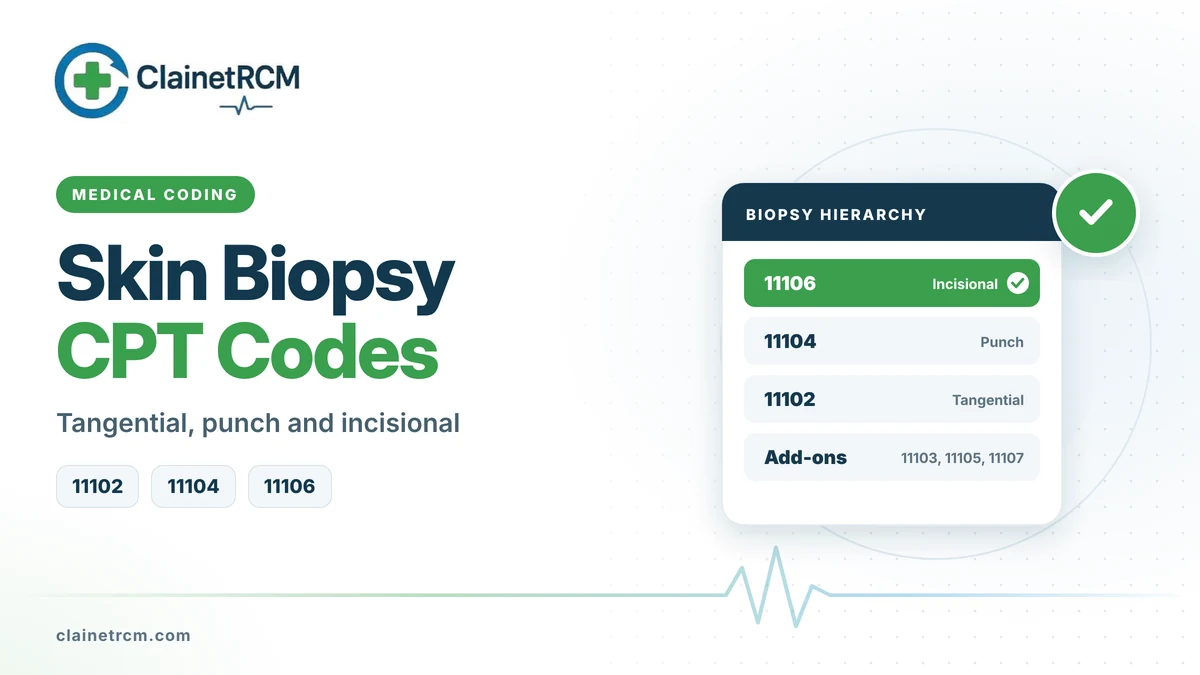
Quick answer: Report 11102 for the first tangential biopsy (shave, scoop, saucerize or curette), 11104 for the first punch biopsy and 11106 for the first incisional biopsy. Each additional lesion uses the add-on for its method: 11103, 11105 or 11107. Only one primary code is reported per encounter, and it must be the most complex method used, in the order incisional, then punch, then tangential. Pathology is billed separately, usually with 88305 per specimen.
Skin Biopsy CPT Codes by Method
| Method | First lesion | Each additional lesion | What it involves |
|---|---|---|---|
| Tangential | 11102 | 11103 | Shave, scoop, saucerize or curettage sampling of epidermis and dermis |
| Punch | 11104 | 11105 | A punch tool removing a full-thickness core |
| Incisional | 11106 | 11107 | A full-thickness wedge or ellipse into subcutaneous tissue |
Simple closure of the biopsy site is included in these codes.
How to Combine Methods
- Pick the primary code. Choose the most complex method performed during the encounter: incisional over punch, and punch over tangential.
- Add the remaining lesions. Report each additional lesion with the add-on code for the method used on it.
- Count lesions, not samples. Each separate lesion biopsied counts once; multiple samples from the same lesion are one biopsy.
| Scenario | Codes |
|---|---|
| Two tangential biopsies | 11102, 11103 |
| One punch and two tangential biopsies | 11104, 11103 ×2 |
| One incisional, one punch and one tangential biopsy | 11106, 11105, 11103 |
| Three punch biopsies | 11104, 11105 ×2 |
Biopsy vs Shave Removal vs Excision
A biopsy samples a lesion to obtain tissue for diagnosis. When the intent is to remove the entire lesion, use removal codes instead:
- Shave removal (11300 to 11313) when the whole lesion is removed by a horizontal slice, coded by site and lesion diameter.
- Excision (11400 to 11646) when the lesion is excised full thickness, coded by benign or malignant status, site and excised diameter.
- Same lesion, same session. If a lesion is biopsied and then excised during the same encounter, report only the excision.
- Different lesions. A biopsy of one lesion and excision of another can both be reported, with modifier 59 or XS on the biopsy when edits require it.
Some sites have their own biopsy codes, such as the lip (40490), eyelid (67810), external ear (69100) and nail unit (11755). Use the site-specific code instead of 11102 to 11107 when it applies.
Pathology and Diagnosis Coding
Each specimen sent to pathology is typically billed with 88305, by the pathologist or by the dermatologist who reads their own slides. Special stains and immunohistochemistry are added with their own codes.
Diagnosis coding is where timing matters. Many practices hold biopsy claims until the pathology report arrives so the definitive diagnosis can be coded, such as a basal cell carcinoma (C44.-), a melanocytic nevus (D22.-) or a seborrheic keratosis (L82.-). If you must bill before pathology is back, code the clinical finding rather than guessing:
- D49.2 (neoplasm of unspecified behavior of bone, soft tissue and skin) applies only when the provider documents a neoplasm but its behavior and type are not specified.
- D48.5 (neoplasm of uncertain behavior of skin) is reserved for a pathologist’s statement that the behavior cannot be determined.
- Signs and symptoms such as a skin lesion or rash are used when the provider has not identified a neoplasm.
E/M Visits and Global Days
Skin biopsy codes carry a zero-day global period. The decision to perform the biopsy is part of the procedure, so an E/M visit is billed separately only when the provider performs a significant, separately identifiable service, such as evaluating other problems. Append modifier 25 to the E/M in that case.
Documentation Tips
- Name the biopsy technique for each lesion: tangential, punch or incisional.
- Record the anatomic location of each lesion precisely, especially when several lesions are close together.
- Describe each lesion’s size and appearance and the clinical concern that prompted the biopsy.
- Label each specimen so the pathology report can be matched to the right lesion and diagnosis.
- Note any closure, hemostasis or dressing, even though simple closure is included.
Example
During a skin check, the dermatologist performs a punch biopsy of a changing mole on the back and tangential biopsies of two scaly lesions on the arm, then addresses the patient’s psoriasis medication plan.
- Procedures: 11104, 11103 ×2
- E/M: a problem-oriented visit with modifier 25 for the separate psoriasis management
- Pathology: three specimens, billed by the pathology provider
- Diagnoses: coded from the pathology report once it is available
Frequently Asked Questions
Code 11102 is a tangential biopsy, such as a shave or curette sample, of the first lesion. Code 11104 is a punch biopsy of the first lesion. The technique, not the lesion size, determines the code.
Not as two primary codes. When both methods are used, report the punch biopsy as the primary code (11104) and the tangential biopsy with the add-on 11103.
No. A shave biopsy samples a lesion for diagnosis and is coded 11102 or 11103. A shave removal removes the entire lesion and is coded 11300 to 11313 by site and size.
Code what the provider documented, such as the sign or symptom. Use D49.2 only when a neoplasm of unspecified behavior is documented, and reserve D48.5 for pathology that states uncertain behavior.
Yes. Simple closure of the biopsy site is included in 11102 to 11107.
Final Thoughts
Skin biopsy CPT codes are simple once you apply the method hierarchy and count lesions correctly. Learn how we support dermatology practices on our dermatology billing page, or pair this guide with our skin lesion ICD-10 coding guide.
Code Every Dermatology Procedure With Confidence
Our dermatology coders apply the biopsy hierarchy, add-on rules and pathology-based diagnoses so your biopsy, excision and Mohs claims pay correctly.
Get Dermatology Coding Help
Written by
ClainetRCM Billing Team
ClainetRCM is a Boston-based revenue cycle management company specializing in medical billing, coding, credentialing and denial management for healthcare providers across all 50 states. Our AAPC and AHIMA certified team works inside your existing EHR, files claims within 24 to 48 hours and reviews every AR bucket on a 14-day cycle.