The global surgery period is the window of time during which a surgeon’s payment for a procedure also covers related preoperative and postoperative care. Bill a visit that is included, and you invite a denial or an overpayment finding. Fail to bill a visit that is not included, and you leave money behind. The right modifier is usually what separates the two.
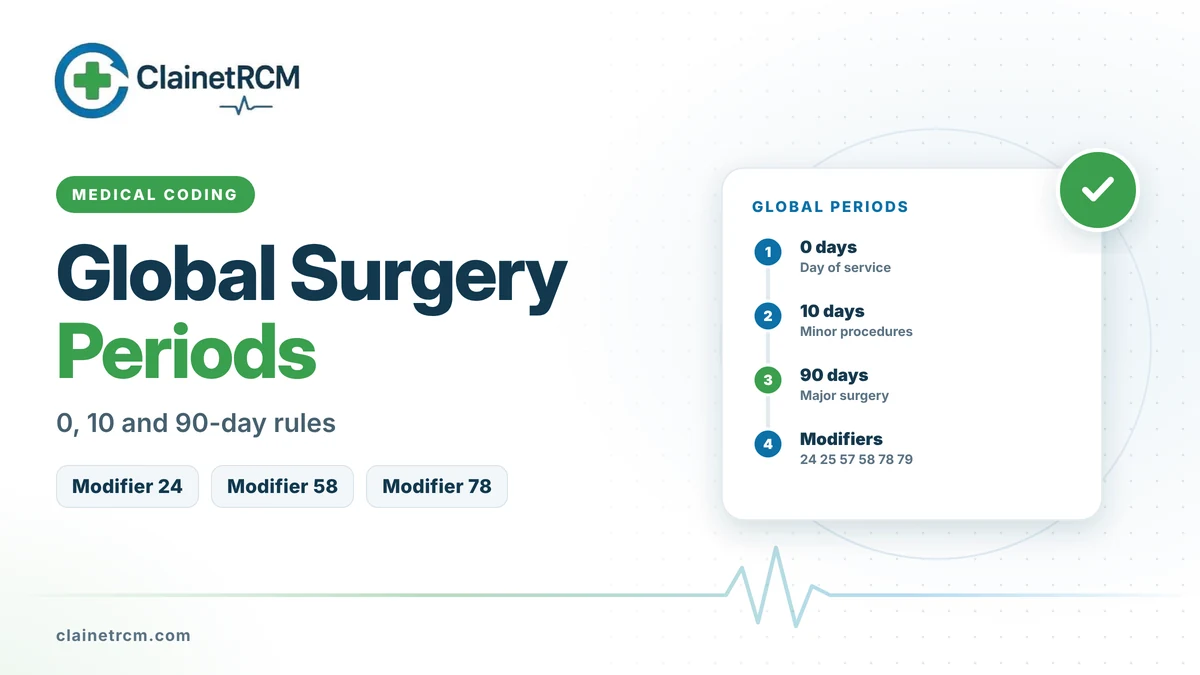
Quick answer: Medicare assigns each procedure a 0-day, 10-day or 90-day global period. A 90-day global includes the day before surgery, the day of surgery and 90 days after; a 10-day global includes the day of surgery and 10 days after; a 0-day global includes only the day of the procedure. Use modifier 57 for the decision for major surgery, modifier 25 for a separate E/M on the day of a minor procedure, modifier 24 for an unrelated E/M during the postoperative period, modifier 58 for a staged or related procedure, modifier 78 for an unplanned return to the operating room and modifier 79 for an unrelated procedure. Modifier 54 and modifier 55 split care between practitioners.
Global Surgery Period Types at a Glance
| Global indicator | Period | What it means |
|---|---|---|
| 000 | Day of procedure | Endoscopies and some minor procedures; same-day E/M generally included |
| 010 | Day of procedure plus 10 days | Minor procedures; same-day E/M generally included |
| 090 | Day before, day of, plus 90 days | Major procedures |
| XXX | Not applicable | The global concept does not apply, such as most E/M and diagnostic services |
| YYY | Set by the contractor | Usually unlisted procedures |
| ZZZ | Within another service’s global | Add-on codes |
| MMM | Maternity | Obstetric packages follow their own rules |
You can look up the global period for any code in the Medicare Physician Fee Schedule.
What the Global Package Includes
- Preoperative visits after the decision for surgery, starting the day before a major procedure
- The procedure itself, including local anesthesia
- Complications after surgery that do not require a return to the operating room
- Postoperative visits related to recovery
- Postsurgical pain management by the surgeon
- Supplies, dressing changes, suture and staple removal, and removal of lines, drains and casts
What Is Not Included
- The initial evaluation where the decision for surgery is made
- Visits for unrelated problems
- Treatment for the underlying condition, or a new complication requiring a return to the operating room
- Diagnostic tests and studies
- Distinct surgical procedures during the postoperative period
- Critical care unrelated to the surgery
Modifiers That Unlock Separate Payment
| Modifier | Use it when | Effect |
|---|---|---|
| 57 | The E/M on the day before or day of a 90-day procedure resulted in the decision for surgery | The E/M is paid separately |
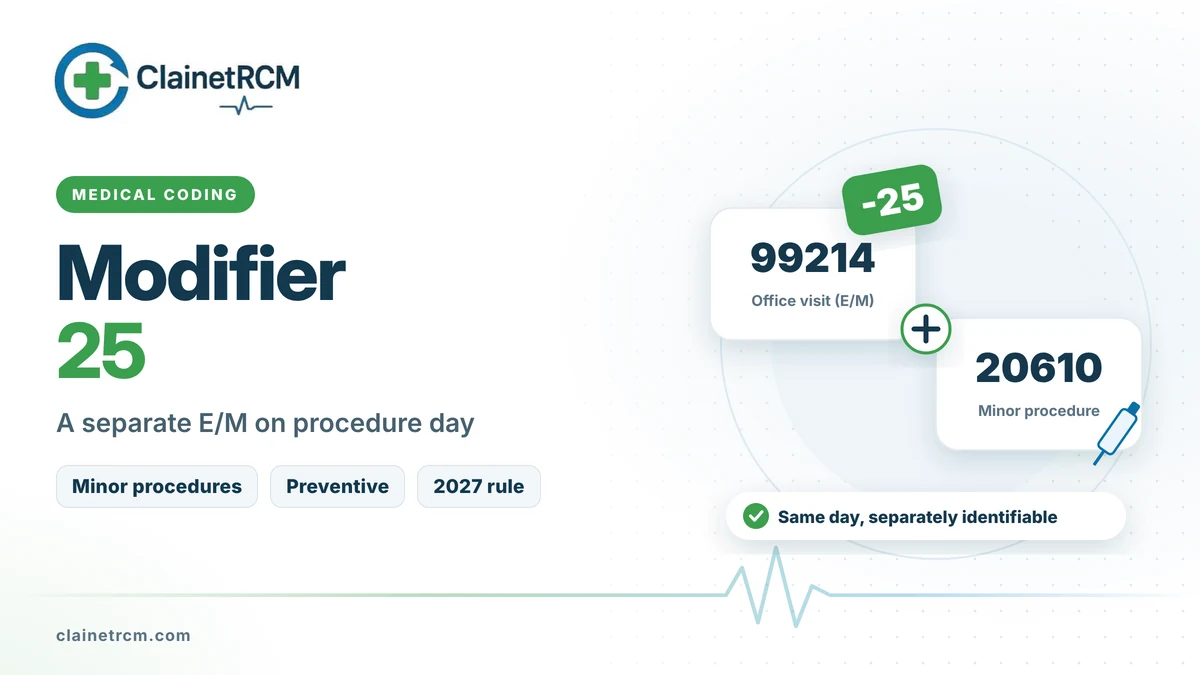
| 25 | A significant, separately identifiable E/M is performed on the same day as a 0- or 10-day procedure | The E/M is paid separately when documentation supports it |
| 24 | An unrelated E/M is performed during the postoperative period | The E/M is paid separately |
| 58 | A staged or related procedure is planned at the time of the original procedure, is more extensive, or is therapy after a diagnostic procedure | Paid in full; a new global period starts |
| 78 | An unplanned return to the operating room for a related complication | Paid for the intraoperative portion; no new global period |
| 79 | An unrelated procedure during the postoperative period | Paid in full; a new global period starts |
| 54 / 55 / 56 | Surgical care only / postoperative management only / preoperative management only | Each practitioner is paid their share of the global fee |
| FT | An unrelated E/M, such as critical care, during the global period | Identifies the visit as unrelated |
Transfer of Care: Modifier 54, 55 and G0559
Since 2025, Medicare requires the surgeon to append modifier 54 to any 90-day procedure whenever they do not expect to provide the postoperative care, even without a formal written transfer agreement. The practitioner who takes over billing postoperative care uses modifier 55 when a formal transfer exists. When a different practitioner provides postoperative follow-up without a formal transfer, they can report add-on code G0559 with their E/M visit, once per 90-day global period.
The 2027 Change for Minor Procedures
Starting January 1, 2027, Medicare reduces payment for the lower-paid service by 20% when an office or outpatient E/M with modifier 25 is billed on the same day as a 0-day global procedure by the same physician or a member of the same specialty in the same group. Procedures with 10- and 90-day globals are excluded. Our modifier 25 guide explains how to document separate E/M services.
Reporting Postoperative Visits With 99024
Code 99024 reports a postoperative visit included in the global package. It pays nothing, but practices with 10 or more practitioners in certain states must report it for CMS’s global surgery data collection, and many practices use it internally to track postoperative care.
Examples
- A patient has a laceration repair with a 10-day global. They return on day 5 for a wound check, which is included. On day 7 they return with unrelated knee pain: bill the E/M with modifier 24.
- A surgeon sees a patient the day before a hernia repair and decides to operate. Bill the E/M with modifier 57.
- On day 3 after surgery, the patient returns to the operating room for bleeding at the surgical site. Bill the procedure with modifier 78.
- A planned second-stage debridement takes place during the global period. Bill it with modifier 58.
Frequently Asked Questions
The period during which payment for a procedure includes related preoperative, intraoperative and postoperative care, set at 0, 10 or 90 days by Medicare.
On the E/M service where the decision for a major (90-day) surgery was made, on the day before or the day of the procedure.
Modifier 58 is for a planned or staged procedure and starts a new global period. Modifier 78 is for an unplanned return to the operating room for a complication and does not start a new global.
Not when they are treated without a return to the operating room. A return to the operating room is billed with modifier 78.
Many do, but some set their own periods or modifier rules. Check each payer’s policy.
Final Thoughts
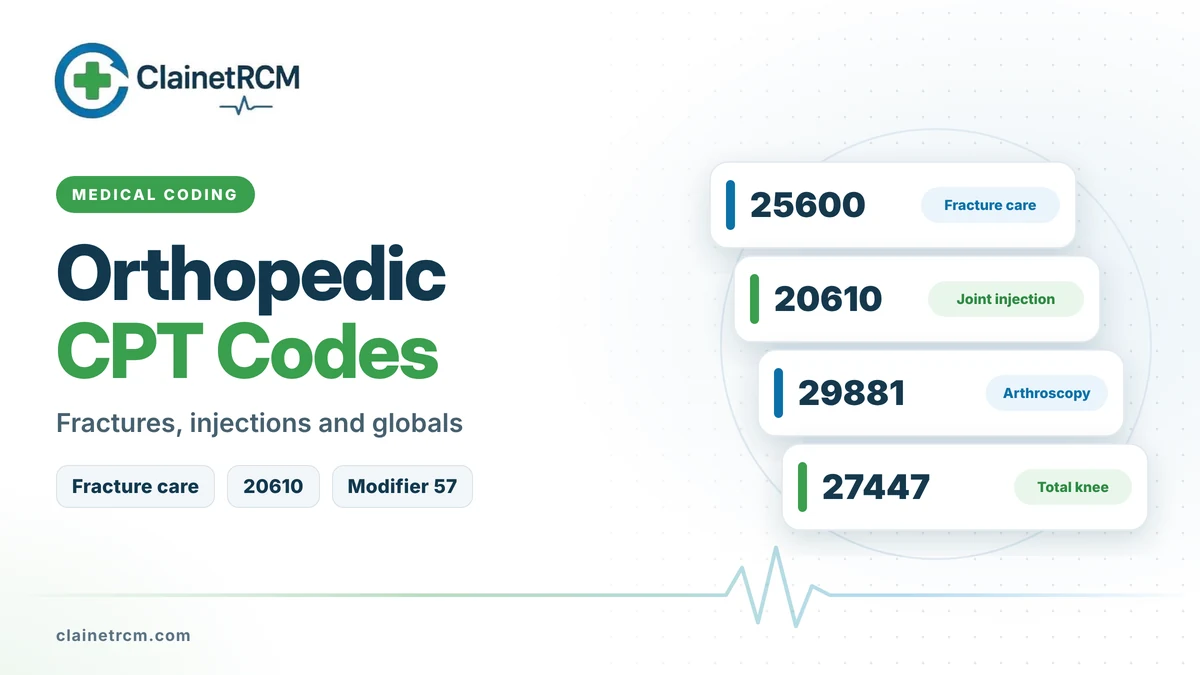
The global surgery period is predictable once you know the indicator for each procedure and the modifiers that separate unrelated, staged and complication care. Our general surgery billing team tracks global periods for every procedure, and our CPT code 16020 guide shows how global rules apply to burn care. For orthopedic procedures, see our orthopedic CPT codes guide.
Stop Losing Billable Visits to the Global Period
We track global periods for every procedure, apply 24, 57, 58, 78 and 79 correctly and keep postoperative billing compliant.
Get a Surgical Coding Review
Written by
ClainetRCM Billing Team
ClainetRCM is a Boston-based revenue cycle management company specializing in medical billing, coding, credentialing and denial management for healthcare providers across all 50 states. Our AAPC and AHIMA certified team works inside your existing EHR, files claims within 24 to 48 hours and reviews every AR bucket on a 14-day cycle.