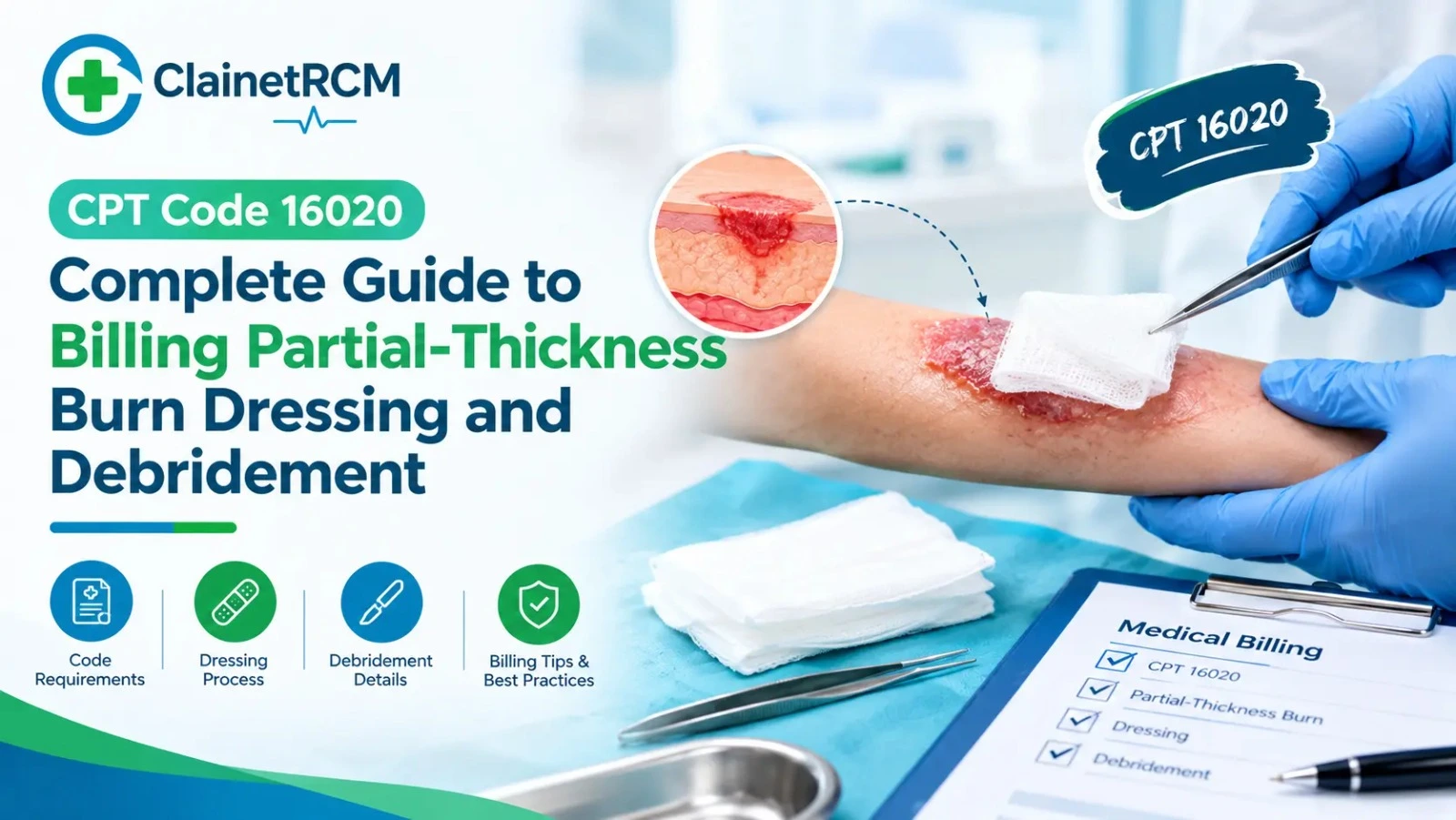
Quick answer: CPT code 16020 reports dressings and/or debridement of a partial-thickness (second-degree) burn that covers less than 5% of total body surface area (TBSA). It can be used for an initial or a subsequent visit, it carries a 000 global period, and a same-day E/M visit needs modifier 25 to be paid separately.
That short answer is correct, but it is not enough to get a claim paid. Burn claims get denied because the percentage was never documented, because the wrong code family was picked, or because the E/M was billed without a modifier. This guide walks through the whole process the way a coder or biller actually needs it, from choosing the code to defending it on appeal.
What Is CPT Code 16020?
CPT 16020 sits in the Local Treatment Procedures for Burns range of the CPT code set, which the American Medical Association maintains. The descriptor reads: dressings and/or debridement of partial-thickness burns, initial or subsequent; small (less than 5% total body surface area).
Three words in that descriptor decide almost every coding question.
Partial-thickness means the burn went through the epidermis into the dermis. Clinically that is a second-degree burn, either superficial or deep. First-degree burns, which only affect the epidermis, do not belong here.
Dressings and/or debridement means the provider actually did something to the wound. Cleaning the burn, removing blisters or loose devitalized tissue, applying a topical agent and placing a dressing all count. A provider who only looked at the burn and told the patient to go home has performed an E/M service, not a 16020 procedure.
Small, less than 5% TBSA means the size must be documented. The code family steps up as the burn gets larger, which we cover below.
CPT 16020 at a Glance
| Detail | What to know |
|---|---|
| Descriptor | Dressings and/or debridement of partial-thickness burns, initial or subsequent; small (less than 5% TBSA) |
| Burn depth | Partial thickness (second degree) |
| Size | Under 5% TBSA |
| Global period | 000 |
| Same-day E/M | Allowed only with modifier 25 and a separately identifiable service |
| Typical settings | Office, urgent care, emergency department, hospital outpatient, burn clinic, ambulatory surgery center |
| Common specialties | General surgery, plastic surgery, emergency medicine, dermatology, urgent care |
When Should You Report CPT 16020?
Report 16020 when all four of the following are true:
- The burn is partial thickness.
- The documented TBSA is under 5%.
- The provider performed a dressing and/or debridement.
- The note supports medical necessity for that service on that date.
Because the descriptor says “initial or subsequent,” 16020 can be reported again at a follow-up visit when the provider debrides or re-dresses the burn again. Payers may apply frequency edits, so check the policy for the plan on the claim.
When Not to Use 16020
Do not report 16020 for a first-degree burn such as a minor sunburn that needed no real treatment. Local treatment of a first-degree burn is reported with CPT 16000 when it is separately supported, and in many cases the work is simply part of the E/M visit.
Do not report it when the burn is larger than 5% TBSA. That moves you to 16025 or 16030.
Do not report it for a nurse-only dressing change with no provider involvement unless your payer’s incident-to rules clearly allow it.
Do not use a generic wound debridement code in place of a burn code. The wound care Local Coverage Article published by a Medicare contractor tells billers to use 16020, 16025 or 16030 to represent the burn percentage and the services provided, and not to use the ulcer debridement codes for burns. That guidance is a good rule of thumb for commercial payers too.
16000 vs 16020 vs 16025 vs 16030
The four burn treatment codes are easy to confuse, so keep this table beside you.
| CPT | Depth | Size | Description |
|---|---|---|---|
| 16000 | First degree | Not size-based | Initial treatment, local treatment only |
| 16020 | Partial thickness | Under 5% TBSA | Small burn dressing and/or debridement |
| 16025 | Partial thickness | 5% to 10% TBSA, or whole face or whole extremity | Medium burn dressing and/or debridement |
| 16030 | Partial thickness | Over 10% TBSA, or more than one extremity | Large burn dressing and/or debridement |
One detail trips up many coders. The medium and large descriptors include anatomical examples as well as percentages. A whole face or a whole extremity falls into the medium category even if the arithmetic comes out lower than 5%. When the chart describes an entire limb, read the descriptor carefully before settling on 16020.
How to Calculate TBSA Correctly
Most 16020 errors begin here. The code depends on the percentage, and the percentage must come from the provider’s documentation, not from the coder’s guess.
Rule of nines (adults): head and neck 9%, each arm 9%, front of trunk 18%, back of trunk 18%, each leg 18%, genitals 1%.
Palm method: the patient’s own palm, including the fingers, is roughly 1% of TBSA. This is useful for scattered or irregular burns.
Children: body proportions differ, so providers often use a pediatric burn diagram instead of the adult rule of nines.
Only partial-thickness areas count toward the total. Areas of simple redness (first degree) are not added in. If the note says “burn to the left forearm” with no percentage and no diagram, the coder should query the provider rather than assume the burn is small. Under-coding leaves money on the table, and over-coding invites an audit.
Documentation Checklist for 16020
Emergency physician coding guidance published by ACEP lists four things that should be recorded for any burn patient: the location, the size relative to TBSA, the depth, and whether dressings or debridement were performed and by whom. That list is a strong foundation. For a bulletproof 16020 claim, add a few more items:
- Mechanism and date of injury (scald, contact, flame, chemical, friction)
- Laterality and specific body part
- Burn depth in clinical terms, such as superficial partial thickness
- TBSA percentage with the method used
- What was removed or cleaned (blisters, loose skin, debris)
- Topical agent and dressing type applied
- Pain control and patient tolerance
- Tetanus status and instructions given
- Follow-up plan
- A clear separation between the E/M work and the procedure work if both are billed
If the provider writes “dressing applied” and nothing else, a payer reviewer can fairly argue that no debridement occurred and that the dressing was part of the E/M. Detailed notes protect the claim. Practices that want help closing documentation gaps often lean on professional medical coding services to catch these issues before submission.
ICD-10-CM Codes to Pair With 16020
A procedure code only works when the diagnosis supports it. For burns, ICD-10-CM organizes codes by site, depth and encounter type.
Site and depth: second-degree burns are reported from the T20 to T25 categories, with the fifth character indicating second degree. Examples include T21.2 for the trunk, T22.2 for the shoulder and upper limb except wrist and hand, T23.2 for the wrist and hand, T24.2 for the lower limb except ankle and foot, and T25.2 for the ankle and foot. T20.2 covers the head, face and neck.
Encounter type: the seventh character matters. Use A for the active treatment phase, D for a subsequent encounter during healing, and S for sequela. A dressing change at a follow-up visit usually takes a D.
Extent of body surface: category T31 identifies the percentage of body surface involved. For a burn under 10%, T31.0 is the code. An example worked through by AAPC for an ED encounter pairs the procedure and E/M with a site code, T31.0 for the extent, and an external cause code.
External cause: add an X code for the source, such as exposure to fire or contact with a hot object or liquid, plus a place of occurrence code when your payer or facility requires it.
Always link the most specific diagnosis to the procedure line on the claim. A vague code such as T30.0 (burn of unspecified body region, unspecified degree) will weaken the medical necessity story.
Modifier 25 and Same-Day E/M Visits
Because 16020 has a 000 global period, payers treat a routine pre-service evaluation as included in the procedure. The E/M is paid separately only when it is significant and separately identifiable from the burn treatment.
Think of a patient who comes in with a burn plus a new fever, or a provider who must take a full history, assess for inhalation risk and decide on a treatment plan before debriding. That work goes beyond the usual pre-procedure check. In that case the E/M, such as CPT code 99213, carries modifier 25.
If the visit was scheduled purely to dress a known burn, billing an E/M on top is hard to defend. Auditors look for E/M plus a minor procedure every day, and a missing or unsupported modifier 25 is among the top reasons these claims are denied or recouped.
Other modifiers you may need:
- Modifier 59 or an X modifier (XS, XP, XU): when a distinct procedure on a separate site would otherwise bundle.
- Modifier 76 or 77: when the same procedure is repeated the same day by the same provider or a different one.
- Modifier 51: where the payer still expects it for multiple procedures in one session.
- Modifiers LT or RT: where payers want laterality on procedure lines.
Bundling Traps and NCCI Edits
Billing 16020 with other wound codes is where compliance risk lives. The usual suspects are 97597 and 97598 (selective debridement of an open wound), 11042 and related debridement codes, and 11000 and 11001 (debridement of extensive infected skin). The National Correct Coding Initiative edits pair several of these with burn codes, and the pairs change quarterly.
A safe approach:
- Do not report a separate debridement code for the same burn that 16020 already describes.
- If a different wound, such as a laceration or ulcer on a different site, was also treated, document it separately and use the right modifier.
- Always run the claim through the current NCCI edit table for the date of service.
- If the burn needs excision, grafting or skin substitute placement, those services have their own codes and are not part of 16020.
Dressing supplies are generally included in the practice expense for physician billing, though facility and payer rules differ. Check policy before adding supply codes.
2026 Medicare Payment for CPT 16020
Under the 2026 Medicare Physician Fee Schedule, the conversion factor is $33.4009. For CPT 16020, the work RVU is 0.69. The total RVU is 2.78 in the non-facility setting and 1.63 in the facility setting. That works out to a national, unadjusted payment of roughly $93 in a non-facility office and about $54 when performed in a facility.
Treat these as starting points. Your actual rate changes with the geographic practice cost indices for your locality, the payer contract, sequestration and any other adjustment that applies. Commercial plans often pay a percentage of Medicare, but contracts vary widely. Pull the exact figure from the CMS Physician Fee Schedule lookup tool or from the payer’s published fee schedule before building revenue projections.
Who Bills CPT 16020 and Where
Emergency physicians, urgent care clinicians, general surgeons, plastic surgeons, dermatologists, family physicians and advanced practice providers all report 16020 in the right circumstances. The place of service can be an office, urgent care, ED, hospital outpatient department or an ASC.
Specialty context matters. A plastic surgery billing team will often see 16020 as a follow-up service in a larger reconstructive plan, while an urgent care billing team will see it as a walk-in procedure that must be paired with the correct E/M level the same day. In both cases the principles above stay the same.
Real-World Coding Examples
Example 1: Small scald on the forearm. A 30-year-old arrives at urgent care with a scald on the left forearm measuring about 3% TBSA. The provider documents second-degree blisters, debrides the loose skin, applies silver sulfadiazine and a non-adherent dressing. Report 16020 with T22.212A (or the equivalent site-specific code), T31.0 for extent, and the appropriate X code. No separate E/M is billed because the evaluation was limited to the burn.
Example 2: Burn plus a separate complaint. A patient with a 2% hand burn also presents with worsening chest pain after the incident. The physician performs a full evaluation for the chest pain and treats the burn. Report 16020 for the hand and a medically necessary E/M with modifier 25, each linked to its own diagnosis.
Example 3: Follow-up dressing change. A patient returns three days later for burn re-evaluation. The provider removes the old dressing, debrides devitalized tissue and re-dresses a 4% burn. Report 16020 again with a seventh character D, and confirm the payer’s frequency limits.
Example 4: Documentation says only “burn, dressed.” No depth, no TBSA, no mention of debridement. This claim should be held and queried, not submitted with a guess.
Common Denials for 16020 and How to Fix Them
| Denial reason | Root cause | Fix |
|---|---|---|
| E/M bundled into procedure | Missing or unsupported modifier 25 | Add 25 only when the E/M is truly separate, and strengthen the note |
| Medical necessity | Diagnosis does not match a second-degree burn | Use a specific T20 to T25 code with correct degree |
| Code mismatch with TBSA | Percentage missing or inconsistent | Query the provider, correct the code family |
| Bundled with wound debridement | 97597 or 11042 reported on the same site | Remove the duplicate or document a distinct site and use a valid modifier |
| Frequency exceeded | Too many dressing changes billed | Review the payer policy and the clinical need for each visit |
| Wrong place of service | POS does not match the actual setting | Correct before resubmission |
Most of these are preventable with a front-end review, which is why teams invest in preventing claim denials rather than chasing them later. When a denial does land, a structured denial management workflow with a corrected claim or a documented appeal letter gets the money back faster.
Compliance and Audit Tips
Burn procedures are low in dollar value, so they rarely trigger audits on their own. The risk comes from patterns. A provider who bills 16020 plus a level 4 E/M on every burn patient will stand out. So will a clinic that never uses 16000 for first-degree burns and always picks a procedure code instead.
Protect your practice with these habits:
- Audit a sample of burn claims every quarter.
- Teach providers to record TBSA and depth every time.
- Build EHR templates with required fields for burn size, depth and treatment.
- Track modifier 25 use by provider and compare against peers.
- Keep payer policies on file and update them when they change.
How to Build a Cleaner Burn Billing Workflow
Strong results usually come from small process changes. Start with a burn documentation template. Add a coder review for any claim that has 16000 to 16030 and an E/M on the same date. Make sure charge entry staff cannot choose a burn code without a TBSA field. Finally, measure results by watching first-pass acceptance, denial rate by code and days in accounts receivable. These steps feed directly into clean claims medical billing, where fewer errors on the first submission mean faster payment.
Tired of Burn and Wound Care Claims Getting Denied?
Clainet RCM helps practices code burn treatments accurately, apply the right modifiers and recover revenue that is slipping through the cracks.
Talk to a Billing ExpertFrequently Asked Questions About CPT Code 16020
It is used to report dressings and/or debridement of a partial-thickness burn that covers less than 5% of total body surface area, for either an initial or a subsequent encounter.
They are the same service at different sizes. 16020 is under 5% TBSA, 16025 is 5% to 10% TBSA or a whole face or extremity, and 16030 is over 10% TBSA or more than one extremity.
Yes, but only when the E/M is significant and separately identifiable from the burn treatment, and it must carry modifier 25. A routine evaluation before the procedure is already included.
No. First-degree burns are reported with 16000 when local treatment is separately supported, and a minor burn with no treatment is usually part of the E/M visit.
The global period is 000, meaning the procedure payment includes the pre-service work on the same day and routine immediate follow-up for that day.
The national unadjusted estimate is about $93 in the non-facility setting and about $54 in the facility setting, based on a conversion factor of $33.4009. Local adjustments apply.
Yes. Because the descriptor includes subsequent dressings, it can be billed at later visits when the provider debrides or re-dresses the burn again. Payer frequency policies still apply.
Second-degree burn codes from T20 to T25 matched to the burn site, usually with T31.0 for the extent when under 10% and an external cause code.
Generally no, unless the payer’s incident-to or facility rules allow it. The code is a procedure performed by a physician or other qualified health care professional.
No. Burns have their own code family. Use 16020, 16025 or 16030 and avoid duplicating the same site with a wound debridement code.
Final Thoughts
CPT code 16020 looks simple, yet it sits at the point where clinical documentation, code selection and payer rules all meet. Get the depth and TBSA right, support the debridement and dressing in the note, pair the code with a specific T-code, and use modifier 25 only when the E/M truly stands alone. Do those four things consistently and 16020 becomes a reliable, low-denial line on your claims.
If your team is tired of rework on small procedure claims, a well-built coding and billing process is the fastest way to protect the revenue you have already earned. Our medical billing services are built to do exactly that.

Written by
ClainetRCM Billing Team
ClainetRCM is a Boston-based revenue cycle management company specializing in medical billing, coding, credentialing and denial management for healthcare providers across all 50 states. Our AAPC and AHIMA certified team works inside your existing EHR, files claims within 24 to 48 hours and reviews every AR bucket on a 14-day cycle.