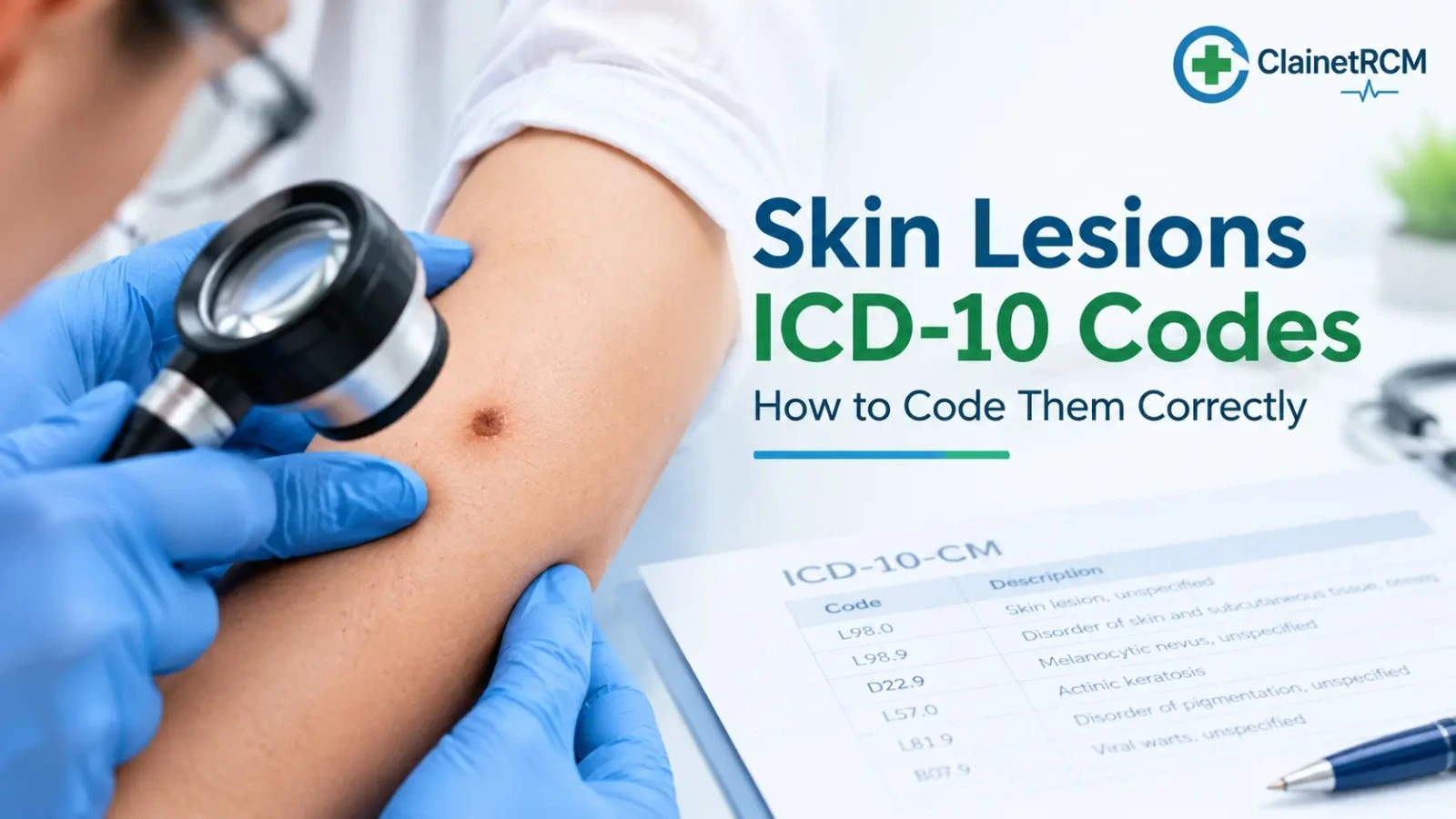
There is no single ICD-10-CM code for a skin lesion. The right code depends on what the provider has documented. An undiagnosed lesion is usually reported with L98.9 (disorder of the skin and subcutaneous tissue, unspecified) or a sign code such as R23.8 (other skin changes). Once a diagnosis is confirmed, you report that diagnosis instead, such as L57.0 for actinic keratosis or C44.- for skin cancer.
That one idea sorts out most of the confusion around this topic. I have spent decades watching dermatology and primary care claims go out with a lazy lesion code and come back with a denial letter. The problem is rarely the code itself. It is usually a mismatch between what the chart says, what the code says and what the procedure line says.
This guide walks you through the whole decision, from the first documented lesion to the paid claim.
Quick Reference: Common Skin Lesion ICD-10-CM Codes
| Situation | Code | Description |
|---|---|---|
| Undiagnosed lesion, not otherwise specified | L98.9 | Disorder of skin and subcutaneous tissue, unspecified |
| Other skin change | R23.8 | Other skin changes |
| Rash or nonspecific eruption | R21 | Rash and other nonspecific skin eruption |
| Lump or mass in the skin | R22.- | Localized swelling, mass and lump, by site |
| Precancerous sun damage | L57.0 | Actinic keratosis |
| Benign waxy growth | L82.1 | Other seborrheic keratosis |
| Mole | D22.- | Melanocytic nevi, by site |
| Other benign skin growth | D23.- | Other benign neoplasms of skin, by site |
| Uncertain behavior after pathology | D48.5 | Neoplasm of uncertain behavior of skin |
| Behavior not specified | D49.2 | Neoplasm of unspecified behavior of bone, soft tissue and skin |
| Basal or squamous cell carcinoma | C44.- | Other malignant neoplasm of skin, by type and site |
| Melanoma | C43.- | Malignant melanoma of skin, by site |
| Skin cancer screening | Z12.83 | Encounter for screening for malignant neoplasm of skin |
| History of skin cancer | Z85.828 | Personal history of other malignant neoplasm of skin |
Treat this table as a map and not as a replacement for the tabular list. Many of these categories need a fourth, fifth or sixth character for site, laterality or type.
What Is a Skin Lesion in Medical Coding?
A skin lesion is any area of skin that looks or feels different from the skin around it. It can be a bump, a patch, a sore, a blister or a growth. Clinically, the word is a description and not a diagnosis. That is exactly why ICD-10-CM does not give it one dedicated code.
From a coding point of view, a lesion sits in one of three states:
- Described but not diagnosed. The provider documents “2 cm scaly lesion on the left forearm” and nothing else.
- Diagnosed clinically. The provider documents “actinic keratosis” or “seborrheic keratosis” based on examination.
- Diagnosed by pathology. A biopsy comes back with a specific result such as basal cell carcinoma or a dysplastic nevus.
Each state calls for a different code family. Most lesion coding errors happen because the coder uses a state 1 code when the chart already supports state 2 or 3, or the other way around.
Step 1: Code What the Provider Has Actually Diagnosed
The ICD-10-CM Official Guidelines for Coding and Reporting say that signs and symptoms are acceptable for reporting when a related definitive diagnosis has not been established. They also say that in the outpatient setting you do not code a diagnosis documented as probable, suspected, questionable, rule out or working diagnosis. You code the condition to the highest degree of certainty, which in practice means the sign or symptom.
So if the note says “suspicious lesion, possible basal cell carcinoma, biopsy today,” you do not report C44.-. You report the lesion with an unconfirmed-diagnosis code until pathology confirms it.
If the note says “seborrheic keratosis” with no hedging language, you code seborrheic keratosis. A clinical diagnosis is still a diagnosis.
Step 2: Choose the Right Code for an Undiagnosed Lesion
When no diagnosis exists yet, you have a few options, and they are not interchangeable.
L98.9, Disorder of the skin and subcutaneous tissue, unspecified. The Alphabetic Index directs a nontraumatic skin lesion here, which makes it the default for an undiagnosed lesion. It is also the code payers see most often when a coder stopped looking too early. Use it when the provider describes a lesion and nothing more specific is supported.
R23.8, Other skin changes. This fits when the documentation describes a change in the skin that is not a distinct lesion, such as an area of altered texture or color that does not fit another R23 code.
R22.-, Localized swelling, mass and lump. If the provider documents a palpable lump or mass in the skin, the R22 subcategory is more accurate. It is organized by body region (head, neck, trunk, upper limb, lower limb), so site matters.
R21, Rash and other nonspecific skin eruption. Use it for a widespread or patchy eruption that the provider calls a rash. It is not a good fit for a single discrete growth.
A word of caution from long experience. Unspecified codes are not wrong, but payers watch them. A claim with L98.9 attached to an excision, a destruction or a biopsy of several sites invites questions about medical necessity. The code does not explain why the service was needed, so the clinical note has to carry that weight.
Step 3: Match Confirmed Diagnoses to the Correct Family
Once a diagnosis is documented, move to the code family that matches it.
Benign lesions
- Seborrheic keratosis: L82.1 for other seborrheic keratosis, L82.0 when it is inflamed.
- Melanocytic nevi (moles): D22.- by site, such as D22.5 for trunk, and D22.9 when the site is unspecified.
- Other benign neoplasms of skin: D23.- by site.
- Epidermal cyst: L72.0.
- Skin tags: reported under L91.8 in most coding references, and removal is often treated as cosmetic unless symptomatic.
- Viral warts: B07.- , with B07.8 and B07.9 being common.
- Molluscum contagiosum: B08.1.
Precancerous lesions
- Actinic keratosis: L57.0. It is a premalignant condition and belongs to the skin disorders caused by chronic exposure to nonionizing radiation. It is not a cancer code, and reporting it as one is a mistake I still see.
Malignant lesions
- Basal cell carcinoma and squamous cell carcinoma: C44.- , selected by histology and anatomic site. For example, C44.311 is basal cell carcinoma of the skin of the nose.
- Melanoma: C43.- , by site.
- Carcinoma in situ and melanoma in situ: D04.- and D03.- respectively.
The malignant codes are site specific. “Skin cancer, face” is not enough documentation. The provider needs to state the type and the exact site so the coder can reach the final character.
Infection and inflammation
- Local skin infection, unspecified: L08.9.
- Diabetic skin complications: E11.628 for type 2 diabetes with other skin complications, when the provider links the lesion to the diabetes.
Ulcers and chronic wounds
- Non-pressure chronic ulcers of the skin fall under L98.4- . This family was heavily expanded in FY 2026 with additional anatomic and severity detail, so older code lists and superbills may be out of date.
Bites and injuries
- A lesion caused by an insect bite or other injury is coded from the injury chapter with the correct external cause. For example, our guide on the tick bite ICD-10 code explains how bite site and complications change the code choice.
D48.5 vs D49.2: The Pair Most Guides Skip
These two codes look similar and they confuse even experienced coders.
D48.5 (neoplasm of uncertain behavior of skin) is used when the pathologist cannot tell whether the growth is benign or malignant. It reflects a pathology statement of uncertain behavior, for example certain atypical lesions where the report says so.
D49.2 (neoplasm of unspecified behavior of bone, soft tissue and skin) is used when there is a growth but nobody has documented its behavior at all, and no histology is available.
The mistake is using D48.5 simply because a lesion looks suspicious. Suspicion is not “uncertain behavior.” If the pathology report does not use that language, D48.5 is not supported.
The Biopsy Workflow: What to Do While Pathology Is Pending
This is where real money gets lost, so it deserves its own section.
A provider biopsies a lesion at the visit. The pathology report arrives three to seven days later. What diagnosis goes on the biopsy claim?
Practices handle this in two common ways:
- Report the sign-level code on the day of service (for example L98.9 or R22.-) and bill the biopsy with that.
- Hold the claim until the pathology result arrives and report the confirmed diagnosis, which links the biopsy to the clinical reason more cleanly.
Many dermatology practices prefer the second approach because the confirmed code tells a stronger medical necessity story and reduces rework. Whichever path you choose, apply it consistently and check your payer contracts for any timely filing limits before you hold claims. A claim held too long can turn into a timely filing denial, which is far worse than an unspecified code.
If the pathology changes the diagnosis after you already billed, do not simply forget it. Follow your payer’s corrected claim process.
Pairing Skin Lesion ICD-10 Codes with CPT Codes
The diagnosis code only matters if it supports the procedure it is attached to. Here is how the common lesion services line up.
| Service | CPT range | Notes |
|---|---|---|
| Skin biopsy, tangential | 11102, 11103 | 11103 is an add-on for each additional lesion |
| Skin biopsy, punch | 11104, 11105 | 11105 is an add-on |
| Skin biopsy, incisional | 11106, 11107 | 11107 is an add-on |
| Shave removal | 11300 to 11313 | Selected by size and body area |
| Excision, benign lesion | 11400 to 11446 | Selected by excised diameter and site |
| Excision, malignant lesion | 11600 to 11646 | Selected by excised diameter and site |
| Destruction, premalignant | 17000, 17003, 17004 | 17000 first lesion, 17003 for each of lesions 2 to 14, 17004 for 15 or more |
| Destruction, benign (warts and similar) | 17110, 17111 | 17110 for up to 14 lesions, 17111 for 15 or more |
A few pairing rules that save claims:
- Excision size is the lesion plus margins, measured before closure. The pathology report size alone does not set the code. The procedure note must record the excised diameter.
- Link each diagnosis to the right line. If a claim carries L57.0 and C44.- together, the pointers must send each to the service it supports.
- Use modifier 25 only when the E/M is significant and separately identifiable. A quick lesion check that leads to a procedure usually does not justify a separate office visit such as CPT code 99213. When a separate problem was truly evaluated, document it clearly.
- Use modifier 59 or the appropriate X modifier when payers require proof that lesions were at separate sites and not part of the same bundled service.
Medical Necessity: Cosmetic or Covered?
Removing a benign lesion is one of the most scrutinized services in dermatology. Many Medicare Administrative Contractors and commercial payers exclude removal when the reason is purely cosmetic.
Payers generally look for documentation of one or more of these:
- Bleeding, pain, itching or irritation
- Repeated inflammation or infection
- Interference with function, such as a lesion rubbing on clothing or blocking vision
- A change in size, color or shape, or features that raise suspicion of malignancy
- A pathology result that confirms a lesion that needed treatment
Coverage rules differ by contractor and by plan, so always check the current local coverage determination or payer policy. A diagnosis code such as L82.1 on its own does not prove necessity. The clinical note does that job, and the code simply has to be consistent with it.
Documentation Checklist for Skin Lesions
Good documentation is the cheapest denial prevention tool a practice has. For every lesion, the record should capture:
- Exact location, including laterality and body region
- Size in millimeters or centimeters
- Morphology, such as macule, papule, nodule, plaque, vesicle, ulcer or crust
- Color, border and surface features
- Duration and any change reported by the patient
- Symptoms, such as itching, bleeding or pain
- The clinical impression, stated with certainty or clearly as unconfirmed
- The plan, such as biopsy, destruction, excision or observation
- Procedure details, including technique, margins and number of lesions
- Photographs where the practice’s policy allows, to track change over time
If a coder has to guess at any of these, the claim is already at risk.
Common Denials on Skin Lesion Claims and How to Fix Them
| Denial | Likely cause | Fix |
|---|---|---|
| CO-50, not medically necessary | Cosmetic exclusion, or unspecified diagnosis with no symptoms documented | Appeal with the clinical note showing symptoms or suspicion of malignancy |
| CO-11, diagnosis inconsistent with procedure | Diagnosis does not support the CPT, such as a malignant code on a benign excision | Correct the diagnosis pointer or code to match pathology |
| CO-97, bundled into another service | Procedure billed with an overlapping service without the right modifier | Review NCCI edits and add modifier 59 or X modifiers where documentation supports it |
| CO-16, missing information | Missing site, size or laterality | Add the missing details and resubmit |
Most of these are preventable before submission. A solid claim scrubbing process catches mismatches early, which is the core idea behind clean claims in medical billing. When a denial does slip through, a structured appeal process is what recovers the revenue, and our notes on claim denials prevention cover the habits that reduce repeat denials.
What Changed for FY 2027
The FY 2027 ICD-10-CM update took effect on October 1, 2026 and applies to dates of service through September 30, 2027. CMS and the CDC posted the official files earlier in the year, and reviews of the update show the big changes landed elsewhere, such as plantar fasciitis codes and a restructured group of cardiomyopathy codes. Wound care analyses also found no significant revisions in several skin ulcer code families.
For skin lesion coding, that means the core codes in this guide were not the target of major changes this year. Still, check three things before you assume you are safe:
- Confirm every code on your superbill against the current tabular list, since deleted or newly non-billable codes get rejected.
- Review the FY 2027 Official Guidelines for any revised instructions.
- Remember that the FY 2026 expansion of chronic ulcer codes may still be missing from older templates.
Five Mistakes That Cost Practices Money
- Coding a suspected cancer as confirmed. If pathology has not confirmed it, you do not report C44.- or C43.-.
- Defaulting to L98.9 for everything. It is a valid code, but overuse signals weak documentation.
- Ignoring site and laterality. Many neoplasm codes cannot be completed without them.
- Calling actinic keratosis a malignancy. L57.0 is premalignant, and the code family reflects that.
- Skipping the medical necessity story on benign removals. The note must explain why the service was needed, or the claim looks cosmetic.
When to Bring in Specialist Support
Skin lesion coding looks simple until you add multiple sites, mixed diagnoses, pathology delays and payer-specific cosmetic rules on a single claim. This is where specialty knowledge pays for itself. Practices that run busy dermatology schedules often work with a team that understands dermatology billing from front desk to final payment, and with medical coding services that review lesion documentation before the claim leaves the building.
Frequently Asked Questions
There is no single code. An undiagnosed skin lesion is commonly reported with L98.9, while R23.8 fits other skin changes and R22.- fits a palpable lump or mass. A confirmed diagnosis replaces these with a specific code.
L98.9, disorder of the skin and subcutaneous tissue, unspecified, is the code the Alphabetic Index points to for a nontraumatic skin lesion with no further detail.
No. In outpatient coding, suspected, probable or rule out diagnoses are not coded as confirmed. Report the lesion with a sign or unspecified code, or wait for pathology and report the confirmed diagnosis.
D48.5 is for a skin neoplasm of uncertain behavior, as stated by pathology. D49.2 is for a skin growth whose behavior has not been specified and for which no histology is available.
L57.0. It is a premalignant condition and is not classified as a cancer.
Z12.83, encounter for screening for malignant neoplasm of skin. A history of skin cancer is reported separately with a personal history code such as Z85.828.
No. The CPT code is chosen by the procedure performed. The ICD-10 code explains why the procedure was necessary, and the two must be consistent.
ICD-10-CM updates every October 1. The FY 2027 update took effect on October 1, 2026, so always check the current tabular list before submitting claims.
Final Takeaway
A skin lesion is a description, and ICD-10-CM wants a diagnosis. Code what the provider has confirmed, use sign-level codes honestly when nothing is confirmed, link every diagnosis to the right procedure line and let the clinical note prove medical necessity. Do those four things and most lesion claims pay on the first pass.
Tired of Skin Lesion Claims Coming Back Denied?
Clainet RCM’s certified coders review your dermatology documentation, match every lesion to the right ICD-10 and CPT codes, and clean up claims before they reach the payer.
Talk to a Billing Expert Today
Written by
ClainetRCM Billing Team
ClainetRCM is a Boston-based revenue cycle management company specializing in medical billing, coding, credentialing and denial management for healthcare providers across all 50 states. Our AAPC and AHIMA certified team works inside your existing EHR, files claims within 24 to 48 hours and reviews every AR bucket on a 14-day cycle.