The ICD-10 code for COPD is J44.9 when the provider documents chronic obstructive pulmonary disease without an exacerbation or infection. When the patient has an acute exacerbation, a lower respiratory infection, emphysema or asthma at the same time, the code changes, and some combinations require more than one code. COPD is also a risk-adjusted condition, so documentation quality matters.
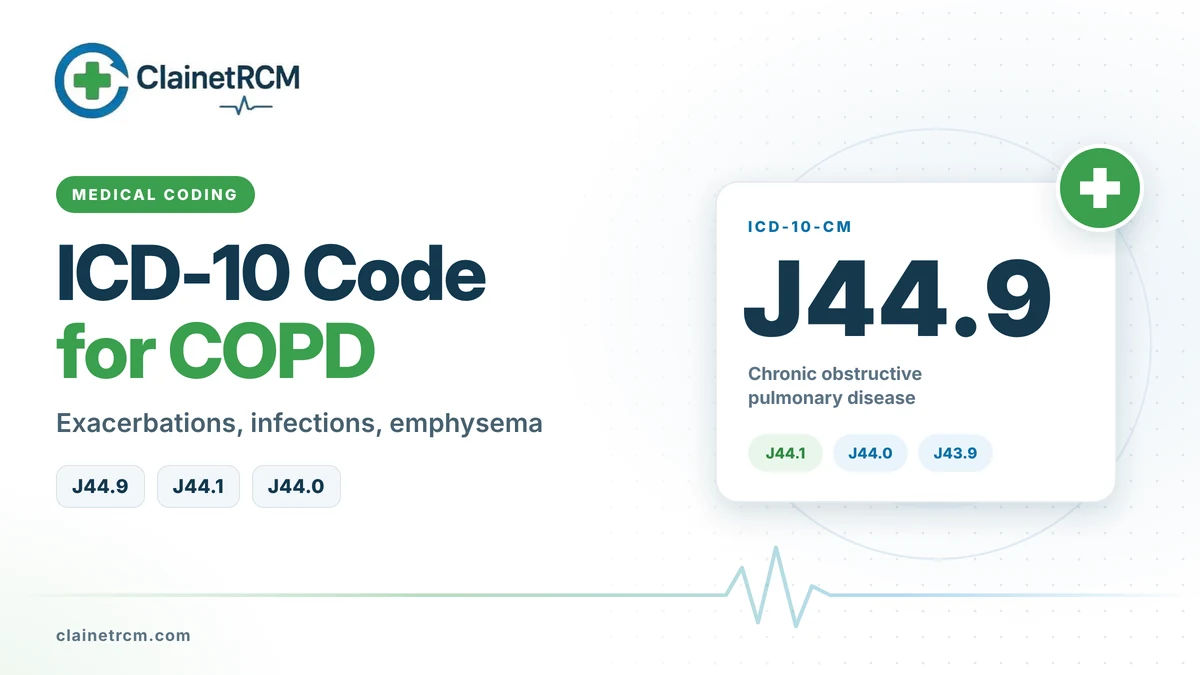
Quick answer: Use J44.9 for COPD, unspecified. Use J44.1 for COPD with acute exacerbation and J44.0 for COPD with an acute lower respiratory infection, plus a code for the infection, such as pneumonia. When both an exacerbation and an infection are documented, J44.0 and J44.1 can be reported together. Emphysema is coded to J43.-, asthma with COPD adds a J45 code, and tobacco use, history or exposure and oxygen dependence (Z99.81) should be coded when documented.
ICD-10 Code for COPD: Main Options
| Code | Description | Code also |
|---|---|---|
| J44.9 | COPD, unspecified | Tobacco use or exposure |
| J44.1 | COPD with (acute) exacerbation | — |
| J44.0 | COPD with (acute) lower respiratory infection | The infection, such as J18.9 or J20.9 |
| J44.81 | Bronchiolitis obliterans and bronchiolitis obliterans syndrome | — |
| J44.89 | Other specified COPD | — |
| J43.9 | Emphysema, unspecified | Tobacco use or exposure |
Exacerbation vs Infection
- Acute exacerbation (J44.1) is a worsening or decompensation of the chronic disease, such as increased shortness of breath and sputum requiring a change in treatment.
- Acute lower respiratory infection (J44.0) applies when COPD occurs with an infection such as acute bronchitis or pneumonia. Use an additional code to identify the infection.
- Both together. When the provider documents both an exacerbation and an infection, assign J44.0 and J44.1, plus the infection code.
An exacerbation is not assumed just because the patient has an infection; the provider must document it.
Emphysema and COPD
Emphysema is a form of COPD. When the provider documents emphysema with COPD, Coding Clinic guidance directs coders to report the emphysema code (J43.-) rather than a J44 code. Code the specific type of emphysema when documented, such as centrilobular (J43.2) or panlobular (J43.1).
Asthma and COPD Overlap
When a patient has both COPD and asthma, report the J44 code and add the J45 code that identifies the type and severity of asthma, such as J45.40 for moderate persistent asthma, uncomplicated. Document both diagnoses clearly, because asthma-COPD overlap affects treatment choices and medication coverage.
Other Codes to Add
- Tobacco: dependence (F17.210 for cigarettes, uncomplicated), history of tobacco dependence (Z87.891) or exposure to secondhand smoke (Z77.22)
- Oxygen: dependence on supplemental oxygen (Z99.81)
- Pulmonary rehabilitation: document the COPD severity and functional limits that support the referral
- Respiratory failure: when documented, such as chronic respiratory failure with hypoxia (J96.11); in the inpatient setting, sequencing depends on the circumstances of the admission
Risk Adjustment and Documentation
COPD and emphysema map to a payment HCC in the current Medicare Advantage risk model, so each encounter should support the condition with MEAT documentation:
- Monitor: symptoms, oxygen saturation and exacerbation history
- Evaluate: exam findings and pulmonary function results
- Assess: stage or severity and stability
- Treat: inhalers, oxygen, pulmonary rehabilitation or referrals
“History of COPD” without current assessment does not support coding the condition at that visit. Inhaler changes, oxygen titration and referrals all count as treatment evidence.
Exacerbations in the Emergency Department and Hospital
During an exacerbation, patients may also have acute respiratory failure (J96.0-), pneumonia or another infection. Code each condition the provider documents. In the inpatient setting, acute respiratory failure can be sequenced as the principal diagnosis when it is the condition chiefly responsible for the admission, with J44.1 as a secondary code; when the exacerbation itself is the main reason for admission, J44.1 comes first. Clear documentation of what prompted the admission decides the sequencing.
Spirometry and Severity Documentation
COPD is confirmed by spirometry showing persistent airflow limitation after a bronchodilator. Record the FEV1 and FEV1/FVC results, the severity or GOLD category, exacerbation history and symptom burden. This documentation supports the diagnosis, medication coverage and pulmonary rehabilitation referrals.
Pairing With CPT Codes
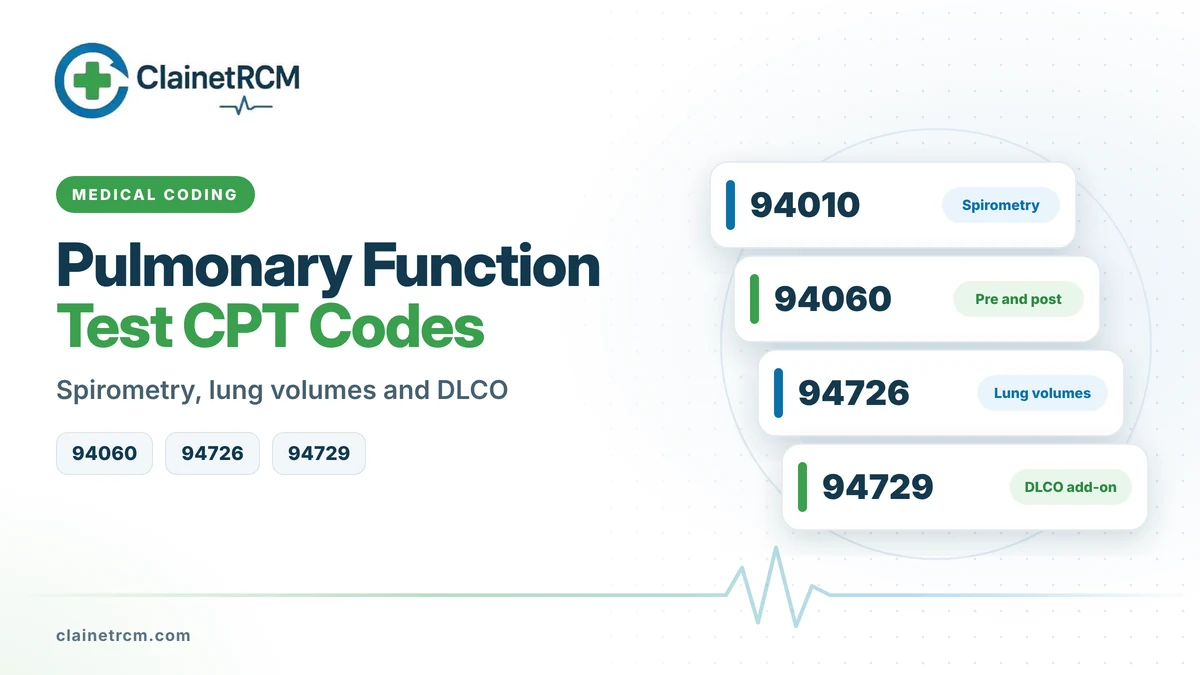
COPD supports spirometry (94010) and bronchodilator responsiveness testing (94060), lung volumes and diffusing capacity, six-minute walk tests (94618), nebulizer treatments (94640), inhaler instruction (94664), pulmonary rehabilitation and chronic care management. Link each service to the COPD code or to the symptom that prompted it, such as shortness of breath.
Coding Examples
| Scenario | Codes |
|---|---|
| Stable COPD, former smoker | J44.9, Z87.891 |
| COPD exacerbation, current smoker | J44.1, F17.210 |
| COPD with pneumonia | J44.0, J18.9 |
| COPD exacerbation with acute bronchitis | J44.0, J44.1, J20.9 |
| Centrilobular emphysema on home oxygen | J43.2, Z99.81 |
Common Errors
- Coding J44.9 when an exacerbation is documented
- Coding J44.0 without the infection code
- Coding J44.- and J43.- together for COPD with emphysema
- Leaving out tobacco and oxygen codes
- Coding COPD from the problem list without current assessment
- Coding an exacerbation at a routine follow-up visit without new or worsening symptoms
Frequently Asked Questions
J44.9 is COPD, unspecified. Use J44.1 for an acute exacerbation and J44.0 for COPD with an acute lower respiratory infection.
Yes, when the provider documents both an acute lower respiratory infection and an acute exacerbation. Add the code for the infection as well.
Report the emphysema code (J43.-), because emphysema is a form of COPD.
Chronic obstructive bronchitis is included in J44.-. Use J44.9 when it is stable, J44.1 for an exacerbation or J44.0 when an acute lower respiratory infection is present.
Yes. ICD-10-CM instructs you to add codes for tobacco use, dependence, history or exposure when documented.
Yes. COPD and emphysema map to a payment category in the Medicare Advantage model, so each visit should document how the condition was monitored, evaluated, assessed or treated.
Final Thoughts
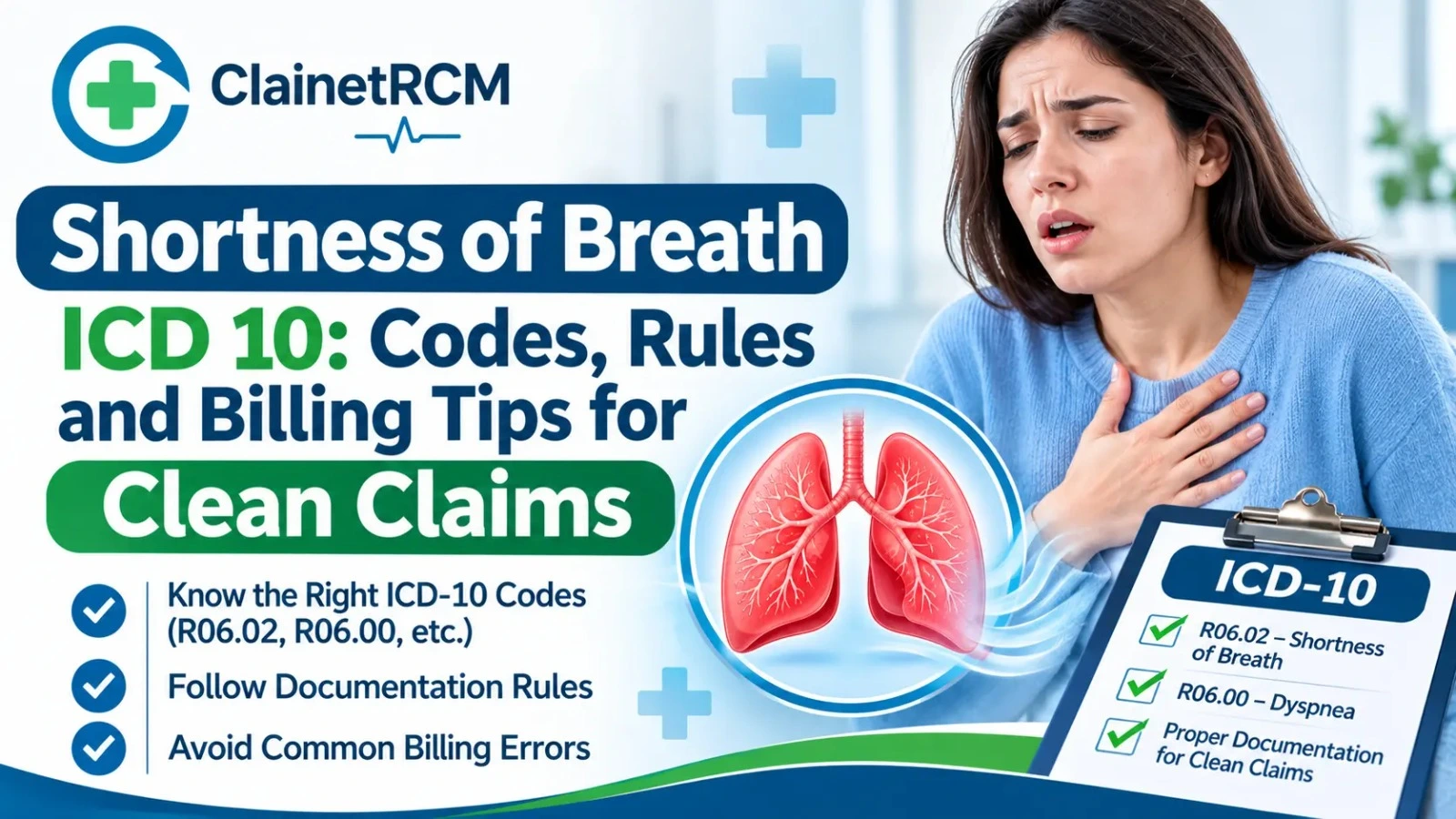
The ICD-10 code for COPD depends on what is happening with the disease at each visit, so precise documentation pays off. Learn how we support lung care practices on our pulmonology billing page, or review symptom coding in our shortness of breath ICD-10 guide.
Code Chronic Lung Disease With Confidence
Our coders capture exacerbations, infections, oxygen dependence and tobacco status so COPD claims, quality measures and risk scores are accurate.
Get Coding Help
Written by
ClainetRCM Billing Team
ClainetRCM is a Boston-based revenue cycle management company specializing in medical billing, coding, credentialing and denial management for healthcare providers across all 50 states. Our AAPC and AHIMA certified team works inside your existing EHR, files claims within 24 to 48 hours and reviews every AR bucket on a 14-day cycle.