Routine foot care billing is one of the most heavily audited areas in podiatry. Medicare excludes routine foot care by law, then makes exceptions for patients whose systemic conditions make that care risky in non-professional hands. Getting paid depends on documenting the right condition, the right class findings and the right modifier, and on respecting how often the service can be repeated.
Quick answer: Medicare covers nail debridement (11720, 11721), trimming of dystrophic nails (G0127) and paring of corns and calluses (11055 to 11057) only when an exception applies, most often a qualifying systemic condition such as diabetes with peripheral vascular disease or neuropathy. Document the class findings and append Q7 (one Class A finding), Q8 (two Class B findings) or Q9 (one Class B and two Class C findings). For certain conditions, the patient must also be under the active care of an MD or DO seen within the prior six months. Most Medicare contractors allow routine foot care once every 61 days.
What Medicare Means by Routine Foot Care
Routine foot care includes cutting or removing corns and calluses, trimming, cutting, clipping or debriding nails and other hygienic or preventive maintenance such as cleaning and soaking the feet. These services are excluded from Medicare coverage unless one of these exceptions applies:
- A qualifying systemic condition such as diabetes, peripheral arterial disease or peripheral neuropathy that makes non-professional care hazardous.
- Treatment of mycotic nails that meets coverage criteria.
- Services that are an integral part of other covered care, such as treating an ulcer or infection.
- Patients with diabetic neuropathy and loss of protective sensation (LOPS), who qualify for the G0245, G0246 and G0247 services.
Class Findings and Q Modifiers
| Class | Findings |
|---|---|
| Class A | Nontraumatic amputation of the foot or an integral skeletal portion of it |
| Class B | Absent posterior tibial pulse; absent dorsalis pedis pulse; advanced trophic changes (three are needed: decreased or absent hair growth, nail thickening, discoloration, thin and shiny skin, rubor or redness) |
| Class C | Claudication; temperature changes such as cold feet; edema; paresthesias; burning |
| Modifier | Requirement |
|---|---|
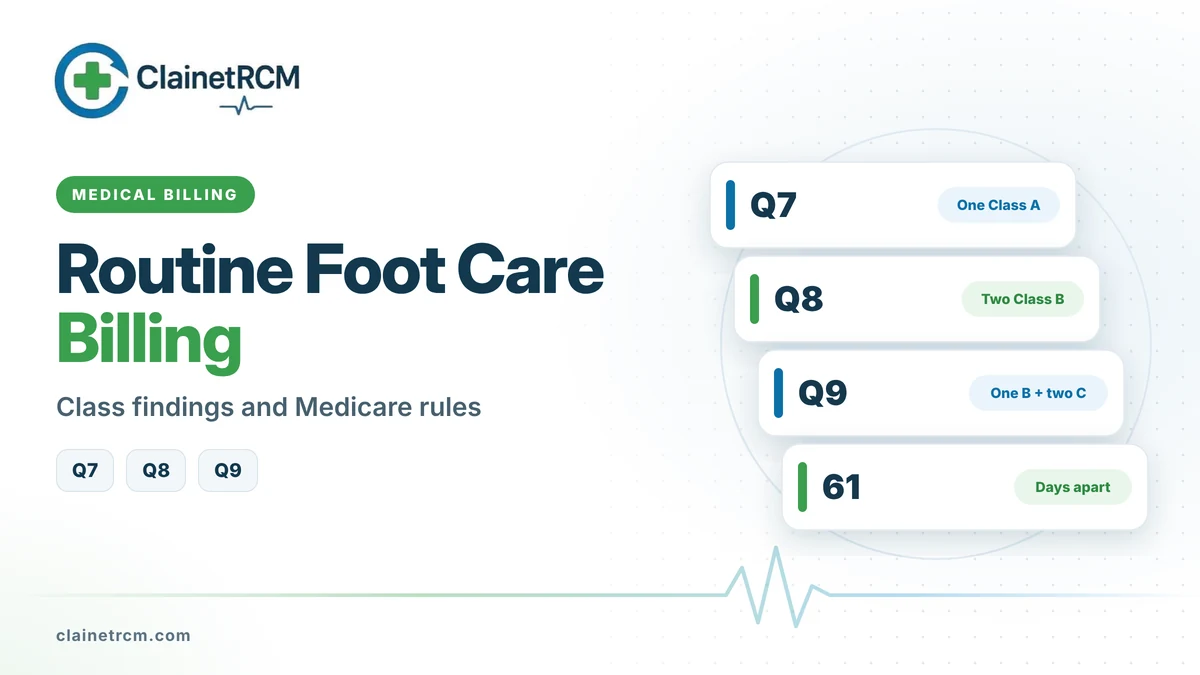
| Q7 | One Class A finding |
| Q8 | Two Class B findings |
| Q9 | One Class B finding and two Class C findings |
When coverage is based on peripheral neuropathy without vascular impairment, the class findings modifiers are generally not required, but the record must describe the neuropathy and its effect on the feet.
Routine Foot Care Billing Codes
| Code | Description | Common coverage path |
|---|---|---|
| 11055, 11056, 11057 | Paring or cutting of benign hyperkeratotic lesions: one, two to four, more than four | Systemic condition with class findings |
| 11719 | Trimming of nondystrophic nails, any number | Systemic condition with class findings |
| G0127 | Trimming of dystrophic nails, any number | Systemic condition with class findings |
| 11720, 11721 | Debridement of nails: one to five, six or more | Mycotic nail criteria or a systemic condition |
| G0247 | Routine foot care for a diabetic patient with LOPS | Diabetic neuropathy with LOPS |
Active Care Requirements
For conditions marked in the routine foot care policy, coverage also requires that the patient be under the active care of an MD or DO (and in some jurisdictions a qualified nonphysician practitioner) for the systemic condition, with a visit within the six months before the foot care. Many Medicare contractors ask for the treating physician’s name or NPI and the approximate date the patient was last seen on the claim. Keep a copy of the supporting documentation, because this is a frequent audit target.
Mycotic Nail Debridement
Debridement of mycotic nails (11720, 11721) is covered when the record shows clinical evidence of mycosis plus, for an ambulatory patient, marked limitation of ambulation, pain or secondary infection caused by the thickened, dystrophic nail. For a non-ambulatory patient, pain or secondary infection is required. Document the number of nails treated, their thickness, discoloration and subungual debris, and the patient’s symptoms.
Frequency Rules
Most Medicare contractors consider routine foot care medically necessary no more often than once every 61 days. Services performed more often need documentation of a specific clinical need, such as an infection or rapidly regrowing painful lesions. Track the last covered date in your scheduling system so patients are not booked early.
ABNs and Modifiers GA and GY
Routine foot care that does not meet any exception is a statutory exclusion, so it can be billed with modifier GY if the patient or a secondary payer needs a denial, and the patient can be charged. When you believe a service meets an exception but may be denied as not reasonable and necessary, such as care before the 61-day mark, give the patient an Advance Beneficiary Notice and append modifier GA.
Example
A patient with type 2 diabetes and peripheral arterial disease has absent dorsalis pedis and posterior tibial pulses in both feet. The podiatrist debrides eight painful, thickened mycotic toenails and pares two calluses. The patient’s primary care physician saw them three months ago for diabetes.
- Codes: 11721-Q8 and 11056-Q8
- Diagnoses: the diabetes and peripheral arterial disease codes, plus onychomycosis and callus
- Claim details: the treating physician’s name or NPI and date last seen, as the contractor requires
Frequently Asked Questions
Only when an exception applies, such as a qualifying systemic condition with documented class findings, mycotic nails meeting coverage criteria or diabetic neuropathy with loss of protective sensation.
Q7 means one Class A finding, Q8 means two Class B findings and Q9 means one Class B finding plus two Class C findings. They identify the clinical evidence that supports coverage.
Most contractors allow it once every 61 days. More frequent care needs documented medical necessity.
G0127 is trimming of dystrophic nails, any number. Code 11720 is debridement of one to five nails, which reduces nail thickness and is often used for mycotic nails.
Not for services that are statutorily excluded, which can be billed with GY. Use an ABN with modifier GA when a covered service may be denied as not medically necessary, such as care before the frequency limit.
Final Thoughts
Routine foot care billing depends on documentation that tells the whole story: the systemic condition, the class findings, the active care and the timing. Learn how we support podiatry practices on our podiatry billing page, or read our specialty medical billing guide.
Make Routine Foot Care Claims Audit-Ready
Our podiatry billing team checks class findings, active care details and frequency before every claim so nail and callus services are paid and protected.
Get Podiatry Billing Help
Written by
ClainetRCM Billing Team
ClainetRCM is a Boston-based revenue cycle management company specializing in medical billing, coding, credentialing and denial management for healthcare providers across all 50 states. Our AAPC and AHIMA certified team works inside your existing EHR, files claims within 24 to 48 hours and reviews every AR bucket on a 14-day cycle.