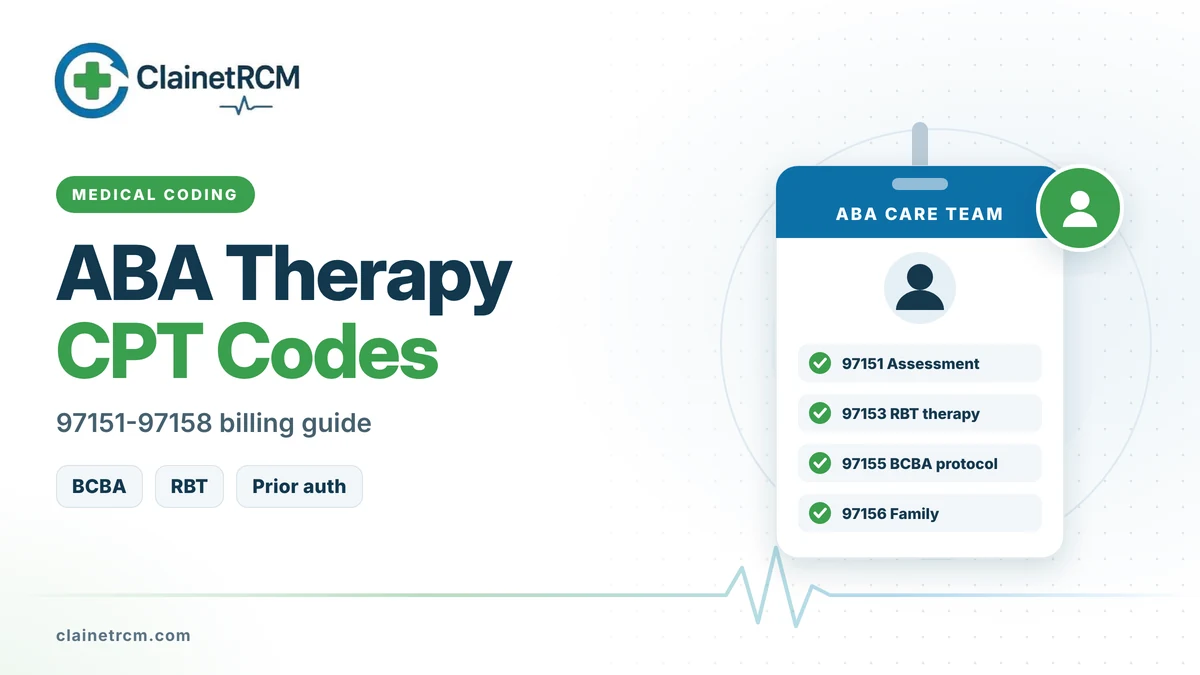
ABA therapy CPT codes describe applied behavior analysis services for autism and related conditions, from the initial assessment to daily treatment and caregiver training. The code set has been stable since 2019, but ABA billing is still one of the most denial-prone areas in behavioral health because every session has to line up with a specific authorization, provider level and unit count.
Quick answer: 97151 is the behavior identification assessment by a qualified professional such as a BCBA, and 97152 is a supporting assessment by a technician. Treatment codes are 97153 (treatment by protocol, by a technician such as an RBT), 97154 (group treatment by a technician), 97155 (treatment with protocol modification by the BCBA), 97156 (family guidance), 97157 (multiple-family group guidance) and 97158 (group treatment with protocol modification). 0362T and 0373T cover severe destructive behavior. All are billed in 15 minutes units, and almost every payer requires prior authorization.
ABA Therapy CPT Codes at a Glance
| Code | Service | Who performs it | Unit |
|---|---|---|---|
| 97151 | Behavior identification assessment, including face-to-face assessment and non-face-to-face analysis and report writing | Qualified health care professional (BCBA) | 15 minutes |
| 97152 | Behavior identification supporting assessment | Technician under QHP direction | 15 minutes |
| 0362T | Supporting assessment for severe destructive behavior, with two or more technicians and the QHP on site | Technicians with QHP | 15 minutes |
| 97153 | Adaptive behavior treatment by protocol, one patient | Technician under QHP direction | 15 minutes |
| 97154 | Group adaptive behavior treatment by protocol, two or more patients | Technician under QHP direction | 15 minutes |
| 97155 | Adaptive behavior treatment with protocol modification, one patient | QHP, may direct a technician at the same time | 15 minutes |
| 97156 | Family adaptive behavior treatment guidance, with or without the patient | QHP with caregivers | 15 minutes |
| 97157 | Multiple-family group treatment guidance, without the patient | QHP with multiple sets of caregivers | 15 minutes |
| 97158 | Group adaptive behavior treatment with protocol modification | QHP with multiple patients | 15 minutes |
| 0373T | Treatment with protocol modification for severe destructive behavior, two or more technicians | Technicians with QHP on site | 15 minutes |
Assessment Codes: 97151, 97152 and 0362T
97151 is billed by the BCBA for the initial assessment and reassessments. It includes face-to-face time with the patient and caregivers and non-face-to-face time analyzing data, scoring and interpreting results and writing the treatment plan. Payers typically authorize a set number of 97151 units for the initial assessment and again at each reassessment, often every six months.
97152 covers a technician administering parts of the assessment under the BCBA’s direction. 0362T applies only when severe destructive behavior requires two or more technicians with the QHP on site in a safe, customized environment.
Treatment Codes: 97153 to 97158 and 0373T
- 97153 is the core direct therapy code: a technician delivering treatment by protocol to one patient. It usually accounts for most authorized hours.
- 97155 is the BCBA’s direct work with the patient when modifying the protocol, including directing the technician in real time.
- 97156 is caregiver training, which payers increasingly expect to see in every treatment plan.
- 97154, 97157 and 97158 are group services, billed per patient.
- 0373T is reserved for severe destructive behavior requiring two or more technicians and the QHP on site.
Concurrent billing. Some payers allow 97155 and 97153 to be billed for the same minutes when the BCBA is directing the technician during the session. Others do not. Confirm the payer’s policy in writing.
Unit Rules
Each code is billed in 15-minute units, and CPT counts a unit once the midpoint is passed, so 8 minutes is the minimum for one unit. Many Medicaid programs apply their own rounding rules, so follow the state manual. For group codes, bill each patient’s own claim for the time they participated.
Who Can Bill, and Modifiers
ABA services are rendered by Board Certified Behavior Analysts (BCBA and BCBA-D), Board Certified Assistant Behavior Analysts in some plans, and Registered Behavior Technicians, plus licensed psychologists in many states. Many states also license behavior analysts. Payers differ on whether the technician or the supervising BCBA is listed as the rendering provider.
Medicaid programs and some commercial plans require modifiers that identify the provider’s education or credential level, such as HM, HN, HO and HP, or state-defined U modifiers. The BACB requires RBTs to receive supervision for at least 5% of their service hours each month, and payers may ask for supervision records.
Coverage Basics
- Medicaid covers ABA for children and young adults under 21 through the EPSDT benefit, following CMS guidance issued in 2014.
- Commercial plans cover ABA under state autism insurance laws, although self-funded employer plans set their own rules.
- Medicare does not enroll behavior analysts, so ABA is rarely billed to Medicare.
Authorization Pitfalls
| Pitfall | Result | Prevention |
|---|---|---|
| Treating after the authorization expires | Denied sessions | Track end dates and request renewal two to four weeks early |
| Exceeding approved units for a code | Denied units | Track authorized versus used units per code, per week |
| Wrong rendering provider | Claim rejection | Match the provider named on the authorization |
| Missing caregiver training | Reduced reauthorization | Include 97156 goals and document attendance |
| Late reassessment | Gap in coverage | Schedule 97151 reassessments before the deadline |
Frequently Asked Questions
97153 is treatment by protocol delivered by a technician. 97155 is treatment with protocol modification delivered by the BCBA, who may direct the technician at the same time.
Four units, because each code is billed in 15-minute increments.
Yes. 97151 includes non-face-to-face time for analyzing data, scoring and preparing the report and treatment plan.
Yes, for eligible children and young adults under 21 through EPSDT, subject to medical necessity and authorization.
Many payers allow caregiver guidance (97156) and some supervision by telehealth. Direct technician services by telehealth are more restricted, so check each policy.
Final Thoughts
ABA therapy CPT codes are clear on paper. Revenue depends on matching every session to the right code, provider, modifier and authorization. Our behavioral therapy billing team manages ABA claims and authorizations end to end, and our specialty medical billing guide explains why this matters. For the authorization side, read our guide to the prior authorization process.
Keep ABA Authorizations and Claims in Sync
We track authorized units by code, bill each session under the right provider and modifier, and resolve ABA denials quickly.
Get ABA Billing Help
Written by
ClainetRCM Billing Team
ClainetRCM is a Boston-based revenue cycle management company specializing in medical billing, coding, credentialing and denial management for healthcare providers across all 50 states. Our AAPC and AHIMA certified team works inside your existing EHR, files claims within 24 to 48 hours and reviews every AR bucket on a 14-day cycle.