The prior authorization process is where clinical decisions meet payer rules, and where practices lose the most time. A missing authorization means a denied claim, a rescheduled patient or care the practice delivers for free. The good news for 2026 is that federal rules now put payers on the clock, and a disciplined process gets most requests approved on the first try.
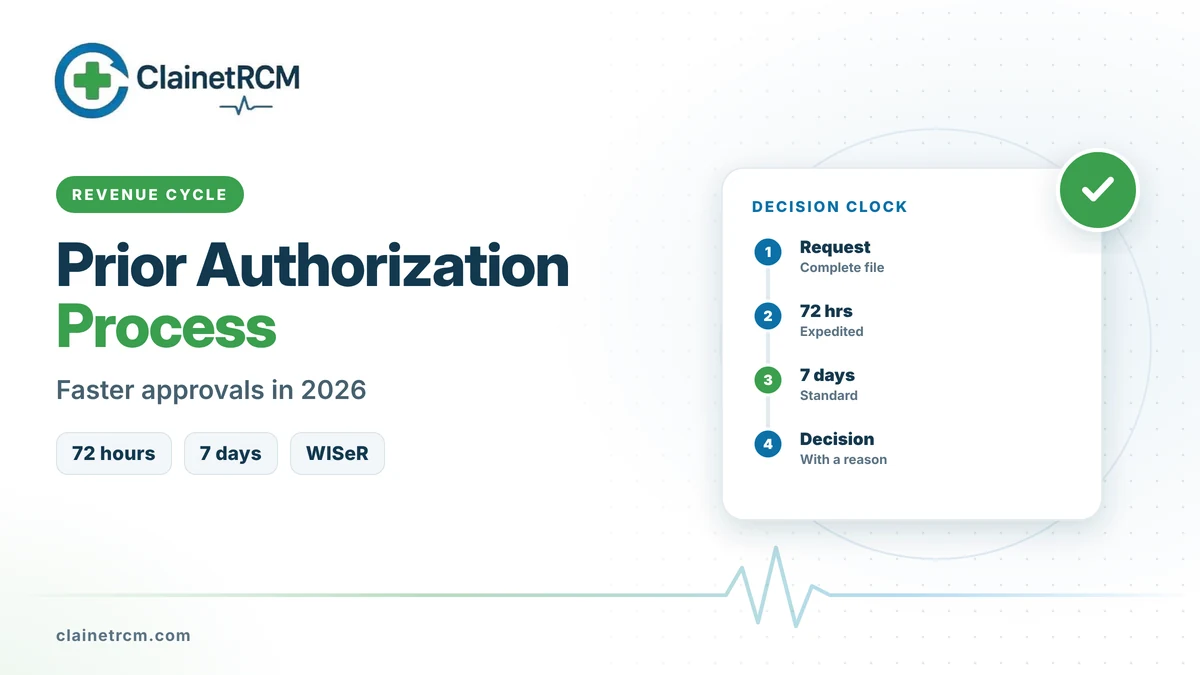
Quick answer: A strong prior authorization process has five steps: (1) identify which services need authorization when the order is placed, (2) gather documentation that meets the payer’s medical necessity criteria, (3) submit electronically through the payer’s portal or an electronic workflow, (4) track the decision and follow up, and (5) handle denials quickly with a peer-to-peer review or appeal. Under CMS-0057-F, Medicare Advantage, Medicaid and CHIP payers must decide expedited requests within 72 hours and standard requests within 7 calendar days, and give a specific denial reason. Original Medicare also began requiring prior authorization for selected services in six states under the WISeR model in 2026.
The Prior Authorization Process at a Glance
| Step | Goal | Owner |
|---|---|---|
| 1. Identify | Know which services need approval when they are ordered | Scheduling or authorization staff |
| 2. Document | Gather records that meet the payer’s criteria | Clinical team and authorization staff |
| 3. Submit | Send a complete request electronically | Authorization staff |
| 4. Track | Follow each request against its decision deadline | Authorization staff |
| 5. Resolve | Handle denials with peer-to-peer reviews or appeals | Physician and authorization staff |
Step 1: Know What Needs Authorization
- Maintain a current list of authorization requirements for your top payers and top services.
- Check requirements when the order is written, not the day before the procedure.
- Watch for changes: payers update their lists several times a year, and many large plans committed in 2025 to reduce the number of services that require authorization.
- Remember that the rendering provider, place of service and CPT codes must match what is approved.
Step 2: Build a Complete Request
Most denials and delays come from incomplete clinical information. A complete request includes:
- Diagnosis codes at the highest specificity
- CPT or HCPCS codes, units and dates requested
- Relevant history, exam findings and test results
- Prior treatments tried and their results, such as medications, physical therapy or injections
- How the request meets the payer’s published criteria, such as its clinical policy or an InterQual or MCG guideline
- Ordering and rendering provider details and the site of service
Step 3: Submit the Right Way
Electronic submission through the payer portal or an integrated electronic prior authorization tool is faster and creates a time-stamped record. Under CMS-0057-F, Medicare Advantage, Medicaid, CHIP and certain marketplace plans must offer a prior authorization API by January 1, 2027, which will let EHRs check requirements and submit requests directly.
Mark a request expedited only when waiting could seriously jeopardize the patient’s life, health or ability to regain maximum function. Payers apply that standard, and overusing it erodes credibility.
Step 4: Track Every Request
| Payer type | Standard decision deadline | Expedited decision deadline |
|---|---|---|
| Medicare Advantage, Medicaid and CHIP (CMS-0057-F, since January 1, 2026) | 7 calendar days | 72 hours |
| Commercial plans | Set by state law and plan policy | Set by state law and plan policy |
| Original Medicare programs, including WISeR | Set by the program | Set by the program |
Track each request in a log with the submission date, reference number, decision due date and status. Follow up the day a decision is due. Impacted payers must also publish their prior authorization metrics each year, which helps you compare their performance.
Step 5: Handle Denials Fast
- Read the denial reason. Since 2026, Medicare Advantage, Medicaid, CHIP and marketplace plans must give a specific reason, which tells you exactly what is missing.
- Request a peer-to-peer review. A conversation between the ordering physician and the payer’s medical director often resolves denials faster than a written appeal. Prepare a short summary of the key clinical facts.
- Resubmit with missing information when the denial was for incomplete documentation.
- Appeal when the payer misapplied its criteria. Include the payer’s own policy language and the clinical evidence that meets it.
What About Retro-Authorization?
Some payers allow retro-authorization for urgent or emergency services, or when the patient’s coverage was not known at the time of service. Most do not allow it for routine scheduled care. If a claim denies for missing authorization, such as CARC 197, check whether the payer accepts retro requests before appealing. Our CO-197 denial code guide covers the options.
The WISeR Model in Original Medicare
Original Medicare traditionally required prior authorization for only a few services, such as certain hospital outpatient procedures and some durable medical equipment. The Wasteful and Inappropriate Service Reduction (WISeR) model, which began January 1, 2026, adds technology-assisted prior authorization or prepayment review for a defined list of services in Arizona, New Jersey, Ohio, Oklahoma, Texas and Washington. Providers in those states can request prior authorization or accept prepayment medical review for listed services, such as skin substitutes, electrical nerve stimulators and knee arthroscopy. Approved requests are valid for 120 days. The model runs through 2031.
Gold Carding
Some states reward providers with high approval rates. Texas, for example, exempts physicians from certain prior authorization requirements when a plan has approved at least 90% of their requests for a service. Check whether your state has a gold-card law and whether you qualify.
Prior Authorization Metrics to Track
- Approval rate on first submission
- Average days from request to decision, by payer
- Denials by reason
- Authorization-related claim denials
- Peer-to-peer and appeal success rates
Frequently Asked Questions
Medicare Advantage, Medicaid and CHIP plans must decide standard requests within 7 calendar days and expedited requests within 72 hours. Commercial timelines depend on state law and plan policy.
A discussion between the ordering physician and the payer’s medical reviewer about a denied or pending request. It is often the fastest way to overturn a denial.
Sometimes. Some payers allow retro-authorization for urgent services or unknown coverage, but most do not for scheduled care.
For a limited set of services, and since 2026 for selected services in six WISeR states.
Usually the ordering or rendering provider’s office. Check each payer’s rules, since some require the facility to obtain it.
Final Thoughts
The prior authorization process rewards preparation: know what needs approval, submit complete requests and track every decision against the payer’s clock. Our prior authorization services team handles requests, follow-up and peer-to-peer scheduling, and our guide on how to reduce claim denials shows how authorization fits into a denial prevention strategy. Pair it with our insurance verification checklist.
Get Authorizations Approved Before the Patient Arrives
Our prior authorization team submits complete requests, tracks every decision clock, schedules peer-to-peer reviews and appeals denials.
Start Prior Authorization Support
Written by
ClainetRCM Billing Team
ClainetRCM is a Boston-based revenue cycle management company specializing in medical billing, coding, credentialing and denial management for healthcare providers across all 50 states. Our AAPC and AHIMA certified team works inside your existing EHR, files claims within 24 to 48 hours and reviews every AR bucket on a 14-day cycle.