Sleep study CPT codes fall into two groups: attended studies performed in a sleep lab and unattended home sleep apnea tests (HSATs). The home test codes are changing: CPT 2027 deletes the current HSAT codes and replaces them with six new codes that separate the technical work from the interpretation. This guide covers the codes in use through 2026, what changes on January 1, 2027, and the authorization and coverage rules that drive denials.
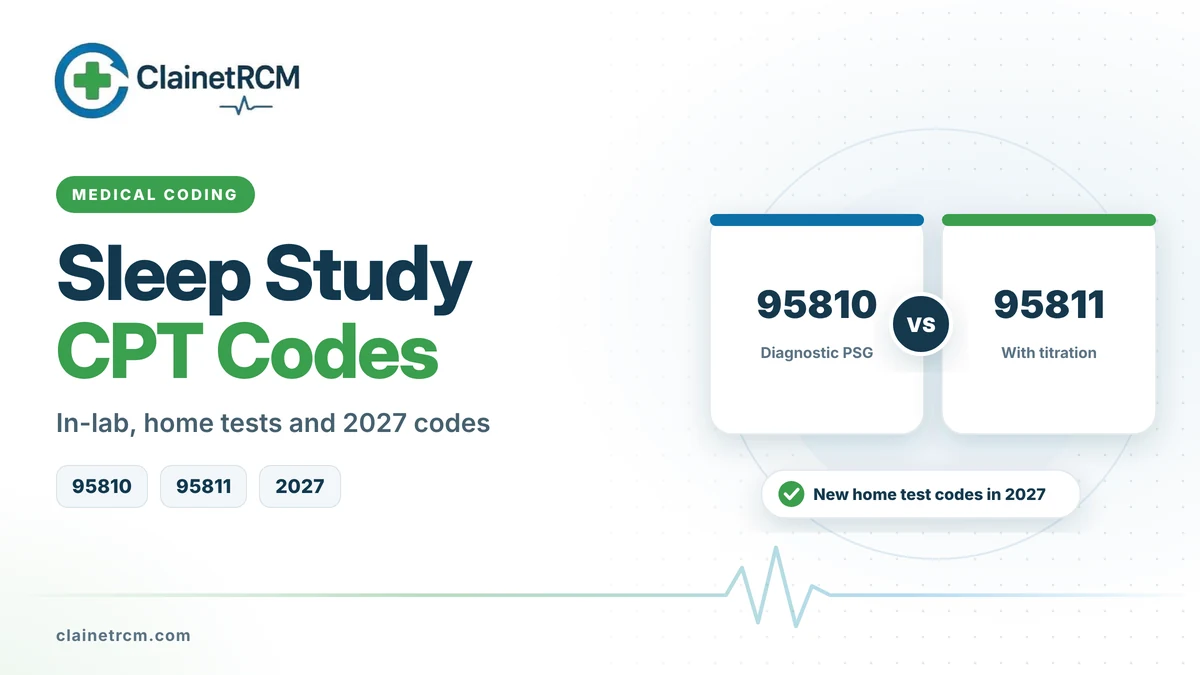
Quick answer: Report an in-lab diagnostic polysomnography with 95810 and a study with CPAP titration (including a split-night study) with 95811. Through December 31, 2026, home sleep apnea tests are reported with 95800, 95801 or 95806, or with HCPCS codes G0398, G0399 or G0400 when a payer requires them. Starting January 1, 2027, home tests use technical codes 95843, 95844 and 95846 and interpretation codes 95847, 95848 and 95849, chosen by study complexity. Many commercial and Medicare Advantage plans require prior authorization, especially for in-lab studies.
In-Lab Sleep Study CPT Codes
| Code | Description |
|---|---|
| 95810 | Polysomnography, age 6 or older, sleep staging with four or more additional parameters, attended |
| 95811 | Same as 95810 with initiation of CPAP or bilevel therapy and titration |
| 95782, 95783 | Polysomnography for children younger than 6, without and with titration |
| 95805 | Multiple sleep latency test or maintenance of wakefulness test |
| 95807 | Attended sleep study without sleep staging (ventilation, effort, heart rate and oxygen saturation) |
| 95808 | Polysomnography with one to three additional parameters |
A split-night study, where the diagnostic portion and CPAP titration happen the same night, is reported with 95811 only; 95810 and 95811 are not billed for the same night. When recording lasts less than six hours, append modifier 52 for reduced services.
Home Sleep Apnea Tests Through 2026
| Code | Description |
|---|---|
| 95806 | Unattended study recording heart rate, oxygen saturation, respiratory airflow and respiratory effort |
| 95800 | Unattended study recording heart rate, oxygen saturation, respiratory analysis and sleep time |
| 95801 | Unattended study recording at least heart rate, oxygen saturation and respiratory analysis |
| G0398 | Home sleep test with a type II portable monitor, at least 7 channels |
| G0399 | Home sleep test with a type III portable monitor, at least 4 channels |
| G0400 | Home sleep test with a type IV portable monitor, at least 3 channels |
Some Medicare contractors and commercial payers require the G codes, while others accept the CPT codes, so confirm each payer’s preference.
The 2027 Unattended Sleep Testing Codes
CPT 2027 deletes 95800, 95801 and 95806 and adds six codes that separate the technical service (setup, data acquisition and technical analysis) from the professional interpretation and report.
| Complexity | Channels and parameter categories | Technical code | Interpretation code |
|---|---|---|---|
| Low | 3 to 4 channels, at least 3 to 5 parameter categories | 95843 | 95847 |
| Moderate | 5 to 10 channels, at least 6 to 8 parameter categories | 95844 | 95848 |
| High | 11 or more channels, at least 9 parameter categories | 95846 | 95849 |
The complexity level is set by the lower of the channel count and the parameter categories. For 2027, CMS crosswalked 95843 and 95847 from 95800 and 95844 and 95848 from 95806. Update device mappings, templates and charge masters, and confirm whether each payer will keep accepting the G codes.
Prior Authorization and Coverage
- Prior authorization. Many commercial and Medicare Advantage plans require approval before an in-lab study and often before a home test. In-lab studies are usually approved when the patient has conditions such as significant cardiopulmonary or neuromuscular disease, suspected sleep disorders other than obstructive sleep apnea or a failed or inconclusive home test.
- Traditional Medicare. No prior authorization is required, but medical necessity must be documented.
- CPAP coverage. Medicare covers CPAP for obstructive sleep apnea with an apnea-hypopnea index of 15 or more, or 5 to 14 with documented symptoms or conditions such as hypertension, ischemic heart disease or history of stroke. Continued coverage requires use of at least four hours per night on 70% of nights during a 30-day period in the first three months, and a follow-up visit between days 31 and 91.
Professional and Technical Components
In-lab codes 95810 and 95811 have professional and technical components. A hospital-based sleep lab bills the technical portion, and the reading physician bills with modifier 26. Independent sleep centers that own the equipment and employ the interpreting physician bill globally.
Documentation Tips
- Record the clinical indication, such as witnessed apneas, daytime sleepiness, snoring and relevant comorbidities.
- For in-lab studies, document why a home test is not appropriate when the payer requires it.
- Include total recording time, sleep time and the scoring criteria used.
- For titration, record the pressures tested and the final recommended settings.
- For home tests, record the channels and parameters captured so the right complexity can be selected in 2027.
Diagnosis Coding
Use obstructive sleep apnea (G47.33) once it is diagnosed and specific symptom codes, such as snoring (R06.83) or hypersomnia, for a diagnostic study. Snoring alone does not support a titration study. For multiple sleep latency testing, document the suspected narcolepsy or hypersomnia.
Frequently Asked Questions
Code 95810 is a diagnostic in-lab polysomnography. Code 95811 adds CPAP or bilevel initiation and titration, including split-night studies.
Use 95806, 95800 or 95801 based on the channels recorded, or G0398, G0399 or G0400 when the payer requires G codes.
Starting January 1, 2027, home tests are reported with a technical code (95843, 95844 or 95846) and an interpretation code (95847, 95848 or 95849) based on complexity. CMS crosswalked 95806 to the moderate-complexity pair, 95844 and 95848.
Use modifier 52 when the recording time is less than six hours.
Traditional Medicare does not, but Medicare Advantage and commercial plans often do. Always verify before scheduling.
Final Thoughts
Sleep study CPT codes are changing in 2027, so this is the time to update device mappings and authorization workflows. Learn how we support sleep practices on our sleep medicine billing page, or read our specialty medical billing guide.
Get Sleep Studies Authorized and Paid
Our sleep medicine billing team handles prior authorizations, chooses the right in-lab and home test codes and is ready for the 2027 unattended testing codes.
Get Sleep Billing Help
Written by
ClainetRCM Billing Team
ClainetRCM is a Boston-based revenue cycle management company specializing in medical billing, coding, credentialing and denial management for healthcare providers across all 50 states. Our AAPC and AHIMA certified team works inside your existing EHR, files claims within 24 to 48 hours and reviews every AR bucket on a 14-day cycle.