How long must a Texas practice keep medical records? The short answer for physicians is seven years from the last treatment, and for minors until age 21 or seven years, whichever is longer. The full answer depends on who you are and whom you bill: hospitals keep records ten years, Texas Medicaid wants five years from the date of service or until audits close, Medicare wants ordering and certifying documentation for seven years, dentists and psychologists have their own boards' rules, and HIPAA adds a six-year rule for a different set of documents altogether.
This guide lays out the medical record retention requirements in Texas by provider type and payer, with the current rule citations (the Texas Medical Board rewrote its records chapter in 2025, and most online guides still cite the repealed one), plus the rules on copy fees, what happens when a physician leaves or a practice closes, and how to build a retention schedule that satisfies every rule at once.
Last updated: October 2026. This is general compliance information, not legal advice; confirm specifics with the current Texas Administrative Code and your counsel.
Key takeaways
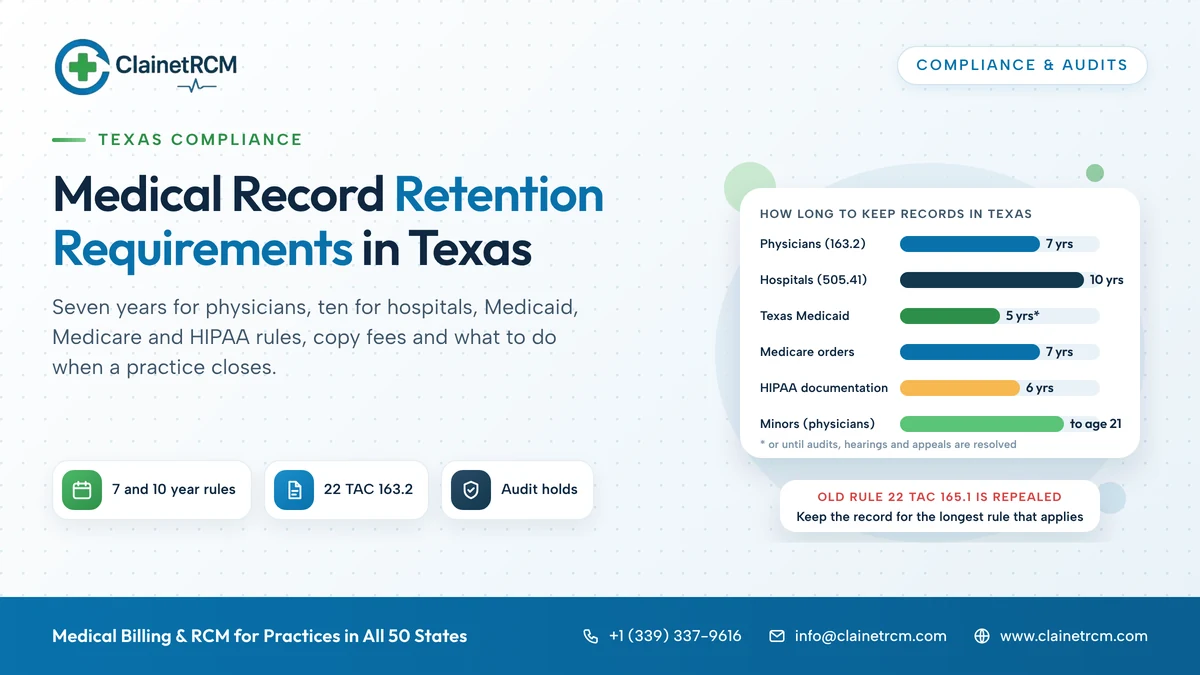
- Physicians: at least seven years from the date of last treatment, or until a minor patient turns 21 or seven years from last treatment, whichever is longer (22 TAC 163.2). The old rule, 22 TAC 165.1, was repealed when the Texas Medical Board adopted Chapter 163 in 2025.
- Hospitals: at least ten years, with minors' records kept until the later of the patient's 20th birthday or ten years after last treatment, imaging kept at least five years and sexual assault forensic exam records kept 20 years (26 TAC 505.41).
- Texas Medicaid: at least five years from the date of service, or until all audits, hearings, investigations and appeals are resolved (1 TAC 371.1667); freestanding rural health clinics six years, hospital-based RHCs ten.
- Medicare: ordering, certifying, referring and prescribing documentation for seven years from the date of service (42 CFR 424.516(f)). HIPAA requires six years for policies, procedures and compliance documentation, not for medical records themselves.
- When several rules apply, keep the record for the longest one. For most practices that means a ten-year default with a longer hold for minors and anything under audit or litigation.
Physicians: Texas Medical Board Rule 22 TAC 163.2
The Texas Medical Board's medical records rules now live in Chapter 163 of Title 22, adopted in the board's 2025 rule rewrite; Chapter 165, which most articles still cite, has been repealed. The retention rule is 22 TAC 163.2:
- The standard retention period is "at least seven years from the date of last treatment by the physician or longer if required by other federal or state law."
- For a patient under 18 at the time of treatment, the record must be kept "until the patient reaches age 21 years old or seven years from the date of last treatment, whichever is longer."
- Records may be retained by the physician or the physician's employer, including group practices, professional associations and non-profit health organizations, but access must be maintained for the full retention period.
- Records of sexual assault forensic examinations follow the separate requirement in Section 153.003 of the Medical Practice Act.
Three details trip practices up. The clock runs from the last treatment by that physician, so a long-standing patient's chart is continuously renewed; the rule is a floor, and payer, litigation and federal rules routinely require longer; and the obligation follows the record, so a practice that stores charts with a vendor or an employer remains responsible for access.
Retention Requirements by Provider Type
| Provider or setting | Adult records | Minor patients | Rule |
|---|---|---|---|
| Physicians (MD and DO) | At least 7 years from last treatment | Until age 21 or 7 years from last treatment, whichever is longer | 22 TAC 163.2 |
| Hospitals | At least 10 years; films and scans at least 5 years; sexual assault forensic exam records 20 years | Until the later of the 20th birthday or 10 years after last treatment | 26 TAC 505.41(j) (formerly 25 TAC 133.41) |
| Dentists | Not less than 5 years from last treatment | Until age 21 or 5 years from last treatment, whichever is longer | 22 TAC 108.8 |
| Psychologists | At least 7 years after termination of services | At least 5 years after the patient reaches the age of majority, if longer | 22 TAC 465.22 |
| Texas Medicaid providers (all types) | At least 5 years from the date of service, or until all audit questions, hearings, investigations, court cases and appeals are resolved | Same, plus the licensing board rule | 1 TAC 371.1667 |
| Rural health clinics billing Medicaid | Freestanding: 6 years; hospital-based: 10 years | Same | 1 TAC 371.1667 |
| Medicare providers and ordering physicians | Documentation of orders, certifications, referrals and prescriptions for 7 years from the date of service | Same | 42 CFR 424.516(f) |
| Medicare Advantage contracted providers | Records supporting MA claims for 10 years under the plan contract | Same | 42 CFR 422.504(d) and plan contracts |
| All HIPAA covered entities | Policies, procedures, risk analyses, authorizations, notices and other compliance documentation for 6 years from creation or last effective date | Not a medical record rule | 45 CFR 164.316(b)(2) and 164.530(j) |
Other Texas licensing boards (nursing, chiropractic, physical therapy, counseling, pharmacy) set their own periods, and facility licenses such as ambulatory surgical centers and nursing facilities carry rules in Title 26. The practical approach is to identify every license and payer that touches a record, list each rule, and keep the record for the longest.
Hospitals: 26 TAC 505.41
Texas hospital licensing rules moved from Title 25 to Title 26 in January 2025, so the hospital medical records requirements formerly at 25 TAC 133.41 are now at 26 TAC 505.41. The medical record services subsection requires hospitals to keep records in original or legally reproduced form for at least ten years; to keep image records such as films and scans for at least five years; to keep records of patients under 18 until the later of the patient's 20th birthday or the tenth anniversary of last treatment; to keep sexual assault forensic examination records until the 20th anniversary of the record's creation; and never to destroy records related to pending litigation. Patients must receive written notice, no later than the date of treatment except in emergencies, that the hospital may dispose of records after the retention period. On closure, a hospital must notify the Health and Human Services Commission of where its records will be stored and who the custodian is.
Payer Rules: Medicaid, Medicare and HIPAA
Texas Medicaid (1 TAC 371.1667)
Texas Medicaid providers must keep records and documentation for a minimum of five years from the date of service, or until all audit questions, administrative hearings, investigations, court cases or appeals are resolved, whichever is later. Freestanding rural health clinics keep records six years and hospital-based rural health clinics ten. Failure to keep or produce records, or to give the HHSC Office of Inspector General timely access, is grounds for administrative actions and sanctions, including recoupment. Note the correct citation: many sites cite 371.1653, which is a different section.
Medicare (42 CFR 424.516(f))
Providers and suppliers that furnish Part A or Part B services, items or drugs that were ordered, certified, referred or prescribed, and the physicians and eligible professionals who did the ordering, must keep the written and electronic documentation for seven years from the date of service, including the NPI of the ordering or prescribing practitioner, and must produce it to CMS or a Medicare contractor on request. Medicare Advantage contracts impose a ten-year record retention requirement on plans and their downstream providers. Our specialty billing teams build these holds into charge documentation for exactly this reason.
HIPAA (45 CFR 164.316 and 164.530)
HIPAA does not set a retention period for medical records; state law does. What HIPAA requires is that covered entities keep their privacy and security documentation (policies and procedures, risk analyses, training records, business associate agreements, authorizations, notices of privacy practices and the like) for six years from the date of creation or the date it was last in effect, whichever is later. Practices that keep medical records for seven years and compliance documentation for six satisfy both.
Patient Requests and Copy Fees (22 TAC 163.3)
Retention and access go together. Under 22 TAC 163.3, a physician must provide records within 15 days of a proper written request under Section 159.005 of the Medical Practice Act, and may not deny the request because the patient has an unpaid balance or require a subpoena for a proper request. The maximum charges are:
| Record type | Maximum fee |
|---|---|
| Paper records | $25.00 for the first 20 pages, plus $0.50 per page after that |
| Electronic records | $25.00 for 500 pages or fewer; $50.00 for more than 500 pages |
| Hybrid paper and electronic records | A separate fee may be charged for each format, including diagnostic studies |
| Affidavit | $15.00 if requested |
| Narrative in lieu of records | $20.00 |
| Postage | Actual cost |
Diagnostic imaging requests must specify whether the requester wants a copy or the original study. Federal HIPAA rules on patient access, including the right to electronic copies and the limit to a reasonable, cost-based fee for patient requests, apply alongside the Texas maximums, so practices generally charge patients the lower of the two.
When a Physician Leaves, Retires or Dies (22 TAC 163.4 and 163.5)
Retention duties do not end when a physician leaves a practice. Under 22 TAC 163.4, on retirement, termination of employment or leaving a practice, patients seen by the departing physician in the last two years must be notified by letter or email, and a notice must be posted in a conspicuous place in the office and on the practice website at least 30 days before the departure. The notice must state the date of departure, how patients can obtain or transfer their records, the name and location of the new practice if any, and the name of the new record custodian if ownership of the records is changing. The practice must give the departing physician a list of patients seen in the last two years and may not interfere with the notices. Locum tenens physicians at a location for less than six months and physicians who practiced only in hospitals, emergency rooms, birthing centers or ambulatory surgery centers, or who provided only anesthesia, radiology or pathology services, are exempt. When a license is surrendered or revoked, notice must be immediate.
Under 22 TAC 163.5, when a physician dies or becomes incapacitated, a record custodian (the estate's administrator or executor, a court-appointed individual, a person holding power of attorney or a legal representative, unless a group practice or pre-existing arrangement covers it) takes over. The custodian must keep the records confidential, notify the Texas Medical Board and patients within 30 days of appointment (by notice at the office, on the website or in the newspaper of greatest circulation in the county), and keep the records for at least 90 days before any destruction, with the 30-day notice period counting toward the 90. The notice must give the custodian's contact details, how to obtain or transfer records, the applicable fees including a $25 custodial fee where it applies, and the destruction date.
Building a Retention Schedule That Satisfies Every Rule
A practice rarely falls under one rule. A Texas family medicine group that bills Medicare, Medicaid managed care and commercial plans, and treats children, is subject to the Medical Board's seven-year rule, Medicaid's five-years-or-until-audits-close rule, Medicare's seven-year ordering documentation rule, Medicare Advantage's ten-year contract requirement and HIPAA's six-year documentation rule at the same time. The schedule that satisfies all of them:
- Default retention of ten years from the last date of service for every patient record, which covers the Medical Board, Medicaid, Medicare and Medicare Advantage rules in one policy.
- Minors: until the later of age 21 and ten years from last treatment. Flag the birth date in the system so the hold is automatic.
- Litigation, audit and investigation holds that suspend destruction for any record under a payer audit, OIG inquiry, subpoena or claim until the matter is finally resolved.
- Compliance documentation for six years under HIPAA: policies, risk analyses, business associate agreements, training logs, authorizations and breach records.
- Billing records tied to the clinical record. Claims, remittances, eligibility responses and authorizations should follow the same retention as the chart they support, because a payer audit asks for both. Our medical billing workflows store claim and remittance data for the full period.
- Documented destruction. Destroy records only on a written schedule, by a method that preserves confidentiality, with a log of what was destroyed and when, and never while a hold is in place.
- Custodian and departure procedures written in advance, with the notice templates required by 22 TAC 163.4 and 163.5 ready to use.
Electronic Records, Vendors and Business Associates
Electronic health records do not change the retention periods, but they change who holds the record. If an EHR or billing vendor stores your records, the business associate agreement must require the vendor to keep them for your retention period, to return them in a usable format at termination and to make them available for patient requests and audits. A practice that changes EHR vendors must plan the export of the legacy records for the remaining retention period before the old system is switched off; the Medical Board's rule that "providers must maintain access to medical records for the duration of the required retention period" applies regardless of which vendor holds them. Our guide to types of medical billing systems covers the data ownership questions to settle before signing with any vendor, and the Texas medical billing page covers how we support practices across the state.
What Happens If Records Are Not Kept
Failure to keep or produce records exposes a Texas practice on several fronts at once: Texas Medical Board discipline under the Medical Practice Act; Medicaid administrative actions, sanctions and recoupment under 1 TAC 371.1667 when the OIG cannot obtain records to support paid claims; Medicare overpayment recovery and possible revocation of billing privileges under 42 CFR 424.535 when ordering documentation is unavailable; and HIPAA enforcement where compliance documentation is missing. In audits, a claim without a supporting record is treated as unsupported and recouped, which is why billing and clinical retention schedules have to match.
Keep Every Claim Audit-Ready
ClainetRCM keeps claims, remittances, eligibility responses and authorizations tied to the encounter for the full retention period, so a Medicaid, Medicare or commercial audit request is answered with the record, not a search. From 2.29 percent of collections, no setup fee, no long-term contract.
Request a Free Revenue AuditFrequently Asked Questions
At least seven years from the date of last treatment by the physician, or longer if required by other federal or state law, under Texas Medical Board rule 22 TAC 163.2. For a patient who was under 18 at the time of treatment, records must be kept until the patient reaches age 21 or for seven years from the last treatment, whichever is longer. The former rule, 22 TAC 165.1, was repealed when Chapter 163 was adopted in 2025.
At least ten years under 26 TAC 505.41. Records of patients under 18 may not be disposed of until the later of the patient's 20th birthday or ten years after the last treatment, image records such as films and scans must be kept at least five years, sexual assault forensic examination records must be kept 20 years, and records related to pending litigation may not be destroyed until the matter is resolved. The rule was formerly at 25 TAC 133.41.
Under 1 TAC 371.1667, Texas Medicaid providers must keep records for a minimum of five years from the date of service, or until all audit questions, administrative hearings, investigations, court cases or appeals are resolved, whichever is later. Freestanding rural health clinics must keep records six years and hospital-based rural health clinics ten. Failure to keep or produce records is grounds for administrative actions, sanctions and recoupment.
No. HIPAA does not set a retention period for medical records; state law and payer rules do. HIPAA's six-year requirement (45 CFR 164.316(b)(2) and 164.530(j)) applies to privacy and security documentation such as policies and procedures, risk analyses, business associate agreements, authorizations and training records, measured from the date of creation or the date the document was last in effect.
Under 42 CFR 424.516(f), providers and suppliers that furnish ordered, certified, referred or prescribed Part A or Part B services, and the physicians who order, certify, refer or prescribe them, must keep the related documentation for seven years from the date of service and produce it to CMS or a Medicare contractor on request. Medicare Advantage contracts require records supporting plan claims to be kept for ten years.
Under 22 TAC 163.3, no more than $25.00 for the first 20 pages of paper records plus $0.50 per page after that; $25.00 for electronic records of 500 pages or fewer or $50.00 for more than 500 pages; $15.00 for an affidavit; $20.00 for a narrative in lieu of records; and actual postage. Records must be provided within 15 days of a proper request, and a request cannot be refused because of an unpaid balance.
Under 22 TAC 163.4, notify patients seen in the last two years by letter or email, post a notice in the office and on the practice website at least 30 days before leaving, and state the departure date, how to obtain or transfer records, the new practice location if any, and the new record custodian if ownership of the records is changing. The practice must supply the list of patients and may not interfere. Locum tenens physicians at a site under six months and physicians who practiced only in hospitals, emergency rooms, birthing centers or surgery centers, or only in anesthesia, radiology or pathology, are exempt.
Under 22 TAC 163.5, a record custodian (the estate's executor or administrator, a court-appointed individual, a holder of a power of attorney or a legal representative, unless a group practice or prior arrangement applies) takes responsibility, must notify the Texas Medical Board and patients within 30 days of appointment, must keep the records at least 90 days before any destruction, and must tell patients how to obtain their records, the applicable fees including any $25 custodial fee, and the planned destruction date.
The Bottom Line
Texas medical record retention comes down to one principle: keep the record for the longest rule that applies. For physicians that is at least seven years from last treatment, or until a minor turns 21; for hospitals ten years; for Medicaid five years or until audits close; for Medicare ordering documentation seven years; and for HIPAA compliance documentation six years. A ten-year default with a minors hold, audit and litigation holds, written custodian and departure procedures and a documented destruction schedule satisfies all of them, and it keeps every claim you have billed supportable for as long as a payer can ask about it.

Written by
ClainetRCM Billing Team
ClainetRCM is a Boston-based revenue cycle management company specializing in medical billing, coding, credentialing and denial management for healthcare providers across all 50 states. Our AAPC and AHIMA certified team works inside your existing EHR, files claims within 24 to 48 hours and reviews every AR bucket on a 14-day cycle.