The ICD-10 code for anxiety depends on what the clinician actually documents. “Anxiety” in a problem list codes differently from generalized anxiety disorder, panic disorder or an adjustment disorder with anxious mood. Choosing the most specific code supports medical necessity for therapy and medication management and keeps claims consistent with the record.
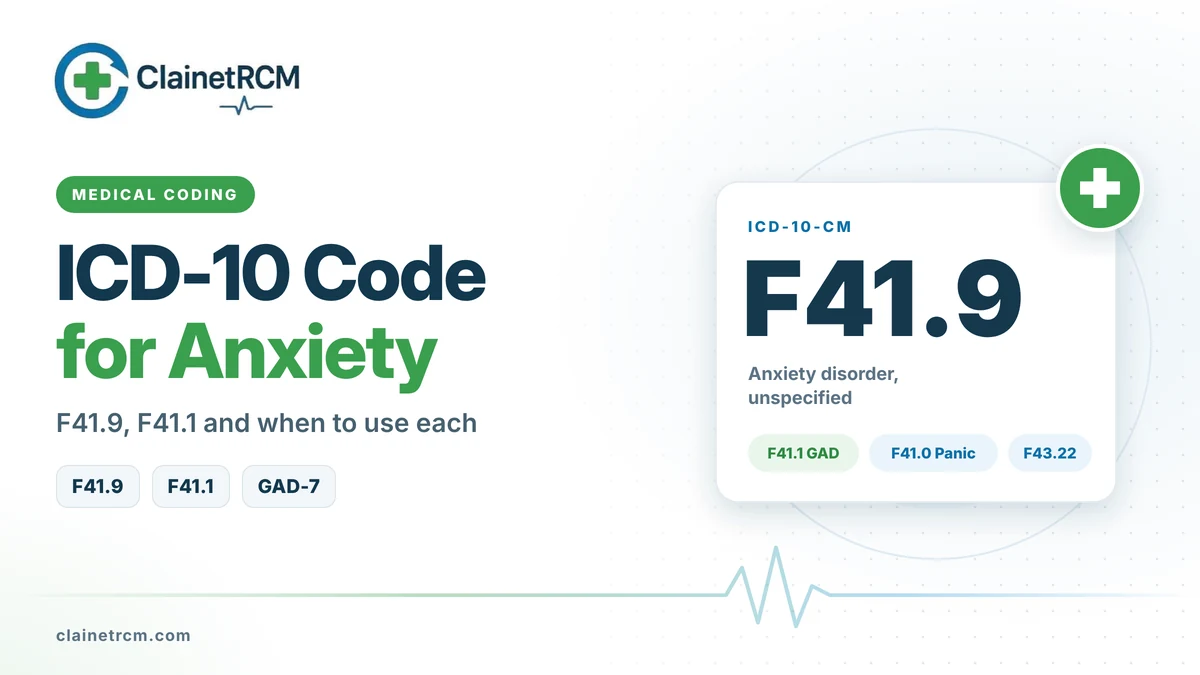
Quick answer: Use F41.9 (anxiety disorder, unspecified) when the documentation says only “anxiety” or “anxiety disorder.” Use F41.1 (generalized anxiety disorder) when the clinician diagnoses GAD. Other common choices are F41.0 (panic disorder), F41.8 (other specified anxiety disorders, including mixed anxiety and depressive disorder), F43.22 (adjustment disorder with anxiety) and F06.4 (anxiety disorder due to a known physiological condition). Use Z13.39 when you screen for anxiety without a diagnosis. Neither the FY2026 nor the FY2027 ICD-10-CM update changed these codes.
ICD-10 Code for Anxiety: The Main Options
| Code | Description | Use when the documentation shows |
|---|---|---|
| F41.9 | Anxiety disorder, unspecified | “Anxiety” or “anxiety disorder” without further detail |
| F41.1 | Generalized anxiety disorder | A GAD diagnosis |
| F41.0 | Panic disorder (episodic paroxysmal anxiety) | Recurrent unexpected panic attacks diagnosed as panic disorder |
| F41.3 | Other mixed anxiety disorders | Mixed anxiety disorders not classified elsewhere |
| F41.8 | Other specified anxiety disorders | Specified anxiety disorders, including mixed anxiety and depressive disorder |
| F40.10 | Social phobia, unspecified | Social anxiety disorder |
| F40.00 | Agoraphobia, unspecified | Agoraphobia |
| F43.22 | Adjustment disorder with anxiety | Anxiety in response to an identifiable stressor that meets adjustment disorder criteria |
| F43.23 | Adjustment disorder with mixed anxiety and depressed mood | Both anxious and depressed mood after a stressor |
| F06.4 | Anxiety disorder due to known physiological condition | Anxiety caused by a medical condition, such as hyperthyroidism |
| F93.0 | Separation anxiety disorder of childhood | Separation anxiety in a child |
F41.9 vs F41.1: Which One Fits?
F41.9 is the default when a provider documents anxiety without specifying the type. It is a valid, billable code and is appropriate early in care, in primary care visits where the full picture is not yet clear, or when symptoms do not fit a specific disorder.
F41.1 requires a diagnosis of generalized anxiety disorder. Under DSM-5-TR, GAD involves excessive anxiety and worry on more days than not for at least six months, difficulty controlling the worry, and at least three of six associated symptoms such as restlessness, fatigue, poor concentration, irritability, muscle tension or sleep disturbance in adults. When the clinician documents those findings and names the disorder, code F41.1 rather than F41.9.
Coders should not upgrade F41.9 to F41.1 on their own. If the documentation suggests GAD but does not state it, query the provider.
Other Anxiety-Related Codes to Know
- Panic disorder: F41.0. A panic attack within another disorder is not coded as panic disorder.
- Phobias: F40.00 to F40.02 for agoraphobia, F40.10 and F40.11 for social phobia, and F40.2- codes for specific phobias.
- Obsessive-compulsive disorder: F42.- codes, which ICD-10-CM classifies separately from anxiety disorders.
- PTSD: F43.10 (unspecified), F43.11 (acute) and F43.12 (chronic).
- Illness anxiety disorder: F45.21.
- Substance-induced anxiety: combination codes in F10 to F19, such as F10.180 for alcohol abuse with alcohol-induced anxiety disorder.
- Anxiety during pregnancy: an O99.34- code for mental disorders complicating pregnancy, followed by the specific F code.
Anxiety With Depression
When a patient has both a documented anxiety disorder and a documented depressive disorder, code both, for example F41.1 with F33.1. Reserve F41.8 for mixed anxiety and depressive disorder when the clinician documents that combined diagnosis, typically when symptoms of both are present but neither is severe enough to diagnose separately. Our guide to the ICD-10 code for depression covers the depression side in detail.
Documentation That Supports the Code
- The specific disorder, not just the symptom
- Duration and frequency of symptoms
- Functional impact at work, school or home
- Screening or monitoring scores, such as the GAD-7
- Contributing medical conditions or substances
- The treatment plan: therapy, medication or referral
Anxiety codes do not map to a payment HCC in Medicare’s V28 risk adjustment model, but they still drive medical necessity for every behavioral health service billed with them.
Pairing Anxiety Codes With CPT Codes
| Service | Common CPT codes | Diagnosis |
|---|---|---|
| Intake evaluation | 90791 or 90792 | Working or confirmed anxiety diagnosis |
| Psychotherapy | 90832, 90834, 90837 | F41.1, F41.9 or other specific code |
| Medication management | 99213 or 99214, plus psychotherapy add-ons when performed | The anxiety disorder being treated |
| Screening | 96127 per instrument | Z13.39, or the known diagnosis when monitoring |
| Integrated care | 99484 or CoCM codes | The behavioral health condition being managed |
For screening details, see our guide to CPT code 96127.
Coding Examples
- A primary care note says “anxiety, start sertraline, recheck in six weeks.” Code F41.9.
- A psychologist documents six months of uncontrollable worry with poor sleep, irritability and muscle tension, and diagnoses generalized anxiety disorder. Code F41.1.
- A patient develops anxiety and insomnia after a job loss, and the clinician diagnoses an adjustment disorder with anxiety. Code F43.22.
- A patient with untreated hyperthyroidism has anxiety the provider attributes to the thyroid disease. Code the thyroid condition and F06.4.
Frequently Asked Questions
F41.9 is the code for anxiety disorder, unspecified. Use a more specific code, such as F41.1 for generalized anxiety disorder, when the clinician documents it.
Yes. F41.9 is valid and billable, although payers may expect a more specific diagnosis as treatment continues.
Code each documented disorder separately, such as F41.1 and F33.1. Use F41.8 only when the clinician documents mixed anxiety and depressive disorder.
Panic disorder is F41.0. Isolated panic attacks within another condition are captured by that condition’s code.
Z13.39, encounter for screening examination for other mental health and behavioral disorders, when no diagnosis is made.
Final Thoughts
The right ICD-10 code for anxiety is the most specific one the documentation supports: F41.9 when the type is not stated, F41.1 for generalized anxiety disorder, and the related codes above when another disorder fits better. Our mental health billing team audits behavioral health diagnosis coding, and our medical coding services cover every specialty. For a pediatric example, read our guide to oppositional defiant disorder ICD-10 coding.
Code Behavioral Health Diagnoses With Confidence
Our certified coders review mental health documentation and diagnosis codes so claims match the record and payer policies.
Get a Coding Audit
Written by
ClainetRCM Billing Team
ClainetRCM is a Boston-based revenue cycle management company specializing in medical billing, coding, credentialing and denial management for healthcare providers across all 50 states. Our AAPC and AHIMA certified team works inside your existing EHR, files claims within 24 to 48 hours and reviews every AR bucket on a 14-day cycle.