The ICD-10 code for depression is not one code. ICD-10-CM separates nonspecific depression from major depressive disorder, single episodes from recurrent ones, and mild, moderate and severe episodes from those in remission. Those details decide whether a claim supports treatments such as TMS and Spravato, and whether the diagnosis counts in Medicare risk adjustment.
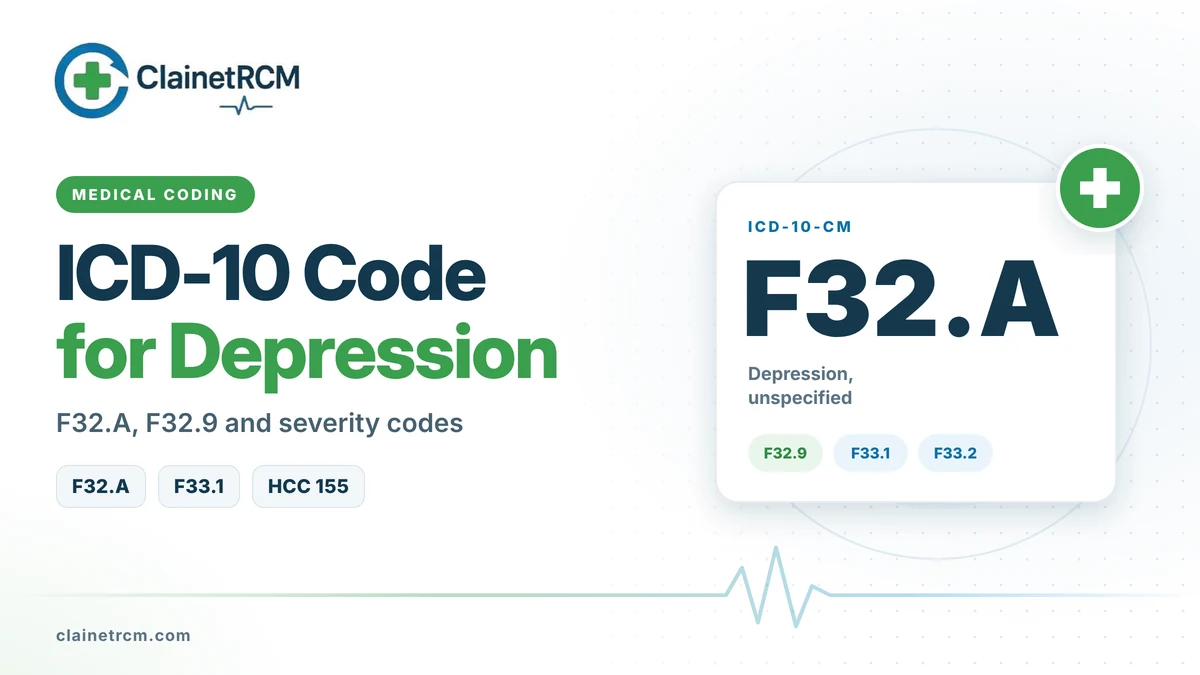
Quick answer: Use F32.A (depression, unspecified) when the provider documents only “depression.” Use F32.9 for major depressive disorder, single episode, unspecified, and F33.9 for recurrent MDD, unspecified. When severity is documented, use the specific codes, such as F32.1 or F33.1 for moderate and F32.2 or F33.2 for severe without psychotic features. Payers that cover TMS and Spravato usually expect a specific major depressive disorder code with severity, and only moderate or severe MDD codes map to HCC 155 under Medicare’s V28 model.
ICD-10 Code for Depression: Full Code Table
| Code | Description |
|---|---|
| F32.A | Depression, unspecified |
| F32.0 | MDD, single episode, mild |
| F32.1 | MDD, single episode, moderate |
| F32.2 | MDD, single episode, severe without psychotic features |
| F32.3 | MDD, single episode, severe with psychotic features |
| F32.4 | MDD, single episode, in partial remission |
| F32.5 | MDD, single episode, in full remission |
| F32.9 | MDD, single episode, unspecified |
| F33.0 | MDD, recurrent, mild |
| F33.1 | MDD, recurrent, moderate |
| F33.2 | MDD, recurrent, severe without psychotic features |
| F33.3 | MDD, recurrent, severe with psychotic symptoms |
| F33.40 | MDD, recurrent, in remission, unspecified |
| F33.41 | MDD, recurrent, in partial remission |
| F33.42 | MDD, recurrent, in full remission |
| F33.9 | MDD, recurrent, unspecified |
F32.A vs F32.9 vs F33.9
These three codes cause the most confusion:
- F32.A is for depression documented without a diagnosis of major depressive disorder. ICD-10-CM indexes “depression NOS” here. It became available in October 2021, and before that many practices used F32.9 for plain “depression.”
- F32.9 is for major depressive disorder, single episode, when severity is not documented.
- F33.9 is for recurrent major depressive disorder when severity is not documented.
None of the three is wrong when it matches the documentation. The problem is using them when the record actually supports a more specific code. If a note says “MDD, recurrent, moderate,” the correct code is F33.1, not F33.9.
Single Episode, Recurrent, Severity and Remission
- Episode. F32 codes are for a single episode; F33 codes are for recurrent major depressive disorder.
- Severity. Mild, moderate and severe are clinical judgments. PHQ-9 scores support them: 5 to 9 suggests mild, 10 to 14 moderate, 15 to 19 moderately severe and 20 to 27 severe symptoms. The clinician’s documented severity, not the score alone, drives the code.
- Psychotic features. F32.3 and F33.3 apply only when psychotic features are documented.
- Remission. Use F32.4 or F32.5, or F33.41 or F33.42, when the clinician documents partial or full remission.
Other Depressive Disorder Codes
| Code | Description |
|---|---|
| F34.1 | Dysthymic disorder (persistent depressive disorder) |
| F34.81 | Disruptive mood dysregulation disorder |
| F32.81 | Premenstrual dysphoric disorder |
| F32.89 | Other specified depressive episodes |
| F43.21 | Adjustment disorder with depressed mood |
| F53.0 | Postpartum depression |
| F06.31, F06.32 | Depressive disorder due to a known physiological condition |
| F31.3- to F31.5 | Bipolar disorder, current episode depressed |
If a patient has bipolar disorder, the current depressive episode is coded in category F31, not F32 or F33.
Why Specificity Matters
TMS and Spravato coverage. Payers that cover transcranial magnetic stimulation generally require major depressive disorder, often moderate to severe and documented as resistant to prior treatment. Spravato prior authorizations expect an MDD diagnosis with documentation of treatment-resistant depression or the other FDA-approved indication. A claim with F32.A or F32.9 rarely satisfies those policies. Our guides to TMS CPT codes and the Spravato CPT code explain the full requirements.
No code for treatment-resistant depression. ICD-10-CM has no specific code for treatment-resistant depression. Document the medication trials, doses, durations and responses, and code the MDD episode with its severity.
Risk adjustment. In the CMS-HCC V28 model, F32.1, F32.2, F33.1 and F33.2 map to HCC 155 (major depression, moderate or severe, without psychosis), and codes with psychotic features map to a different HCC. Mild, unspecified and in-remission codes, including F32.9, F33.9 and F32.A, do not map to a payment HCC.
Coding Examples
- A primary care note reads “depression, continue sertraline.” Code F32.A.
- A psychiatrist documents “major depressive disorder, recurrent, severe without psychotic features” with a PHQ-9 of 22. Code F33.2.
- A patient with recurrent MDD has had no significant symptoms for several months, and the psychiatrist documents “MDD, recurrent, in partial remission.” Code F33.41.
- A new mother is diagnosed with postpartum depression. Code F53.0, plus the appropriate pregnancy or puerperium code when required.
Documentation Tips for Providers
A short checklist helps providers document depression in a way that supports the most accurate code:
- Name the disorder. “Major depressive disorder” rather than “depressed mood” when the criteria are met.
- State the episode. Single episode or recurrent.
- State the severity. Mild, moderate or severe, and whether psychotic features are present.
- Update remission status. Partial or full remission once symptoms improve.
- Record scores. Include the PHQ-9 or another validated scale at each visit when used.
- List treatment history. Medication names, doses, durations and responses, which payers review for TMS and Spravato.
Coders should query the provider when the record suggests more specificity than the assessment states, rather than assigning severity themselves.
Frequently Asked Questions
F32.A when only “depression” is documented. For major depressive disorder, use F32 (single episode) or F33 (recurrent) codes with the documented severity.
Use F32.A for depression without an MDD diagnosis, and F32.9 for major depressive disorder, single episode, without documented severity.
F33.2 without psychotic features, or F33.3 with psychotic symptoms.
Z13.31, encounter for screening for depression, when no diagnosis results. Screening instruments are billed with CPT code 96127.
Not under the CMS-HCC V28 model. Only moderate or severe major depression codes map to HCC 155.
Final Thoughts
The right ICD-10 code for depression is the most specific one the documentation supports. Encourage providers to document episode, severity, psychotic features and remission status, and code exactly that. Our mental health billing team audits depression coding for therapy, medication management and interventional psychiatry. For related coding, read our guides to the ICD-10 code for anxiety and CPT code 96127.
Get Depression Coding Right for Every Payer
We review depression documentation and diagnosis codes so therapy, medication management, TMS and Spravato claims meet payer requirements.
Get a Coding Review
Written by
ClainetRCM Billing Team
ClainetRCM is a Boston-based revenue cycle management company specializing in medical billing, coding, credentialing and denial management for healthcare providers across all 50 states. Our AAPC and AHIMA certified team works inside your existing EHR, files claims within 24 to 48 hours and reviews every AR bucket on a 14-day cycle.