CPT code 96127 is one of the most under-billed codes in primary care and pediatrics. Practices administer depression, anxiety and ADHD questionnaires every day, but many never bill for them, or bill them in ways that deny. Each payment is small, but across a full panel of well visits and follow-ups it adds up quickly.
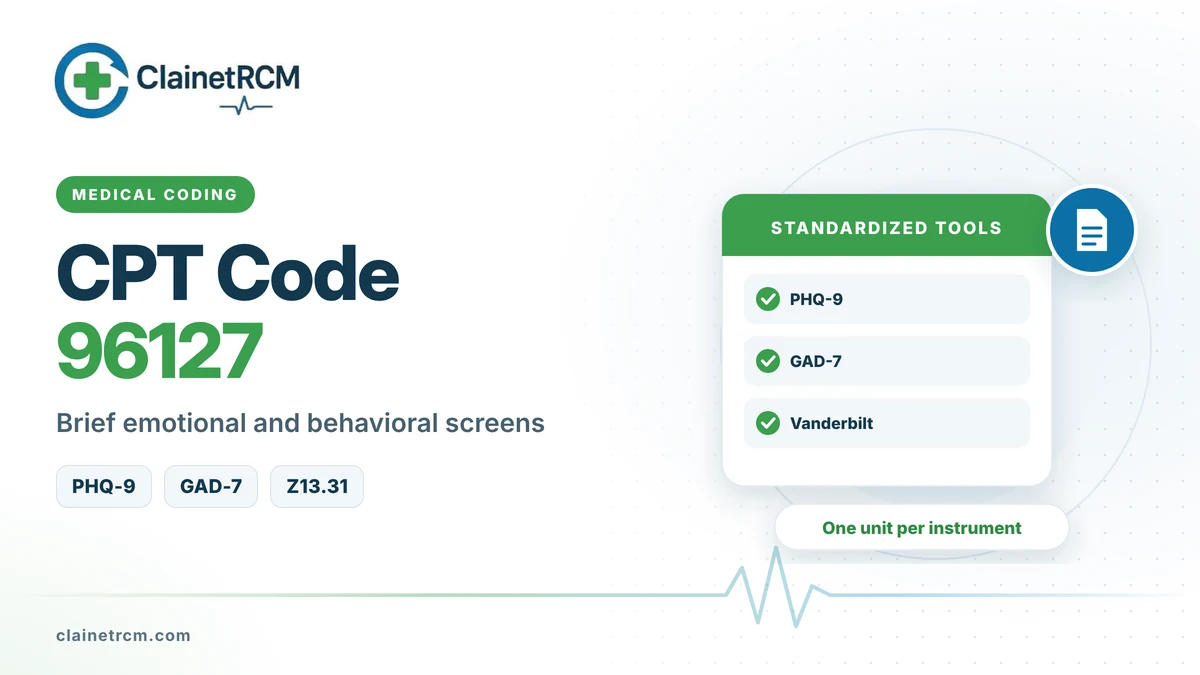
Quick answer: CPT code 96127 is a brief emotional or behavioral assessment with scoring and documentation, billed per standardized instrument. Examples include the PHQ-9, GAD-7 and Vanderbilt ADHD rating scales. Bill one unit for each different instrument. Medicare’s medically unlikely edit for 96127 is commonly cited as three units per day, and the 2026 Medicare rate is about $5 per unit. Pair it with a screening code such as Z13.31 (depression) or Z13.39 (other mental health conditions), or with the diagnosis being monitored, and document the instrument, the score and what you did with the result.
What CPT Code 96127 Covers
96127 describes the administration, scoring and documentation of a standardized instrument that measures emotional or behavioral symptoms. The instrument must be validated; a few open-ended questions in the history do not qualify. The code applies to patients of any age and can be used for both screening and ongoing measurement of a known condition.
Common instruments billed with 96127 include:
- PHQ-9 and PHQ-A for depression
- GAD-7 and SCARED for anxiety
- Vanderbilt and similar rating scales for ADHD
- Pediatric Symptom Checklist (PSC-17) for general behavioral health in children
96127 vs Related Screening Codes
| Code | What it describes | Typical example |
|---|---|---|
| 96127 | Brief emotional or behavioral assessment of the patient, per instrument | PHQ-9 at a depression follow-up |
| 96110 | Developmental screening, per instrument | ASQ or M-CHAT at an 18-month well-child visit |
| 96161 | Caregiver-focused health risk assessment for the benefit of the patient | Maternal depression screening at an infant’s well-child visit |
| 96160 | Patient-focused health risk assessment | General health risk questionnaire |
| G0444 | Medicare annual depression screening, 5 to 15 minutes | Depression screen in primary care for a Medicare patient |
Choosing the right code matters. A postpartum depression screen of the mother at the baby’s visit is 96161, not 96127, because the instrument assesses the caregiver.
Units and Payer Limits
- One unit per instrument. Two different instruments on the same day are two units. The same instrument twice on the same day is still one unit.
- Daily limits. Medicare’s MUE is commonly cited as three units per date of service. Many commercial plans pay two to four units, and some Medicaid programs and Medicare contractors pay fewer.
- Line format. Some payers want all units on one line; others want each instrument on its own line with modifier 59 or an X modifier on the additional lines. Follow each payer’s instructions.
- Bundling. Some payers bundle 96127 into psychiatric evaluations or psychotherapy on the same day. Check edits before billing it with 90791 or a psychotherapy code.
ICD-10 Pairing for 96127
| Situation | Diagnosis coding |
|---|---|
| Screening during a well-child visit | Z00.121 or Z00.129 first, then Z13.31 or Z13.39 |
| Screening an adult with no known condition | Z13.31 for depression or Z13.39 for other mental health conditions |
| Monitoring a diagnosed condition | The condition itself, such as F33.1 or F41.1 |
| Positive screen leading to a new diagnosis | The new diagnosis, with the screening code as appropriate |
Our guides to the ICD-10 code for anxiety and the ICD-10 code for depression explain how to choose the condition codes.
Documentation Requirements
For each unit, the record should show:
- The name of the instrument
- Who administered it (patient self-report, parent or teacher form)
- The score
- The clinician’s interpretation
- The action taken, such as reassurance, referral, a medication change or follow-up
A scanned questionnaire with no interpretation in the note is a common reason for recoupment on audit.
Billing Examples
Adolescent well visit. A 15-year-old completes the PHQ-A and a GAD-7. The physician reviews both, notes negative results and documents anticipatory guidance. Bill the preventive visit code plus 96127 x 2, with Z00.129, Z13.31 and Z13.39.
Depression follow-up. An adult with recurrent moderate depression completes a PHQ-9 that shows improvement. Bill the E/M (for example, 99214) plus 96127 x 1 with F33.1.
ADHD follow-up. A child’s parent and teacher return Vanderbilt follow-up forms, which are separate standardized forms. Many payers allow one unit for each completed form; confirm the payer’s rule before billing two units.
Common 96127 Denials
| Denial | Cause | Fix |
|---|---|---|
| Units over the limit | More instruments than the payer allows | Bill only the allowed units; prioritize the most relevant instruments |
| Bundled | Billed with a psychiatric evaluation or psychotherapy | Check payer edits; bill on a separate line with a modifier only when allowed |
| Missing documentation | No score or interpretation | Document score and action for every instrument |
| Diagnosis mismatch | Screening billed without a Z13 code | Add Z13.31 or Z13.39 |
Frequently Asked Questions
One per standardized instrument, subject to payer limits. Medicare’s MUE is commonly cited as three units per day, and commercial limits vary.
Not by itself. Some payers require modifier 59 or an X modifier on additional lines, and some want modifier 25 on the E/M. Follow each payer’s billing instructions.
Yes. It is commonly billed at preventive visits for depression, anxiety and behavioral screening, separate from the preventive E/M code.
Many payers allow it when the therapist administers and scores a standardized instrument, though some bundle it into psychotherapy. Check the payer’s policy.
About $5 per unit nationally in 2026, before geographic adjustment.
Final Thoughts
CPT code 96127 rewards practices that already do the right thing clinically: screen with validated tools, score them and act on the results. Capture each instrument, follow payer unit rules and pair the right diagnosis codes. Our pediatrics billing team helps practices capture screening revenue, and practices running integrated care should read our guide to behavioral health integration codes. For a related pediatric diagnosis guide, see our article on oppositional defiant disorder ICD-10 coding.
Stop Leaving Screening Revenue Behind
We make sure every documented PHQ-9, GAD-7 and Vanderbilt is captured with the right units, diagnosis codes and payer rules.
Review My Screening Billing
Written by
ClainetRCM Billing Team
ClainetRCM is a Boston-based revenue cycle management company specializing in medical billing, coding, credentialing and denial management for healthcare providers across all 50 states. Our AAPC and AHIMA certified team works inside your existing EHR, files claims within 24 to 48 hours and reviews every AR bucket on a 14-day cycle.