Behavioral health integration codes pay primary care and other practices for managing patients’ mental health and substance use conditions between visits. They reward work many practices already do, such as care manager outreach, symptom tracking and psychiatric consultation, but only if the practice meets the code requirements and tracks time every month.
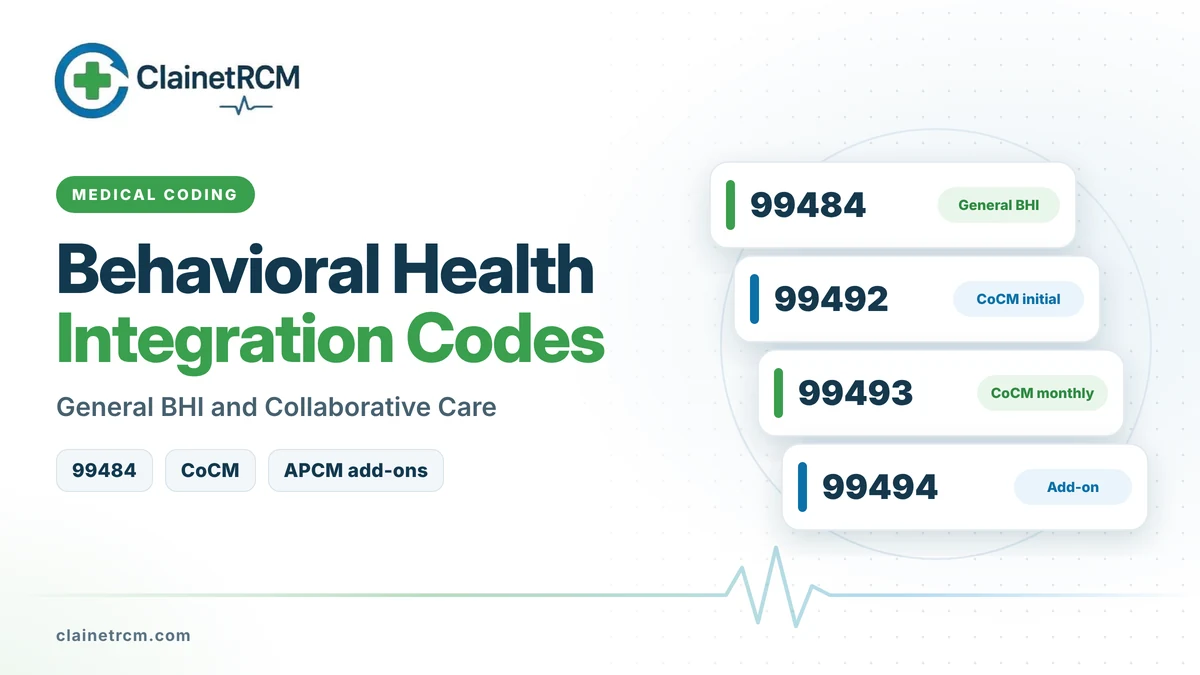
Quick answer: 99484 pays for general behavioral health integration (BHI): at least 20 minutes of clinical staff time per calendar month, directed by the billing practitioner. The Collaborative Care Model (CoCM) uses 99492 (initial month), 99493 (subsequent months) and add-on 99494 (each additional 30 minutes), and requires a behavioral health care manager and a psychiatric consultant. G2214 covers shorter CoCM months, and G0323 lets clinical psychologists and clinical social workers bill care management. For 2026, Medicare added optional APCM add-ons G0568, G0569 and G0570. New patients need an initiating visit, and the patient must consent.
Behavioral Health Integration Codes at a Glance
| Code | Service | Time per calendar month |
|---|---|---|
| 99484 | General BHI care management by clinical staff | At least 20 minutes |
| 99492 | Initial month of psychiatric CoCM | 70 minutes (reportable from 36 minutes) |
| 99493 | Subsequent month of CoCM | 60 minutes (reportable from 31 minutes) |
| 99494 | Each additional 30 minutes of CoCM (add-on) | Additional 30 minutes |
| G2214 | Initial or subsequent CoCM, first 30 minutes | For months below the 99492 or 99493 thresholds |
| G0323 | Behavioral health care management by a clinical psychologist or clinical social worker | At least 20 minutes |
| G0568, G0569, G0570 | APCM add-ons for CoCM (initial and subsequent) and general BHI | Billed with APCM codes G0556 to G0558 |
General BHI (99484) vs Collaborative Care
General BHI is the simpler option. It covers care management for any behavioral health condition, including systematic assessment and monitoring with validated rating scales, care planning, facilitation of treatment such as psychotherapy or medication, and a continuous relationship with a designated care team member. Clinical staff can perform the work under general supervision.
Collaborative Care is a specific, evidence-based model with three required roles:
- Treating (billing) practitioner, usually a primary care physician, NP or PA
- Behavioral health care manager, who does outreach, tracks outcomes in a registry and delivers brief interventions
- Psychiatric consultant, who reviews the caseload regularly and advises on diagnosis and treatment, usually without seeing the patient
CoCM pays more because it requires more structure. Practices often start with 99484 and move to CoCM once they have a care manager and a psychiatric consultant in place.
Time Thresholds for CoCM
Medicare’s guidance for counting CoCM time per calendar month:
| Care manager time in the month | Initial month | Subsequent months |
|---|---|---|
| Under 16 minutes | Not reported | Not reported |
| 16 to 35 minutes (initial) or 16 to 30 minutes (subsequent) | G2214 | G2214 |
| 36 to 85 minutes (initial) or 31 to 75 minutes (subsequent) | 99492 | 99493 |
| 86 to 115 minutes (initial) or 76 to 105 minutes (subsequent) | 99492 + 99494 | 99493 + 99494 |
Each additional 30 minutes beyond those ranges adds another unit of 99494.
Who Can Bill Behavioral Health Integration Codes
- Physicians, NPs, PAs, CNSs and CNMs can bill 99484 and the CoCM codes as treating practitioners.
- Clinical psychologists and clinical social workers can bill G0323 for behavioral health care management they direct.
- Psychiatric consultants are part of the CoCM team; their consultative work is included in the CoCM payment.
- RHCs and FQHCs bill the individual care management codes starting in 2026, after Medicare retired their old general care management code.
Requirements Before You Bill
- Initiating visit. For patients not seen recently, the billing practitioner must furnish an initiating visit, such as an E/M visit, an annual wellness visit or a Welcome to Medicare visit.
- Consent. Inform the patient about the service and cost sharing, and document verbal or written consent.
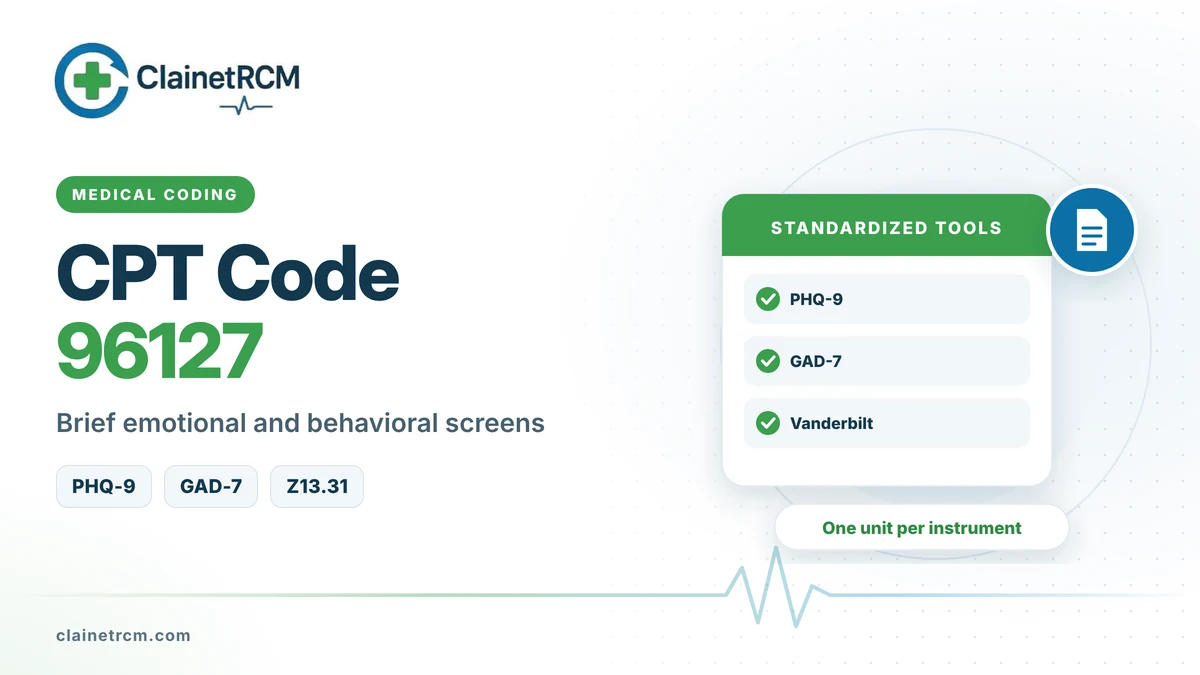
- Measurement. Use validated rating scales such as the PHQ-9 or GAD-7 to track response. Brief instruments may be billed separately with CPT code 96127 when payer rules allow.
- Time logs. Record each care manager contact with date, duration and activity.
- One model per month. Do not report 99484 and the CoCM codes for the same patient in the same month. BHI can be billed in the same month as chronic care management when the time is not counted twice.
The 2026 APCM Add-On Codes
The 2026 Medicare Physician Fee Schedule created three optional add-on codes for practices that bill Advanced Primary Care Management (APCM) codes G0556 to G0558:
- G0568: an add-on based on 99492 for the initial month of CoCM
- G0569: an add-on based on 99493 for subsequent CoCM months
- G0570: an add-on based on 99484 for general BHI
They let APCM practices deliver integrated behavioral health within the APCM framework instead of billing the standalone codes. Review CMS’s full descriptors before you switch, and do not bill the add-on and the matching standalone code for the same service.
Billing Example
A primary care practice enrolls a patient with recurrent moderate depression (F33.1) in Collaborative Care after a 99214 visit. In the first month, the care manager spends 52 minutes on outreach, a PHQ-9 and brief behavioral activation, and the psychiatric consultant reviews the case. The practice bills 99492. In the second month, the care manager spends 81 minutes, so the practice bills 99493 plus 99494.
Frequently Asked Questions
99484 is general BHI with at least 20 minutes of clinical staff time per month. 99492 is the initial month of the Collaborative Care Model, which requires a care manager, a psychiatric consultant and a registry.
Yes. Document consent, including that cost sharing may apply.
Yes, when each service’s requirements are met and the same time is not counted toward both.
Clinical psychologists and clinical social workers can bill G0323. Other therapists usually work as care managers within a practice that bills the codes.
Much of the care manager work, such as phone outreach, is non-face-to-face by design. The initiating visit follows the usual telehealth rules.
Final Thoughts
Behavioral health integration codes turn integrated care into a sustainable program, but only with consistent time tracking, consent and measurement. Start with 99484 if you are building the model, and move to CoCM as your team grows. Our mental health billing team helps practices launch and audit BHI programs, and our specialty medical billing guide explains how specialty rules affect revenue. Practices also billing CCM should see our guide to chronic care management CPT codes.
Turn Integrated Care Into Reliable Revenue
We set up BHI and Collaborative Care billing, track monthly time thresholds and make sure every eligible month is captured.
Set Up BHI Billing
Written by
ClainetRCM Billing Team
ClainetRCM is a Boston-based revenue cycle management company specializing in medical billing, coding, credentialing and denial management for healthcare providers across all 50 states. Our AAPC and AHIMA certified team works inside your existing EHR, files claims within 24 to 48 hours and reviews every AR bucket on a 14-day cycle.