Telehealth billing guidelines keep changing, and the details decide whether a virtual visit pays at the full rate, a reduced rate or not at all. For 2026, Congress extended Medicare’s telehealth flexibilities again, behavioral telehealth remains permanent, and commercial payers continue to set their own rules. Here is what billing teams need to apply on every claim.
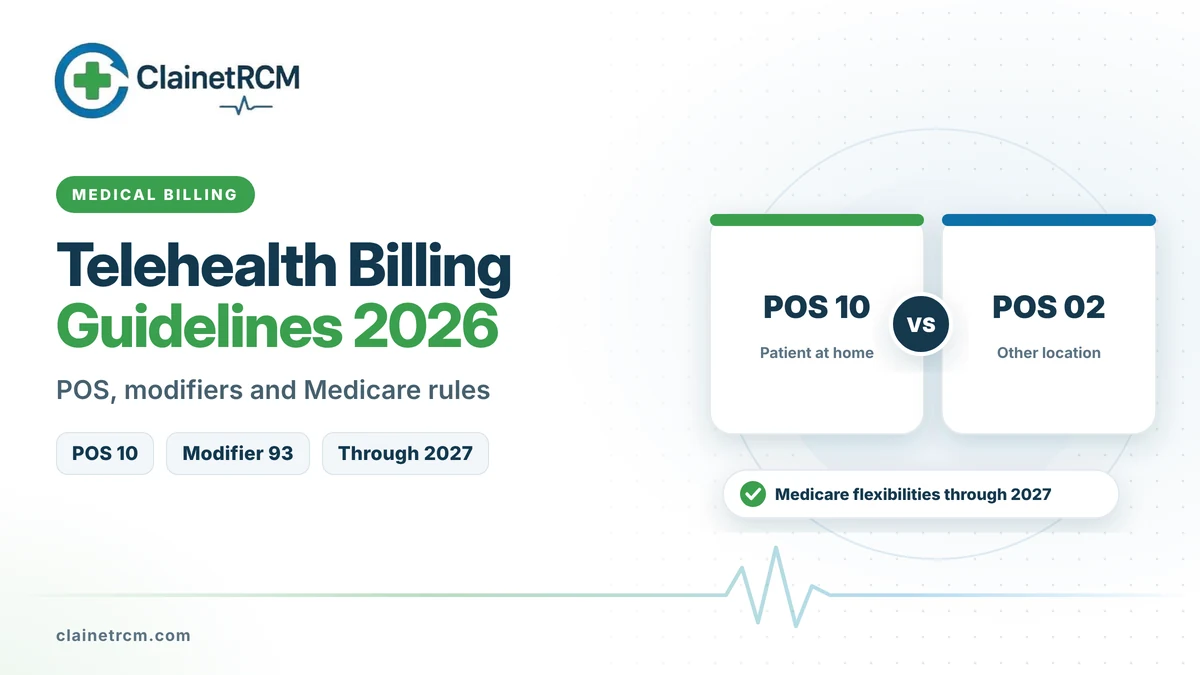
Quick answer: Bill telehealth with the same CPT code you would use in person and the telehealth place of service: POS 10 when the patient is at home and POS 02 when the patient is somewhere else. Medicare pays POS 10 at the non-facility rate and POS 02 at the facility rate. Use modifier 93 for audio-only services, modifier 95 where a payer requires it for audio-video visits, and the FQ modifier for audio-only services at RHCs and FQHCs. Under the Consolidated Appropriations Act 2026, Medicare’s telehealth flexibilities, including home visits for all services, audio-only care and the expanded list of eligible practitioners, run through December 31 2027.
Medicare Telehealth Billing Guidelines in Effect Through 2027
The Consolidated Appropriations Act, 2026, signed February 3, 2026, extended these Medicare flexibilities through December 31, 2027:
- No geographic or originating site restrictions. Patients can receive telehealth anywhere, including at home.
- All eligible practitioners. Physical therapists, occupational therapists, speech-language pathologists and audiologists can continue billing telehealth.
- Audio-only care. Allowed for services on the telehealth list when the patient cannot use or does not consent to video.
- FQHCs and RHCs. Can serve as distant sites for non-behavioral telehealth.
- Mental health in-person requirement. The requirement for an in-person visit within six months of starting mental health telehealth, and annually after, is waived through 2027.
Behavioral and mental health telehealth into the home is permanent, regardless of these extensions.
Place of Service Codes
| POS | Meaning | Medicare payment |
|---|---|---|
| 10 | Telehealth provided in the patient’s home | Non-facility rate |
| 02 | Telehealth provided somewhere other than the patient’s home | Facility rate |
The “home” includes temporary lodging and other locations where the patient receives care in private.
Telehealth Modifiers
| Modifier | Meaning | When to use |
|---|---|---|
| 95 | Synchronous telemedicine via real-time audio and video | When a payer requires it for audio-video telehealth; many commercial plans and Medicaid programs do |
| 93 | Synchronous telemedicine via audio only | Audio-only services, including behavioral health |
| FQ | Service furnished using audio-only technology | RHC and FQHC audio-only services |
| FR | Supervising practitioner present through two-way audio and video | When direct supervision is provided virtually |
| GT | Via interactive audio and video | Mainly for critical access hospital method II billing |
Codes Specific to Virtual Care
- Virtual check-ins: 98016 (brief communication technology-based service, which replaced G2012) and G2010 (review of recorded video or images).
- Online digital E/M: 99421 to 99423 for patient-initiated portal communication over seven days.
- Telemedicine E/M codes 98000 to 98015: CPT added these in 2025, but Medicare does not pay most of them; bill the standard office E/M codes with a telehealth POS instead. Some commercial payers accept them.
- Originating site fee: Q3014, billed by an eligible facility where the patient is located during the visit.
FQHC and RHC Telehealth Billing
Rural health clinics and federally qualified health centers bill non-behavioral telehealth with G2025 through December 31, 2026, paid at a rate based on the average for physician fee schedule telehealth services. Mental health visits furnished by telehealth are billed as regular visits, using the clinic’s standard billing method with the appropriate modifiers.
Remote Supervision
Medicare now permanently allows direct supervision through real-time audio and video for many services, excluding certain procedures with 10- and 90-day global periods. Use modifier FR when supervision was provided virtually.
Commercial and Medicaid Telehealth
- Many states have payment parity laws that require commercial plans to pay telehealth at the same rate as in-person care; others require coverage but not parity.
- Medicaid programs set their own codes, POS rules and modifiers.
- Some commercial plans still require modifier 95 and the in-person POS instead of POS 02 or 10.
Keep a payer-specific telehealth grid and update it whenever a payer publishes a new policy.
Licensing and Prescribing
- State licensure. The clinician must be licensed in the state where the patient is located at the time of the visit. Interstate licensure compacts, such as the Interstate Medical Licensure Compact, can simplify this.
- Controlled substances. The DEA’s telemedicine prescribing flexibilities, which waive the in-person visit requirement, are extended through December 31, 2026.
Documentation Requirements
- That the service was provided by telehealth, and whether by audio-video or audio-only
- The patient’s location and the clinician’s location
- Patient consent, when the payer or state requires it
- Why audio-only was used, when applicable
- The same clinical documentation required for an in-person visit
Common Telehealth Denials
| Denial | Cause | Fix |
|---|---|---|
| Wrong POS | POS 11 used for a virtual visit | Use POS 10 or 02 unless the payer instructs otherwise |
| Missing modifier | Payer requires 95 or 93 | Follow the payer’s telehealth policy |
| Service not on the telehealth list | Code not covered as telehealth | Check the Medicare telehealth services list |
| Out-of-state patient | Clinician not licensed where the patient is | Verify the patient’s location at every visit |
Frequently Asked Questions
POS 10 means the patient was at home during the telehealth visit; POS 02 means the patient was somewhere else. Medicare pays POS 10 at the non-facility rate.
Through December 31, 2027, under the Consolidated Appropriations Act, 2026.
Yes, through 2027 for services on the telehealth list when video is not possible or the patient declines it, and permanently for behavioral health.
Yes, through December 31, 2027.
Mostly no. Bill standard E/M codes with a telehealth place of service.
Final Thoughts
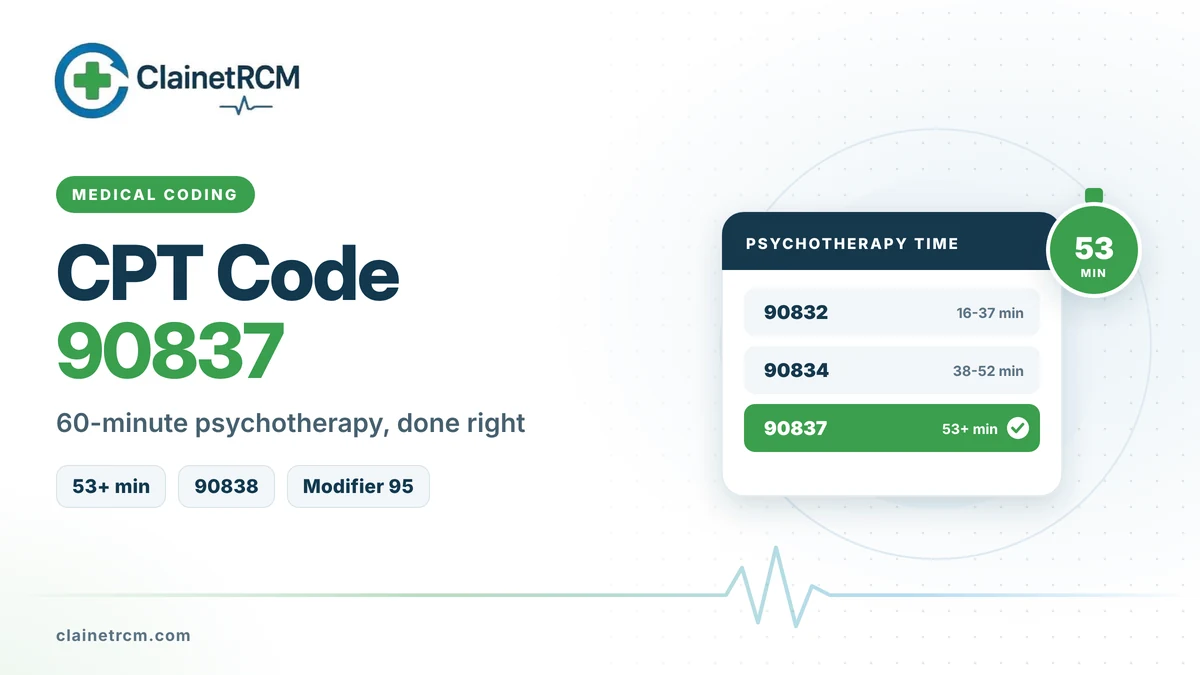
Telehealth billing guidelines come down to the right code, the right POS, the right modifier and a current payer grid. Medicare’s rules are stable through 2027, but commercial plans still differ. Our telemedicine billing team keeps virtual care claims clean, and our guide on how to bill Medicare as a provider covers the basics. Behavioral health practices should also read our CPT code 90837 guide.
Get Every Virtual Visit Paid
We apply the right POS codes, modifiers and payer rules to every telehealth claim and keep up with Medicare’s changing flexibilities.
Review My Telehealth Billing
Written by
ClainetRCM Billing Team
ClainetRCM is a Boston-based revenue cycle management company specializing in medical billing, coding, credentialing and denial management for healthcare providers across all 50 states. Our AAPC and AHIMA certified team works inside your existing EHR, files claims within 24 to 48 hours and reviews every AR bucket on a 14-day cycle.