CPT code 90837 is the highest-paying individual psychotherapy code and one of the most scrutinized codes in behavioral health. It describes a 60-minute session, but the rules that decide whether you can report it are more specific than “about an hour,” and payers watch how often each clinician uses it. Get the time, documentation and code combinations right and 90837 pays reliably.
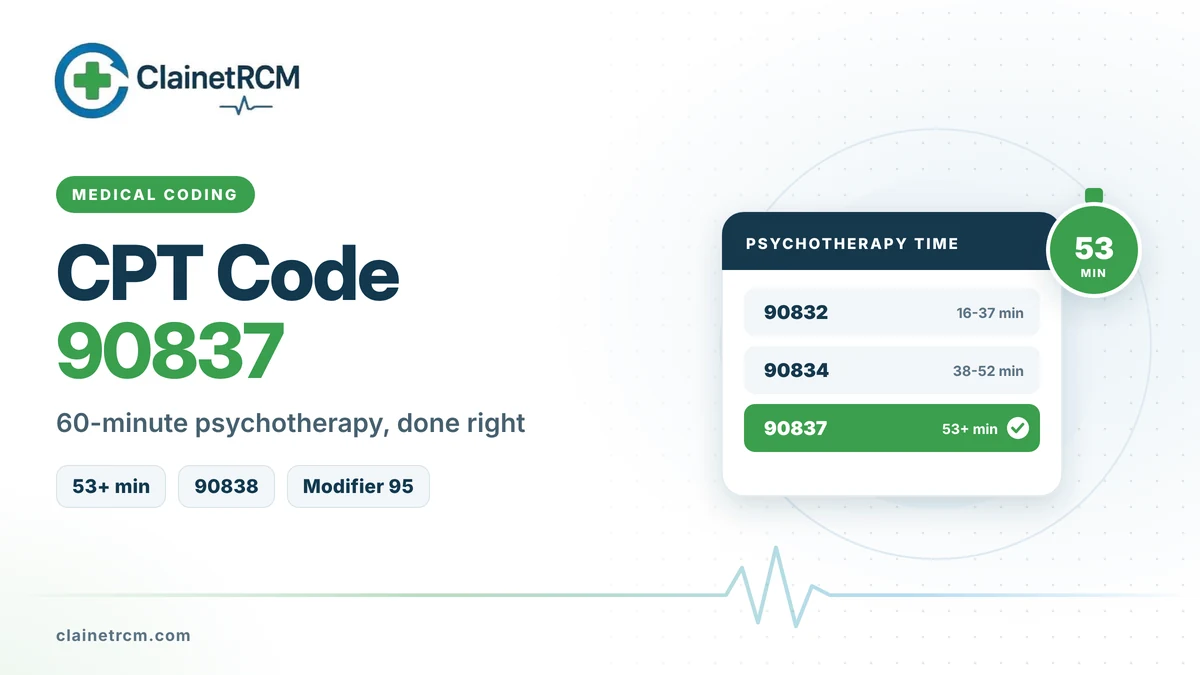
Quick answer: CPT code 90837 is individual psychotherapy, 60 minutes, with the patient and/or family member. Report it when psychotherapy lasts 53 minutes or more. The 2026 Medicare national rate is about $167 in an office (non-facility) setting and about $135 in a facility. Document the total psychotherapy time or start and stop times, the interventions used and why the session length was medically necessary. If a prescriber performs an E/M visit on the same day, use add-on code 90838 instead. There is no prolonged-service add-on for psychotherapy, and 99417 cannot be used with 90837.
What CPT Code 90837 Covers
90837 is a time-based code for individual psychotherapy. The patient must be present for all or part of the service, and a family member or caregiver may participate. Physicians, psychologists, psychiatric nurse practitioners and PAs, licensed clinical social workers, professional counselors and marriage and family therapists can all report it within their scope of practice and payer enrollment.
Only face-to-face psychotherapy time counts. Time spent writing notes, scoring a separately billed instrument or performing another billed service does not.
| Psychotherapy time | Psychotherapy only | With an E/M by the same provider |
|---|---|---|
| Under 16 minutes | Not reported | Not reported |
| 16 to 37 minutes | 90832 | 90833 (add-on) |
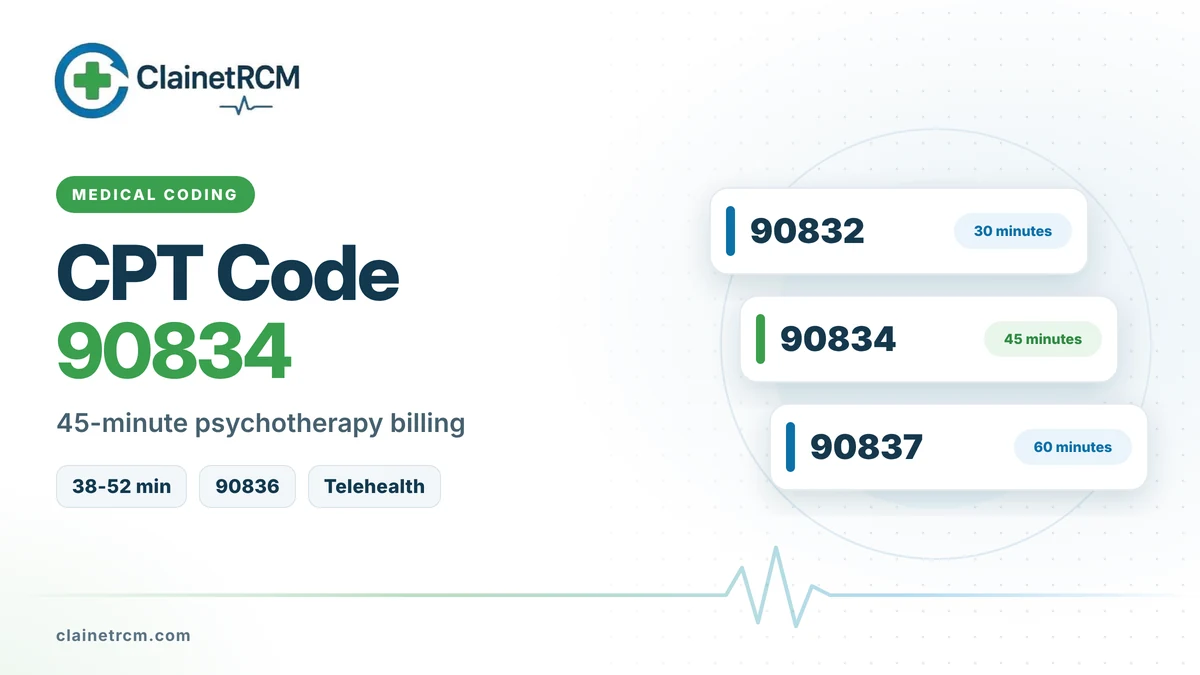
| 38 to 52 minutes | 90834 | 90836 (add-on) |
| 53 minutes or more | 90837 | 90838 (add-on) |
A 50-minute session is a 90834, not a 90837, even though many practices call it “the therapy hour.”
2026 Medicare Payment for 90837
| Code | Session length | 2026 national non-facility | 2026 national facility |
|---|---|---|---|
| 90832 | 16 to 37 minutes | About $85.84 | Lower than non-facility |
| 90834 | 38 to 52 minutes | About $113.90 | About $91.85 |
| 90837 | 53 minutes or more | About $167.00 | About $135.27 |
These are national amounts before geographic adjustment. Medicare pays clinical social workers, mental health counselors and marriage and family therapists 75% of the psychologist amount, and nurse practitioners 85%. The 2027 Physician Fee Schedule final rule lowers the conversion factor, so confirm your 2027 rates when they load.
Why Payers Scrutinize 90837
90837 pays roughly 47% more than 90834 under Medicare, so payers track how often each clinician bills it. Several behavioral health payers and managed care plans have run outlier reviews of clinicians whose share of 90837 sessions is far above their peers. Possible results include record requests, prepayment review, recoupment, or requests to justify the longer session. That is not a reason to avoid 90837 when you earn it. It is a reason to document every session as if it will be read by an auditor.
Documentation That Supports 90837
- Time. Total psychotherapy time, or start and stop times. Some Medicare contractors specifically expect start and stop times for timed psychotherapy codes.
- Medical necessity. Why this patient needs a 60-minute session: symptom severity, risk, trauma processing, family involvement or a treatment approach that requires the time.
- Interventions. The specific techniques used, such as CBT, DBT skills, EMDR or motivational interviewing, and how the patient responded.
- Progress toward goals. Link the session to measurable goals in the treatment plan.
- Risk assessment. Update suicide or safety risk when clinically indicated.
- Signature and credentials. Signed and dated by the rendering clinician.
Avoid cloned notes. Identical language session after session is one of the first things reviewers flag.
Add-On Codes and Code Combinations
- Interactive complexity (90785). Add it when specific communication factors complicate the session, such as managing maladaptive communication among participants or a caregiver whose behavior interferes with treatment.
- E/M plus psychotherapy. A psychiatrist or psychiatric NP who manages medication and provides 53 or more minutes of psychotherapy bills the E/M code plus 90838, not 90837. The E/M must be separately identifiable, and its time does not count toward psychotherapy time.
- Crisis psychotherapy. When a session meets the definition of crisis psychotherapy, use 90839 (first 60 minutes) and 90840 (each additional 30 minutes) instead of 90837. Interactive complexity is not reported with crisis codes.
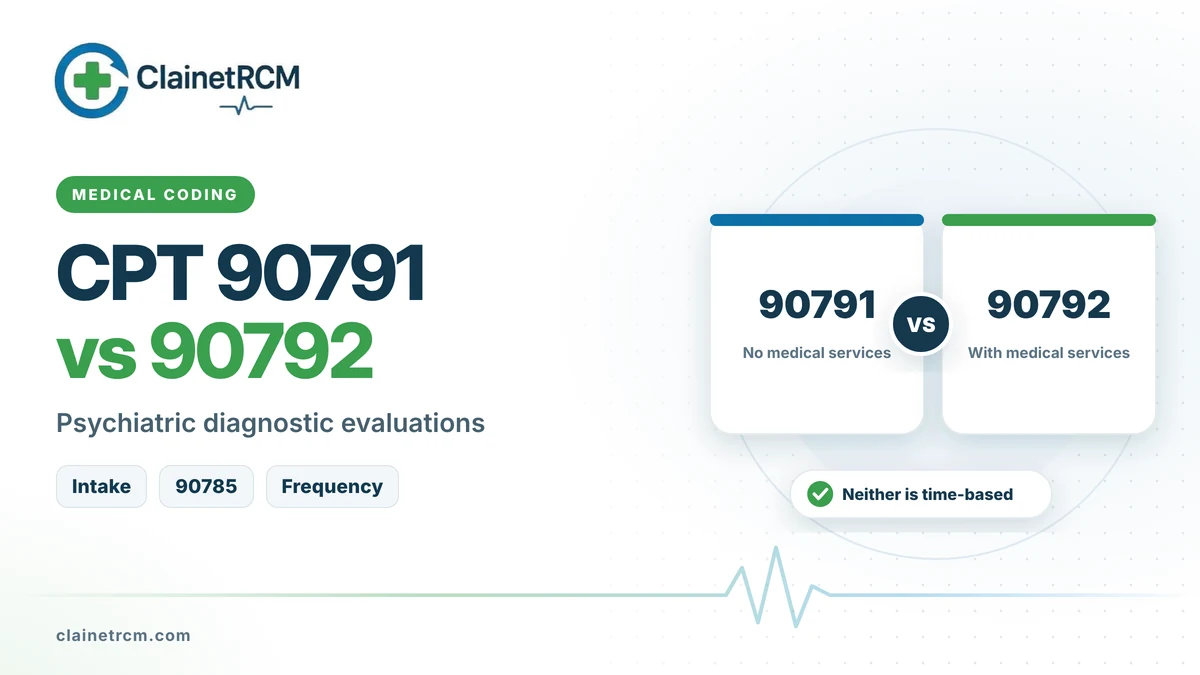
- Same-day evaluation. 90791 and 90837 are not reported for the same patient by the same provider on the same day.
- Family sessions. If the session focuses on family dynamics, family psychotherapy codes 90846 and 90847 may fit better.
What About Sessions Longer Than 60 Minutes?
There is currently no CPT prolonged-service add-on for psychotherapy. The older prolonged-service codes were deleted, and 99417 applies only to office and outpatient E/M visits, so it cannot be billed with 90837. For a 90-minute session, report 90837 once unless the session qualifies as crisis psychotherapy. A few Medicaid programs allow an additional state-defined code for extended sessions; check your state manual.
Telehealth Billing for 90837
90837 is on Medicare’s telehealth list. Medicare telehealth flexibilities run through December 31, 2027, and mental health telehealth into the home is a permanent benefit.
- Modifier 95 for real-time audio-video sessions.
- Modifier 93 for audio-only sessions, which Medicare allows for behavioral health when the patient cannot use or does not consent to video.
- Place of service. POS 10 when the patient is at home and POS 02 when the patient is somewhere else, unless a payer instructs otherwise. Medicare pays POS 10 at the non-facility rate.
Commercial and Medicaid rules vary, so check each payer’s telehealth policy.
Common 90837 Denials and Fixes
| Problem | Likely cause | Fix |
|---|---|---|
| Downcoded to 90834 | Time missing or under 53 minutes | Document time on every note and appeal with records when time was met |
| Denied with E/M on the same day | Standalone code billed with an E/M | Bill the E/M plus 90838 |
| Denied with 90791 | Evaluation and therapy on the same day | Bill them on separate dates |
| Authorization exceeded | Visit limit or session-length limit reached | Request additional authorization before the session |
| Telehealth denial | Missing modifier or wrong place of service | Add 95 or 93 and the correct POS |
Frequently Asked Questions
At least 53 minutes of face-to-face psychotherapy. Sessions of 38 to 52 minutes are reported with 90834.
No. A 50-minute session falls within the 90834 range.
Yes. Medicare covers 90837 when it is medically necessary and provided by an eligible practitioner, including in-person and telehealth sessions.
Not by the same provider on the same day. Use the E/M code plus add-on 90838 for 53 or more minutes of psychotherapy.
Not for routine psychotherapy. Report 90837 once, or use crisis psychotherapy codes when the session meets crisis criteria.
Final Thoughts
CPT code 90837 is fully legitimate when the time and clinical need are there, and it is a frequent audit target when they are not documented. Record time on every note, explain why the session length was needed and use the right add-ons. Our mental health billing team reviews psychotherapy coding every day, and our CPT code 90834 guide covers the 45-minute session. Practices that also offer TMS should read our TMS billing guide.
Bill Every Therapy Session at the Right Level
Our behavioral health coders review psychotherapy notes, time and add-ons before claims go out, so 90837 pays and holds up to audits.
Get a Free Billing Review
Written by
ClainetRCM Billing Team
ClainetRCM is a Boston-based revenue cycle management company specializing in medical billing, coding, credentialing and denial management for healthcare providers across all 50 states. Our AAPC and AHIMA certified team works inside your existing EHR, files claims within 24 to 48 hours and reviews every AR bucket on a 14-day cycle.