CPT code 90791 is the psychiatric diagnostic evaluation most therapists and psychologists bill at intake. Its sibling, 90792, adds medical services and is reserved for clinicians who can prescribe. Choosing between them, and between them and a new-patient E/M visit, affects both payment and audit risk, so it is worth getting the distinction exactly right.
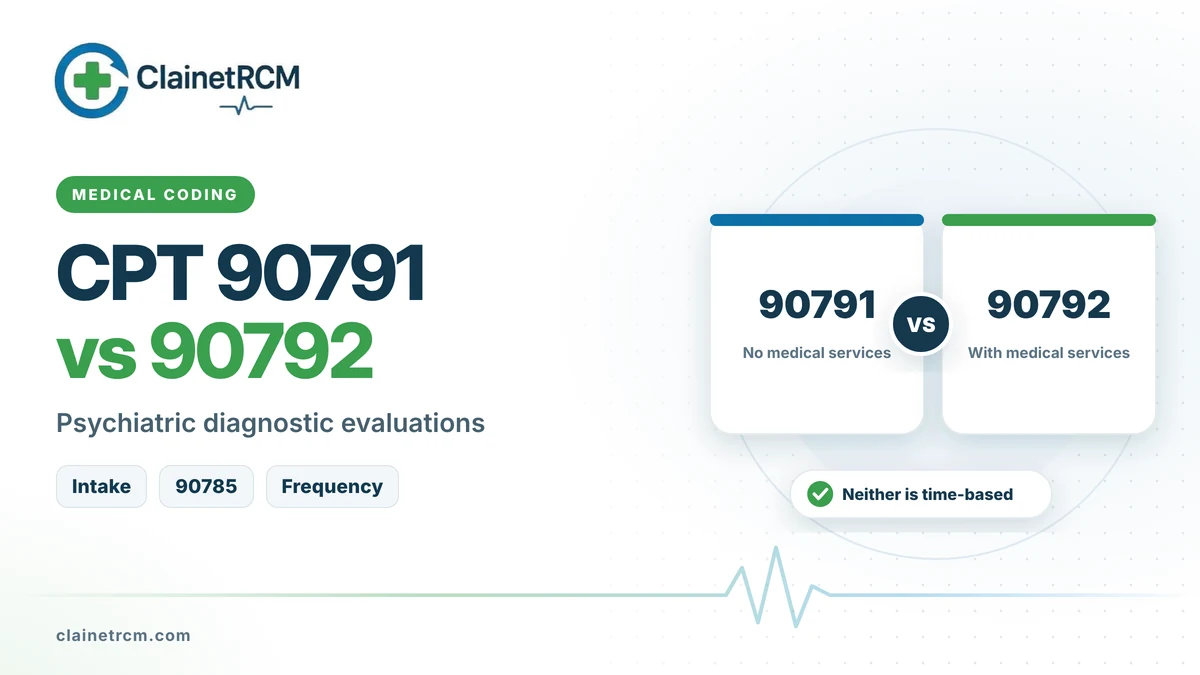
Quick answer: 90791 is a psychiatric diagnostic evaluation without medical services. Any qualified mental health professional can bill it, including psychologists, LCSWs, LPCs and LMFTs. 90792 is a psychiatric diagnostic evaluation with medical services, such as a medical history, relevant physical exam elements and medication evaluation, and it is billed by physicians and other practitioners with prescriptive authority. Neither code is time-based. The 2026 Medicare national non-facility rates are about $173.35 for 90791 and $202.08 for 90792. Neither is billed with psychotherapy or an E/M by the same provider on the same day, but interactive complexity (90785) can be added.
What CPT Code 90791 Includes
90791 is an integrated biopsychosocial assessment. It typically includes:
- The reason for referral and history of the present problem
- Psychiatric, medical, family, social and substance use history
- A mental status examination
- Diagnostic impressions and recommendations, including a treatment plan
It may also include communication with family members or other sources, review of records and ordering diagnostic studies. The evaluation can be done with the patient, with informants, or both.
What 90792 Adds
90792 includes everything in 90791 plus medical services: a medical assessment that goes beyond a mental status exam, review of medical conditions and medications, relevant physical examination elements, and the ability to order labs and prescribe. That is why it is limited to clinicians whose scope of practice includes medical evaluation and prescribing.
90791 vs 90792 at a Glance
| 90791 | 90792 | |
|---|---|---|
| Medical services | Not included | Included |
| Who typically bills | Psychologists, LCSWs, LPCs, LMFTs, and physicians or NPs who choose this code | Psychiatrists and other physicians, psychiatric NPs, PAs and CNSs with prescriptive authority |
| Time-based | No | No |
| 2026 Medicare national non-facility rate | About $173.35 | About $202.08 |
| Interactive complexity add-on | Allowed | Allowed |
Frequency Limits by Payer
CPT allows the code to be reported once per day, and more than once for the same patient when separate evaluations are done with the patient and with other informants on different days. Payers add their own frequency limits:
- Medicare generally expects one evaluation at the start of an episode of care, with another only when there is a new problem, a significant change or a long gap in treatment.
- Many commercial plans limit 90791 or 90792 to once every six or twelve months per provider, sometimes per patient across all providers.
- Some Medicaid programs require a new evaluation at set intervals for continued services.
Document why a repeat evaluation was needed. “New plan year” is not a clinical reason.
Code Combinations to Avoid
- Psychotherapy on the same day. 90791 or 90792 and 90832 to 90838 are not reported together by the same provider. Start psychotherapy billing at the next session.
- E/M on the same day. A prescriber chooses either 90792 or a new-patient E/M, not both.
- Crisis psychotherapy. 90839 and 90840 are not billed with 90791 or 90792.
Interactive complexity (90785) can be added to either evaluation when communication factors complicate the assessment, such as a caregiver whose behavior interferes or the need for play equipment to communicate with a young child.
Should a Prescriber Bill 90792 or a New-Patient E/M?
Psychiatrists and psychiatric NPs can bill a new-patient office E/M (99204 or 99205) instead of 90792 when the documentation supports it. The 2026 Medicare national non-facility rates are about $177.36 for 99204 and $236.81 for 99205, compared with about $202.08 for 90792. Office E/M visits can also carry add-on G2211 for longitudinal care, which 90792 cannot. When medical decision making is high, a 99205 may pay more; when it is moderate, 90792 often pays more than a 99204. Code what the documentation supports and stay consistent within the practice.
Telehealth
Both evaluations are on Medicare’s telehealth list. Use modifier 95 for audio-video visits, modifier 93 for audio-only behavioral health visits when video is not possible or the patient declines it, and POS 10 or 02 depending on where the patient is. Medicare’s telehealth flexibilities run through December 31, 2027. Commercial and Medicaid telehealth rules vary.
Common Denials and Fixes
| Denial | Cause | Fix |
|---|---|---|
| Frequency exceeded | Evaluation billed again within the payer’s limit | Check history first; document the clinical reason for a repeat evaluation |
| Bundled with psychotherapy | Same-day therapy billed | Move therapy to the next session |
| Provider not eligible for 90792 | Clinician without prescriptive authority | Bill 90791 |
| Medical necessity | Diagnosis does not support the evaluation | Code the presenting problem to the highest specificity |
Frequently Asked Questions
No. 90792 requires medical services that fall outside a social worker’s scope. LCSWs, counselors and marriage and family therapists bill 90791.
Not by the same provider for the same patient. Bill the evaluation first and start psychotherapy at the next visit.
CPT allows it once per day, and payers set their own limits, often once every six or twelve months per provider. Check each payer’s policy.
No. There is no minimum time, although most intake evaluations take 45 to 90 minutes. Document the components of the evaluation rather than relying on time.
Yes, psychiatric nurse practitioners with prescriptive authority can bill 90792 within their state scope of practice and payer enrollment.
Final Thoughts
Choosing between CPT code 90791 and 90792 comes down to one question: did the evaluation include medical services by a clinician who can provide them? Track frequency limits, avoid same-day psychotherapy and compare 90792 with a new-patient E/M when the documentation supports either. Our mental health billing team handles intake coding for practices of every size. For diagnosis coding, see our guides to the ICD-10 code for depression and oppositional defiant disorder.
Get Intake Evaluations Paid the First Time
We match each intake to the right evaluation or E/M code, track payer frequency limits and keep behavioral health claims clean.
Request a Coding Review
Written by
ClainetRCM Billing Team
ClainetRCM is a Boston-based revenue cycle management company specializing in medical billing, coding, credentialing and denial management for healthcare providers across all 50 states. Our AAPC and AHIMA certified team works inside your existing EHR, files claims within 24 to 48 hours and reviews every AR bucket on a 14-day cycle.