The Interstate Medical Licensure Compact (IMLC) gives qualified physicians a faster path to full, unrestricted medical licenses in other member states. Instead of repeating the same verifications for every state board, you apply once, pass one background check and receive a Letter of Qualification that member states use to issue licenses quickly. Each state still issues its own license, and you practice under the medical practice act of the state where your patient is located.
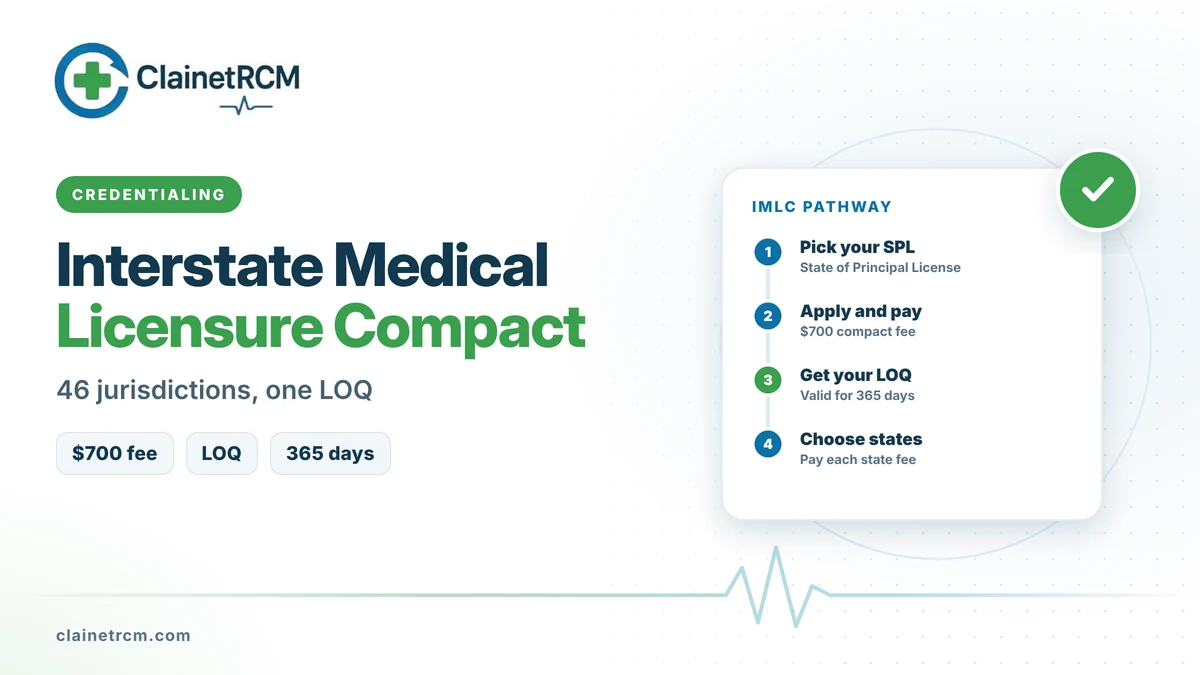
Quick answer: As of mid-2026, the compact includes 44 states plus the District of Columbia and Guam. To use it, you need a full, unrestricted license in a member state that qualifies as your State of Principal License, plus a clean record and board certification. You apply through the Interstate Medical Licensure Compact Commission, pay a $700 non-refundable application fee, receive a Letter of Qualification valid for 365 days, then choose your states and pay each state’s license fee.
How the Interstate Medical Licensure Compact Works
| Step | What happens | Who handles it |
|---|---|---|
| 1. Choose your State of Principal License | Pick a member state where you hold a full, unrestricted license and meet a residence, practice, employer or tax link | You |
| 2. Apply and pay | Submit the compact application and the $700 fee | Interstate Commission |
| 3. Eligibility review | Your principal license state verifies eligibility and runs a background check with fingerprints | State of Principal License |
| 4. Letter of Qualification | You receive a Letter of Qualification, valid for 365 days | State of Principal License |
| 5. Select states and pay | Choose the member states you want and pay each state’s license fee | You, through the Interstate Commission |
| 6. Licenses issued | Each state issues an expedited license under its own rules | Each member state board |
Choosing your State of Principal License
Your State of Principal License must be a member state where you hold a full, unrestricted license and that meets at least one of these tests:
- It is your primary state of residence.
- At least 25% of your practice of medicine occurs there.
- Your employer is located there.
- You use it as your state of residence for U.S. federal income tax purposes.
Who Qualifies
The compact’s eligibility standards require that you:
- Graduated from an accredited medical school, or a school listed in the World Directory of Medical Schools.
- Passed each component of the USMLE or COMLEX licensing exam within three attempts, or an equivalent exam accepted by the compact.
- Completed graduate medical education accredited by the ACGME or AOA.
- Hold current specialty board certification, or a time-unlimited certificate, from an ABMS or AOA member board.
- Hold a full, unrestricted license in your State of Principal License.
- Have no history of discipline on any medical license.
- Have no criminal history.
- Have no history of controlled substance actions against your license or DEA registration.
- Are not under active investigation by a licensing or law enforcement agency.
If you do not meet every standard, you can still apply to each state board through its traditional process.
What the Compact Costs
| Cost | Amount |
|---|---|
| Compact application fee | $700, non-refundable, paid to the Interstate Commission |
| Sending your Letter of Qualification to more states later | $100 service fee each time after the first distribution |
| State license fees | Set by each state and passed through to the state board |
| Fingerprinting and background check | Varies by state and vendor |
| Renewals | Each state’s renewal fee, plus any service fee for renewing through the compact |
Budget for the total, not just the $700. State fees vary widely, and a physician who adds five or six states can spend several thousand dollars.
Which States Participate
As of mid-2026, the compact covers 46 jurisdictions: 44 states, the District of Columbia and Guam. Recent additions include North Carolina, which joined in January 2026, Connecticut, which began issuing Letters of Qualification on March 15, 2026, and Alaska, which joined in June 2026. Not every member participates in the same way. A few members issue licenses through the compact but cannot yet serve as a State of Principal License, and some new members are still putting their processes in place. Check the Interstate Commission’s current map before you choose your states.
How Fast Is It?
Speed depends mostly on background checks and how quickly each state processes its part. The North Carolina Medical Board reported that in the first five months of 2026, licenses issued through the compact were granted an average of nine days after the board received the application. That is far faster than a traditional application that requires new primary source verification of your education, training and exams.
What the Compact Does Not Do
- It is not a multistate license. You receive separate licenses, renew each one and follow each state’s rules, including its continuing medical education requirements.
- It does not credential you with payers. Each new state means new payer enrollment, including Medicare enrollment updates and the state Medicaid program, plus primary source verification by each health plan.
- It does not cover prescribing registrations. You still need a DEA registration and any state controlled substance registration in each state where you prescribe controlled substances.
- It does not cover hospital privileges, which each facility grants separately.
- It is for physicians only. Nurses, physician assistants, counselors and psychologists use other interstate compacts or traditional applications.
The Compact and Telehealth
For telehealth, you generally need a license in the state where the patient is located during the visit. The compact makes it practical to add the states your patients live in, which is why telehealth groups and locum tenens physicians use it heavily. Line up payer enrollment in each new state at the same time, so you can bill for the visits your new licenses allow.
Tips for a Smooth Application
- Confirm your State of Principal License qualifies before you apply.
- Gather board certification, exam history and training dates in advance.
- Schedule fingerprints promptly and follow your principal state’s instructions exactly.
- Choose states within the 365-day life of your Letter of Qualification.
- Start payer credentialing for each new state as soon as the license issues.
Frequently Asked Questions
Timelines vary by state. Background checks drive the Letter of Qualification, and some states issue licenses within days of receiving a compact application.
The compact application fee is $700. You also pay each state’s license fee, fingerprinting costs and later renewal fees.
Physicians with a full, unrestricted license in a qualifying member state, board certification, a clean disciplinary and criminal record, and licensing exams passed within the attempt limits.
No. It is an expedited pathway. Each state issues and renews its own license.
No. The compact applies to MDs and DOs. Other clinicians use separate compacts where available or apply to each state.
Yes. A new license does not enroll you with payers. Each health plan and each state Medicaid program has its own enrollment process.
Final Thoughts
The Interstate Medical Licensure Compact can cut months off multi-state licensing, but it is only the first step. Plan the state fees, keep each license current and pair every new license with payer enrollment so you can see and bill patients in that state. Our provider licensing services manage compact and traditional applications for you. Before you add states, review our credentialing checklist for new providers.
Get Licensed in More States, Faster
We prepare your compact application, track your Letter of Qualification and state licenses, then credential you with payers in each new state.
Start Multi-State Licensing
Written by
ClainetRCM Billing Team
ClainetRCM is a Boston-based revenue cycle management company specializing in medical billing, coding, credentialing and denial management for healthcare providers across all 50 states. Our AAPC and AHIMA certified team works inside your existing EHR, files claims within 24 to 48 hours and reviews every AR bucket on a 14-day cycle.