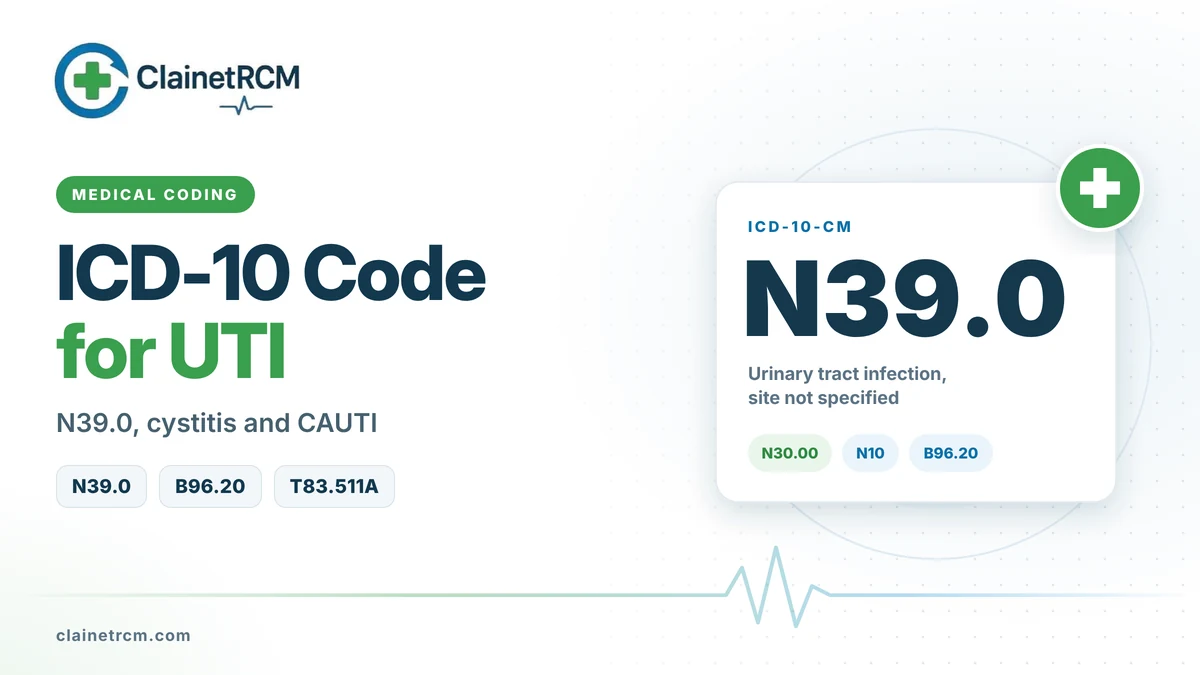
The ICD-10 code for UTI is N39.0, urinary tract infection, site not specified. It fits most office and urgent care visits where the provider documents a UTI without naming the part of the urinary tract involved. When the site, the organism or a device is documented, ICD-10-CM expects more specific codes, and pregnancy, sepsis and catheters each change the coding.
Quick answer: Use N39.0 for a UTI with no site specified, and add the organism when known, such as B96.20 for E. coli or B95.2 for Enterococcus. Use site-specific codes when documented: acute cystitis is N30.00 (without hematuria) or N30.01 (with hematuria), and acute pyelonephritis is N10. A catheter-associated UTI starts with T83.511A for an indwelling urethral catheter, followed by the infection and organism. UTIs in pregnancy are coded from O23.-, and asymptomatic bacteriuria is R82.71.
ICD-10 Code for UTI and Site-Specific Codes
| Code | Description |
|---|---|
| N39.0 | Urinary tract infection, site not specified |
| N30.00 | Acute cystitis without hematuria |
| N30.01 | Acute cystitis with hematuria |
| N30.90, N30.91 | Cystitis, unspecified, without or with hematuria |
| N10 | Acute pyelonephritis |
| N11.9 | Chronic tubulo-interstitial nephritis, unspecified |
| N34.1 | Nonspecific urethritis |
| R82.71 | Bacteriuria (asymptomatic) |
If the provider documents cystitis, code the cystitis rather than N39.0, because the site is known.
Organism Codes
N39.0 and the cystitis codes carry a note to use an additional code to identify the infectious agent when it is known.
| Organism | Code |
|---|---|
| E. coli, unspecified | B96.20 |
| Klebsiella pneumoniae | B96.1 |
| Proteus | B96.4 |
| Pseudomonas aeruginosa | B96.5 |
| Enterococcus | B95.2 |
| Staphylococcus aureus | B95.61 (MSSA) or B95.62 (MRSA) |
Add resistance codes when documented, such as Z16.12 for an extended-spectrum beta-lactamase (ESBL) producing organism.
Catheter-Associated UTI (CAUTI)
When the provider documents that a UTI is associated with a urinary catheter, code the complication first:
- T83.511A, infection and inflammatory reaction due to indwelling urethral catheter, initial encounter (other catheter types have their own T83.51- codes)
- The infection, such as N39.0 or the specific site
- The organism, such as B96.20
Hospital-acquired CAUTI is a hospital-acquired condition, so present-on-admission reporting matters for inpatient claims.
UTI in Pregnancy
UTIs during pregnancy are coded from Chapter 15, not N39.0. Use O23.4- (unspecified infection of urinary tract in pregnancy) or the site-specific O23 code, with the trimester character, plus the organism code. Postpartum UTIs use O86.2-.
Sepsis and Urosepsis
“Urosepsis” has no ICD-10-CM code and must be clarified with the provider: the provider may mean a UTI or sepsis due to a UTI. When sepsis due to a UTI is documented, sequence the sepsis code first, such as A41.51 (sepsis due to E. coli), followed by N39.0 and any severe sepsis or organ dysfunction codes.
Recurrent and Complicated UTIs
For patients with repeated infections, code the current infection and add codes that explain the risk and management:
- Z87.440, personal history of urinary tract infections, when the current visit is not for an active infection
- Z79.2, long-term (current) use of antibiotics, for prophylaxis
- Underlying conditions, such as neurogenic bladder (N31.9), urinary retention (R33.9), kidney stones (N20.0) or vesicoureteral reflux in children (N13.7-)
- Devices, such as long-term catheter use, with the appropriate status codes
Documenting these factors supports imaging, urology referrals and longer treatment courses.
Documentation Tips
- State the site of infection when it is known, such as bladder or kidney.
- Record symptoms, urinalysis findings and culture results, including the organism and resistance.
- Note any catheter or other device and whether the infection is related to it.
- Document pregnancy status and trimester when applicable.
- If the provider writes “urosepsis,” query before coding.
Pairing With CPT Codes
UTI visits commonly include a urinalysis (81002 or 81003 for dipstick testing, with modifier QW when the payer requires it for CLIA-waived tests, or 81001 with microscopy), a urine culture (87086), identification (87088) and susceptibility testing (87186). Link each test to the UTI or to the symptoms that prompted it, such as dysuria (R30.0) or frequency (R35.0), if no diagnosis was made. In urgent care, an uncomplicated UTI visit often supports a low to moderate E/M level, and prescribing an antibiotic counts as prescription drug management, which is moderate risk in medical decision-making.
Coding Examples
| Scenario | Codes |
|---|---|
| UTI, site not specified, culture positive for E. coli | N39.0, B96.20 |
| Acute cystitis with hematuria | N30.01 |
| Acute pyelonephritis due to Klebsiella | N10, B96.1 |
| UTI due to indwelling Foley catheter, E. coli | T83.511A, N39.0, B96.20 |
| UTI in the second trimester of pregnancy | O23.42, plus the organism if known |
Common Errors
- Coding N39.0 when cystitis or pyelonephritis is documented
- Leaving out the organism when the culture result is documented
- Coding a UTI for asymptomatic bacteriuria
- Using N39.0 in pregnancy instead of O23.-
- Coding “urosepsis” without querying the provider
- Forgetting the resistance code when an ESBL or other resistant organism is documented
Frequently Asked Questions
The ICD-10 code for UTI, site not specified, is N39.0. Use a site-specific code, such as N30.00 for acute cystitis, when the site is documented.
Yes, when it is known. N39.0 instructs you to add a code for the infectious agent, such as B96.20 for E. coli.
Start with the catheter complication code, such as T83.511A for an indwelling urethral catheter, then add the infection and organism codes.
Use a code from O23.-, such as O23.4- for an unspecified urinary tract infection in pregnancy, with the trimester.
Use R82.71, bacteriuria. Do not code a UTI unless the provider diagnoses an infection.
Acute pyelonephritis is N10. Add the organism code when the culture identifies it.
No. Urosepsis has no ICD-10-CM code. Query the provider to clarify whether the patient has a UTI or sepsis due to a UTI.
Final Thoughts
The ICD-10 code for UTI is just the starting point; site, organism and circumstances complete the claim. Learn how we support walk-in clinics on our urgent care billing page, or review related coding in our rectal bleeding ICD-10 guide.
Get Urgent Care Claims Right the First Time
Our coders match diagnoses, organisms and lab services on every UTI visit so urgent care and primary care claims pay without rework.
Get Coding Help
Written by
ClainetRCM Billing Team
ClainetRCM is a Boston-based revenue cycle management company specializing in medical billing, coding, credentialing and denial management for healthcare providers across all 50 states. Our AAPC and AHIMA certified team works inside your existing EHR, files claims within 24 to 48 hours and reviews every AR bucket on a 14-day cycle.