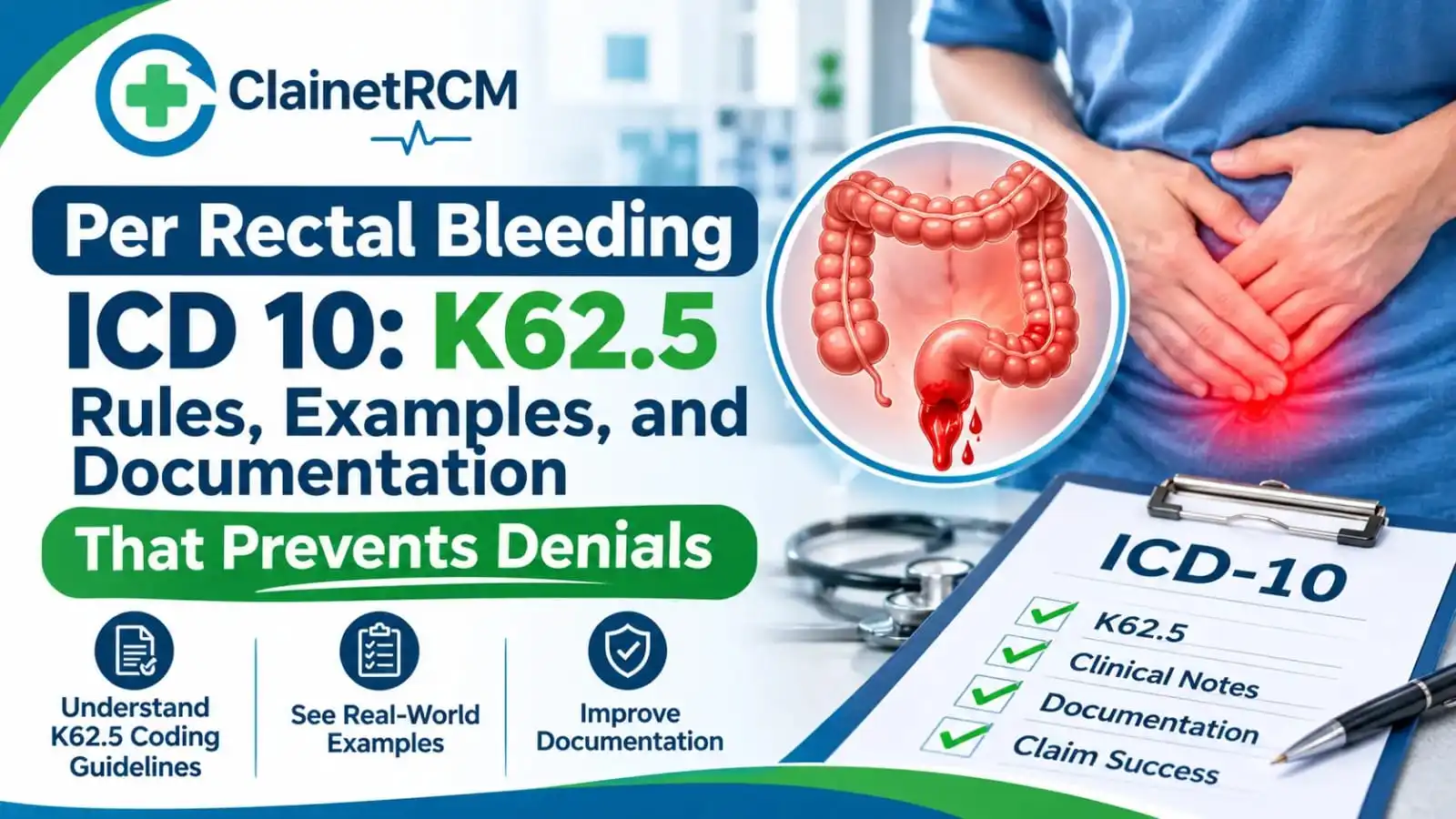
Quick answer: The ICD-10-CM code for per rectal bleeding is K62.5, Hemorrhage of anus and rectum. It is a billable code, but it is a symptom code. Once the provider finds the cause of the bleeding, you code the cause and drop K62.5.
That one sentence answers the search. The rest of this guide covers what most coding articles skip: when K62.5 is the wrong choice, why hematochezia causes so much confusion, and what your documentation needs to say so the claim gets paid the first time.
What Does “Per Rectal Bleeding” Mean in Medical Coding?
“Per rectal” simply means “through the rectum.” When a chart says PR bleeding, bleeding per rectum, blood per rectum, or BRBPR (bright red blood per rectum), the provider is describing blood passing from the anus or rectum.
Coders see these phrases constantly in emergency department notes, primary care visits, and gastroenterology consults. The clinical meaning is usually fresh, bright red blood, which points to the lower gastrointestinal tract. The coding meaning is narrower. You are not coding the color of the blood. You are coding what the provider documented and whether a cause has been established.
ICD-10 Code for Per Rectal Bleeding: K62.5
| Detail | Information |
|---|---|
| Code | K62.5 |
| Description | Hemorrhage of anus and rectum |
| Chapter | Diseases of the digestive system (K00-K95) |
| Block | Other diseases of intestines (K55-K64) |
| Billable | Yes |
| HCC category | None in current risk adjustment models |
| Type | Symptom or sign code |
The FY 2027 code set took effect on October 1, 2026, and K62.5 remains the code that captures bleeding from the anus and rectum.
K62.5 belongs to the K62 category, Other diseases of anus and rectum. Its neighbors include anal polyp (K62.0), rectal polyp (K62.1), rectal prolapse (K62.3), and radiation proctitis (K62.7). That neighborhood matters because many bleeding patients end up with a diagnosis from this same family once the workup is done.
Which Terms Point to K62.5?
These documented phrases all lead to K62.5 when no more specific cause has been identified:
- Bleeding per rectum
- Rectal bleeding
- Rectal hemorrhage
- Anal bleeding
- Blood per rectum
- Bright red blood per rectum (BRBPR)
- Rectorrhagia
If the note only says “rectal bleeding” with no cause yet, K62.5 is the right choice. That is the situation K62.5 was built for: a patient presents, the bleeding is real, and the workup is still pending.
The Hematochezia Problem Nobody Explains Clearly
This is where a lot of online guides go wrong, and where real claims get delayed.
Many websites state that hematochezia equals K62.5. The ICD-10-CM Alphabetic Index does not quite work that way. In the index, hematochezia carries a cross reference to melena, which sits at K92.1. Bleeding from the rectum, on the other hand, indexes to K62.5.
So the same clinical picture can land on two different codes depending on the exact word the provider used. A note that says “rectal bleeding” supports K62.5. A note that says only “hematochezia” can send you toward K92.1 under the index.
What should a coder do about this?
- Code from the provider’s documented wording, and follow the index entry for that exact term.
- If the documentation is vague, query the provider. Ask whether the bleeding is from the rectum or anus, or whether the source is not yet known.
- Do not assign both K62.5 and K92.1 together. They are mutually exclusive, which brings us to the Excludes1 note.
I have watched practices lose days of cash flow over this exact word choice. A two line provider query solves it, and a template that prompts for the bleeding site solves it permanently.
Excludes1 Note for K62.5: Codes You Cannot Report Together
K62.5 carries an Excludes1 note. An Excludes1 note means “not coded here.” The two conditions are mutually exclusive, so you do not report them together.
K62.5 excludes:
- Gastrointestinal bleeding NOS (K92.2), when the bleeding is not localized
- Melena (K92.1)
- Neonatal rectal hemorrhage (P54.2)
The logic is simple. K62.5 says the bleeding source is the anus or rectum. K92.2 says the source is somewhere in the gut and unspecified. You cannot assert both at once. For newborns, a separate perinatal code applies, so never use K62.5 for a neonatal patient.
When NOT to Use K62.5: Code the Cause Instead
Here is the rule that saves the most denials. ICD-10-CM guidelines tell us that signs and symptoms routinely associated with a confirmed disease process are not coded separately. When a provider documents a definitive cause for the bleeding, that diagnosis replaces K62.5.
| Documented cause | Code family | Notes |
|---|---|---|
| Hemorrhoids (bleeding) | K64.- | Bleeding is built into the hemorrhoid code, so no K62.5 |
| Anal fissure | K60.- | Fissure codes, not K62.5 |
| Diverticulosis with bleeding | K57.-1 and K57.-3 subcodes | Example: K57.31 for large intestine without perforation or abscess, with bleeding |
| Angiodysplasia of colon with hemorrhage | K55.21 | Vascular source |
| Ulcerative colitis with rectal bleeding | K51.-11 subcodes | Rectal bleeding is captured in the colitis code |
| Crohn’s disease with rectal bleeding | K50.-11 subcodes | Same principle |
| Radiation proctitis | K62.7 | Cause is known |
| Rectal polyp | K62.1 | Polyp is the diagnosis |
| Malignant neoplasm of rectum | C20 | Code the cancer |
Notice the pattern. Several ICD-10-CM categories already include a “with rectal bleeding” or “with hemorrhage” option. In those cases, the bleeding is baked into the code, and adding K62.5 on top is redundant.
If a claim carries K62.5 alongside a code that already explains the bleeding, a payer’s edit may flag it, or an auditor will. Clean sequencing is part of a healthy front end. Our guide to clean claims in medical billing walks through how these small diagnosis errors turn into rejections.
Real Claim Scenarios
Scenario 1: New complaint, workup pending.
A 45 year old reports bright red blood on tissue for three days. The provider documents “rectal bleeding, likely benign, will refer for evaluation.” No cause is confirmed. Report K62.5.
Scenario 2: Cause found on exam.
The same patient returns. Anoscopy shows internal hemorrhoids with active bleeding. Report the hemorrhoid code from K64.-. Drop K62.5.
Scenario 3: Colonoscopy finds diverticular bleeding.
An older patient with painless, heavy bleeding undergoes colonoscopy, and diverticulosis with hemorrhage is documented. Report the appropriate K57.- code with bleeding. K62.5 is not needed.
Scenario 4: Bleeding with anemia.
A patient presents with rectal bleeding and low hemoglobin. If the provider documents chronic blood loss anemia, you may report the anemia code (such as D50.0 for iron deficiency anemia secondary to chronic blood loss) in addition to the bleeding or its cause. If the anemia is acute, D62 applies. Only code anemia when the provider documents it.
Scenario 5: Positive stool test, no visible bleeding.
A positive fecal occult blood result without visible blood is not per rectal bleeding. It is typically reported with R19.5, other fecal abnormalities. Do not convert it into K62.5.
Related ICD-10 Codes Worth Knowing
These codes often appear in the same encounters as per rectal bleeding:
- K92.1, melena (black, tarry stool, usually upper GI source)
- K92.2, gastrointestinal hemorrhage, unspecified
- K62.6, ulcer of anus and rectum
- K63.5, polyp of colon
- R19.5, other fecal abnormalities, including occult blood
- Z12.11 and Z12.12, encounters for screening for malignant neoplasm of colon and rectum
- Z86.010, personal history of colonic polyps
- Z87.19, personal history of other diseases of the digestive system
- Z80.0, family history of malignant neoplasm of digestive organs
- Z79.01, long term use of anticoagulants
Z codes carry real weight in this scenario. A patient on blood thinners with new rectal bleeding, or a patient with a family history of colorectal cancer, tells a different medical necessity story than a patient with no risk factors.
Documentation Checklist for Per Rectal Bleeding
Weak documentation is the root of most bleeding related denials. Ask providers to capture these elements:
- Source: rectal, anal, colonic, or not yet determined
- Wording: use “rectal bleeding” or “bleeding per rectum” when that is the clinical meaning
- Acuity: acute, chronic, or recurrent
- Amount and character: streaks on paper, blood in the bowel, clots, or large volume
- Associated findings: anemia, pain, change in bowel habits, weight loss
- Risk factors: anticoagulants, antiplatelets, NSAIDs, family history, prior polyps
- Test results and findings: exam, anoscopy, labs, and colonoscopy results
- Final diagnosis: the confirmed cause as soon as it is known
- Plan: referral, imaging, procedure, or follow up
A note that says only “rectal bleeding, will monitor” supports a symptom code and little else. A note that links the bleeding to a risk factor and a plan supports both the diagnosis and the next service.
Why This Code Affects Procedure Claims
Per rectal bleeding is a common reason patients get scoped, so the diagnosis often rides on a procedure claim. That makes accuracy more important, not less.
Typical procedures tied to this complaint include anoscopy (CPT 46600), flexible sigmoidoscopy (45330), and diagnostic colonoscopy (45378), with add-on variations such as biopsy (45380) or snare polyp removal (45385) when applicable.
Two payer behaviors to watch:
- Medical necessity edits. A payer compares the diagnosis to the procedure. A specific, well documented bleeding diagnosis supports a diagnostic scope. A vague or mismatched code invites a denial.
- Screening versus diagnostic. If a patient comes in for screening and the provider finds a reason to treat bleeding, the claim may need a different diagnosis and modifier approach. For Medicare, the PT modifier commonly signals a screening that turned diagnostic. Always check the payer’s current policy.
If bleeding evaluation includes upper endoscopy for melena or suspected upper GI sources, our breakdown of ICD-10 codes for EGD procedures shows how those diagnoses line up on the claim.
For practices that handle high volumes of scopes and GI visits, specialty knowledge matters. A team that understands gastroenterology billing will catch bleeding diagnosis mismatches before the claim leaves the building.
Common Coding Mistakes With K62.5
Using K62.5 after the cause is known. If the final diagnosis is documented, report that instead.
Pairing K62.5 with K92.1 or K92.2. The Excludes1 note blocks this.
Treating hematochezia as an automatic K62.5. Follow the index and query when the term is ambiguous.
Coding from a problem list instead of the encounter note. The current visit documentation drives the code.
Reporting K62.5 for a newborn. Neonatal rectal hemorrhage has its own code.
Skipping the risk factors. Anticoagulant use and family history strengthen medical necessity and protect the claim.
Coding “history of rectal bleeding” as active. If the bleeding has resolved and the provider only references the past, a history code may be more appropriate, such as Z87.19 when documented that way.
How Per Rectal Bleeding Claims Get Denied
The typical denial reasons tied to this diagnosis are:
- Diagnosis does not support the procedure. The documented code and the CPT do not match the payer’s medical necessity policy.
- Conflicting diagnoses. Excludes1 pairs or redundant symptom plus cause combinations trigger edits.
- Missing specificity. An unspecified code is used where the chart supports a precise one.
- Missing prior authorization. Advanced imaging or procedures were done without approval.
- Frequency limits. Repeat scoping inside a payer’s window.
Most of these are preventable at the coding and documentation stage. When one slips through, a structured appeal process matters. Practices that want a repeatable process can look at our denial management services and our guide on preventing claim denials for the underlying workflow.
Best Practices for Coders and Billers
- Build a short query template: “Please clarify the source of the documented bleeding: rectal, anal, colonic, or undetermined.”
- Review the chart for a final diagnosis before sending a claim that carries a symptom code.
- Keep the Alphabetic Index open. Do not code from memory or from a lookup website alone.
- Update encoders every October and April, because code sets and edits change.
- Run diagnosis to procedure edits before submission.
- Audit a sample of K62.5 claims every quarter to see how often a definitive diagnosis was available.
- Train providers to document the source and cause in the same note.
If your team is stretched thin, outsourced medical coding services can keep this review consistent without adding headcount.
Frequently Asked Questions
The code is K62.5, Hemorrhage of anus and rectum.
Yes. K62.5 is a billable, specific code that can be reported on a claim.
BRBPR is reported with K62.5 when the provider documents bleeding from the rectum and no more specific cause has been established.
Not automatically. In the ICD-10-CM Alphabetic Index, hematochezia is cross referenced to melena (K92.1), while rectal bleeding indexes to K62.5. Code from the provider’s exact wording and query if the documentation is unclear.
No. K62.5 has an Excludes1 note for gastrointestinal bleeding NOS (K92.2), so the two are not reported together.
Bleeding hemorrhoids are reported with the K64 hemorrhoid codes. K62.5 is not added because the bleeding is part of the hemorrhoid diagnosis.
It depends on the documentation. Visible rectal bleeding points to K62.5. Black, tarry stool points to K92.1. A positive occult blood test without visible blood is usually R19.5.
No. K62.5 does not map to an HCC category in current risk adjustment models.
Yes. K62.5 remains the code for hemorrhage of anus and rectum under the FY 2027 code set effective October 1, 2026. Always confirm in your encoder for the date of service.
Final Thoughts
K62.5 looks like an easy code, and that is exactly why it causes trouble. It is a symptom code, which means it has a short shelf life on a claim. The moment a cause is documented, the diagnosis should change. Add the hematochezia index wrinkle and the Excludes1 note, and you can see why careless coding here leads to rework and denials.
Get the wording right, query when the source is unclear, and let the final diagnosis lead whenever the chart supports it. Do that consistently and per rectal bleeding claims stop being a headache.
Stop Losing Revenue to Diagnosis Coding Errors
Clainet RCM helps practices code accurately, submit cleaner claims, and recover payments faster. From GI and surgical specialties to full revenue cycle support, our team handles the details so your staff does not have to.
Talk to Our Billing Experts
Written by
ClainetRCM Billing Team
ClainetRCM is a Boston-based revenue cycle management company specializing in medical billing, coding, credentialing and denial management for healthcare providers across all 50 states. Our AAPC and AHIMA certified team works inside your existing EHR, files claims within 24 to 48 hours and reviews every AR bucket on a 14-day cycle.