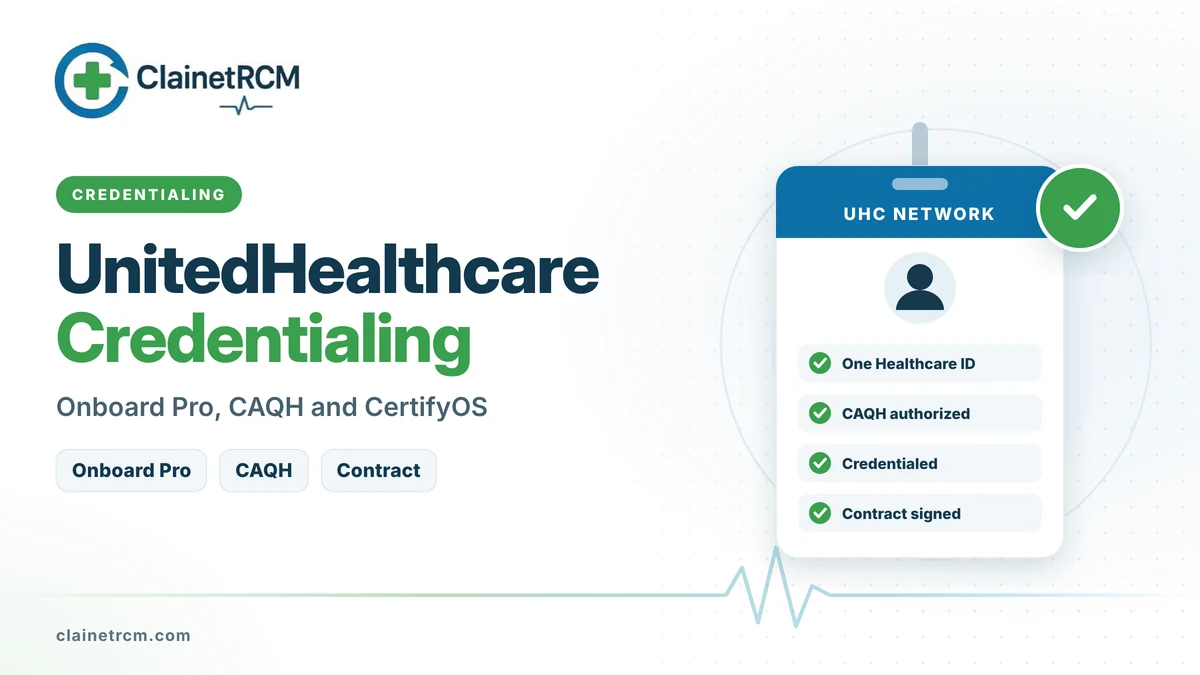
UnitedHealthcare credentialing is the process UHC uses to verify a clinician’s qualifications before adding them to its commercial, Medicare Advantage or Community Plan (Medicaid) networks. Most requests start in Onboard Pro, UHC’s self-service onboarding tool, and finish with a contract. In November 2026, UHC also began moving credentialing in several states to a new partner, CertifyOS. Here is how the process works and how to avoid the delays that catch most practices.
Quick answer: Get a One Healthcare ID, sign in to the UnitedHealthcare Provider Portal and open Onboard Pro. Enter the provider’s legal name, business name, TIN, state and lines of business, then complete the credentialing steps. Make sure the CAQH profile is complete, attested and authorized for UnitedHealthcare where CAQH is required. Once credentialing is approved, Onboard Pro triggers contracting, and you are in network only after both are complete. Behavioral health clinicians apply to Optum Behavioral Health through Provider Express instead.
Which UHC Network Are You Joining?
| Network | Where to apply | Notes |
|---|---|---|
| Commercial and Medicare Advantage (medical) | Onboard Pro | Credentialing first, then contracting |
| Community Plan (Medicaid) | Onboard Pro plus state rules | Requires enrollment in that state’s Medicaid program |
| Optum Behavioral Health | Provider Express | Separate application for mental health and substance use providers |
| UnitedHealthcare Dental | UHC Dental join page | Separate dental network process |
| Facilities and ancillary providers | Onboard Pro or provider portal chat | Facility credentialing stays in Onboard Pro |
What to Have Ready
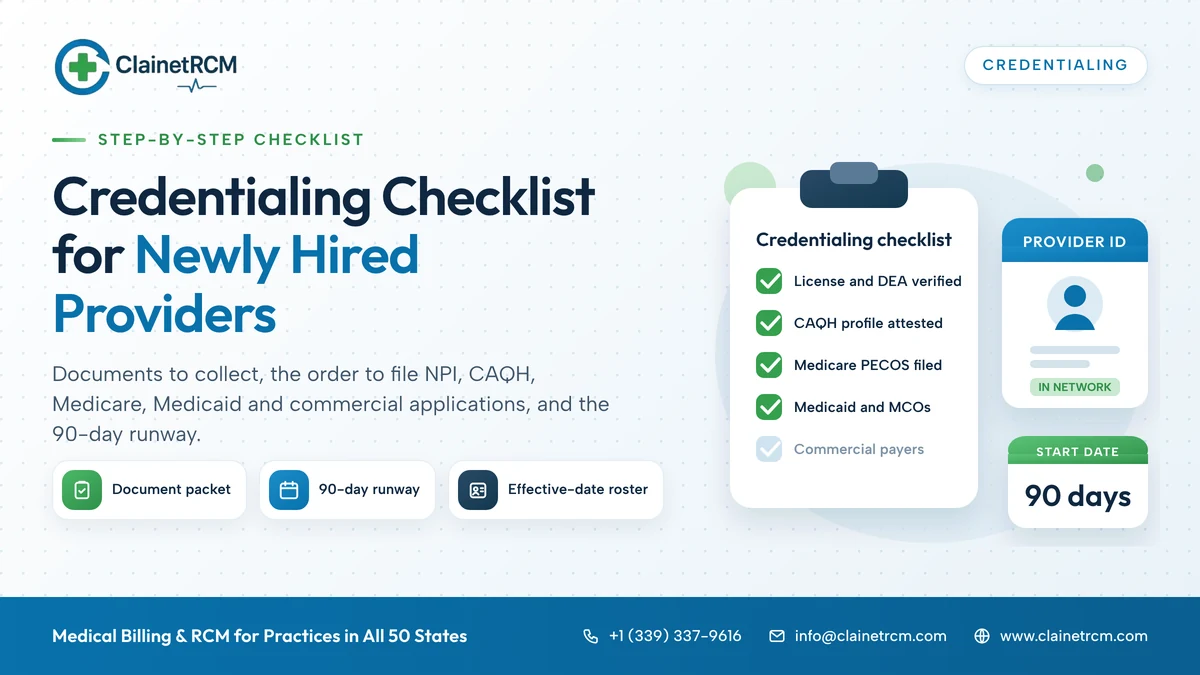
- A One Healthcare ID for the person submitting the request
- The provider’s NPI and legal name, plus the group’s TIN and W-9
- A complete, attested CAQH profile authorized for UnitedHealthcare
- State license, DEA registration if applicable and board certification
- A malpractice insurance face sheet with current dates
- Practice locations with full addresses and phone numbers
- Proof of Medicaid enrollment for Community Plan requests
How UnitedHealthcare Credentialing Works Step by Step
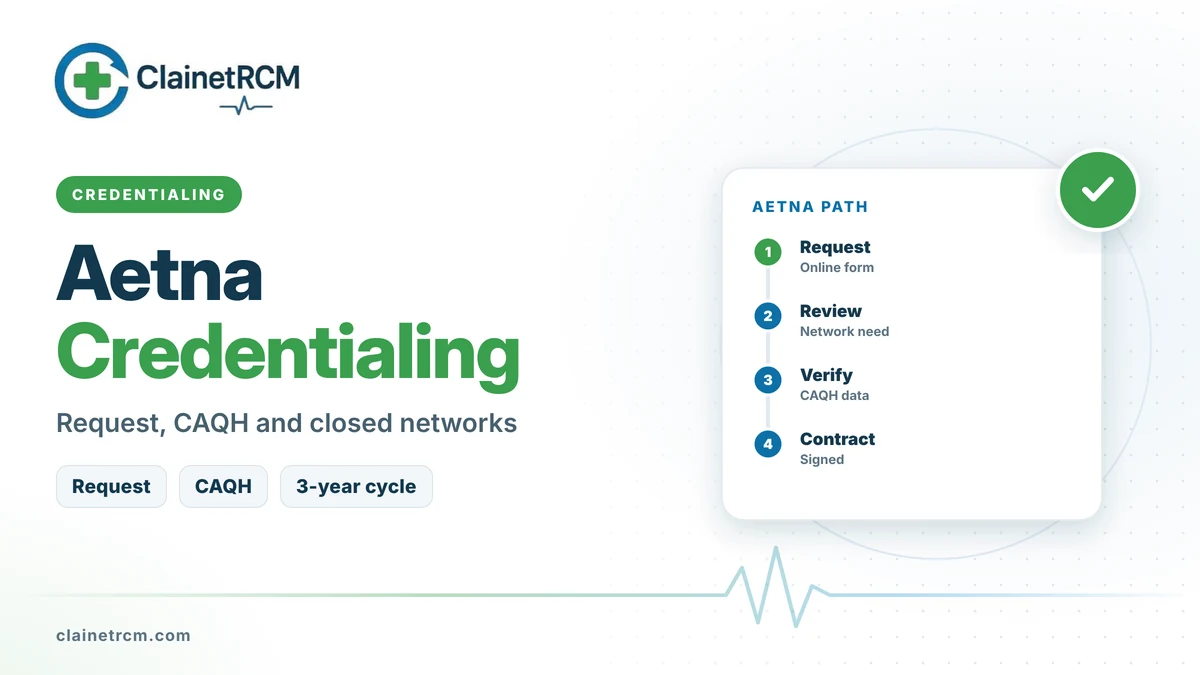
- Create a One Healthcare ID. This login gives access to the UnitedHealthcare Provider Portal and Onboard Pro.
- Prepare CAQH. UHC uses the CAQH Provider Data Portal (formerly ProView) to collect credentialing data in most states, and Minnesota providers may use ApplySmart from the Minnesota Credentialing Collaborative instead. Complete every section, upload current documents, authorize UHC to view the profile and attest.
- Start the request in Onboard Pro. Enter the legal and business names, TIN, state and lines of business. Onboard Pro handles single-state requests, so submit a separate application for each state where the provider practices.
- Complete credentialing. Onboard Pro prompts you for anything missing and shows real-time status on your dashboard.
- Review and sign the contract. After credentialing is approved, Onboard Pro automatically triggers contracting. Receiving a contract to review is not confirmation that credentialing is approved.
- Confirm the effective date. Do not schedule UHC patients as in network until both credentialing and contracting are complete and you have an effective date.
Adding a provider to a group that already has a UHC agreement follows a shorter path in Onboard Pro, but the new clinician still needs credentialing.
The 2026 CertifyOS Transition
UHC is moving credentialing work from Onboard Pro to CertifyOS, starting in Alabama, Montana, North Dakota, South Dakota and Wyoming:
- From November 2, 2026: New submissions in those states still start in Onboard Pro, but CertifyOS completes primary source verification and may contact providers directly. CertifyOS also manages recredentialing for providers due in April 2027.
- From November 16, 2026: Providers in those states complete the credentialing application in the CertifyOS portal, where UnitedHealthcare appears as a participating health plan.
- Exceptions: Virtual-only and multistate providers, delegated groups and facility credentialing stay on their current processes for now.
CertifyOS works alongside CAQH, so an accurate, attested CAQH profile matters even more.
Community Plan and Medicare Advantage Requirements
For UnitedHealthcare Community Plan, you must be enrolled in the state’s Medicaid program, and each state’s care provider manual lists its credentialing rules. For Medicare Advantage, the provider must be enrolled in Medicare in good standing; clinicians who have opted out of Medicare cannot join MA networks.
Recredentialing
UHC recredentials providers on a regular cycle under its credentialing plan, generally every three years in line with NCQA standards. Recredentialing relies on CAQH, so keep the profile attested, upload renewed licenses and malpractice certificates promptly and respond to any outreach.
Common Delays and Fixes
| Problem | What happens | Fix |
|---|---|---|
| CAQH not authorized | UHC cannot see the profile | Authorize UnitedHealthcare in CAQH |
| CAQH attestation expired | The file pauses | Re-attest and confirm documents are current |
| Multistate provider in one request | The request cannot cover every state | Submit one Onboard Pro request per state |
| Network not accepting the specialty or area | The request is closed | Make an access case or join a participating group |
| Contract received but not signed | Provider is not in network | Sign and return it, then confirm the effective date |
Frequently Asked Questions
It varies by state, specialty and how complete the CAQH profile is. Many practices plan on roughly two to four months from request to effective contract, and you can check status anytime in Onboard Pro.
UHC uses CAQH to collect credentialing data in most states, and registration is required for some states and specialties. Check the requirements for your state when you start in Onboard Pro.
Mental health and substance use clinicians join the Optum Behavioral Health network through Provider Express rather than Onboard Pro.
UHC notifies you in writing and explains how to dispute the decision. You also have the right to review and correct information submitted with your application.
No. As of November 2026 the change applies to Alabama, Montana, North Dakota, South Dakota and Wyoming. Other states, facilities and multistate or virtual-only providers continue to use Onboard Pro for now.
Final Thoughts
UnitedHealthcare credentialing is mostly about preparation: a clean CAQH profile, one Onboard Pro request per state and close attention to the contract stage. Read our CAQH ProView guide, use our credentialing checklist for new providers, or let our credentialing services team manage UHC enrollment for you.
Get Credentialed and Contracted With UnitedHealthcare
We manage Onboard Pro requests, CAQH profiles, Community Plan requirements and Optum applications so your providers join UHC networks without stalls.
Start UHC Credentialing
Written by
ClainetRCM Billing Team
ClainetRCM is a Boston-based revenue cycle management company specializing in medical billing, coding, credentialing and denial management for healthcare providers across all 50 states. Our AAPC and AHIMA certified team works inside your existing EHR, files claims within 24 to 48 hours and reviews every AR bucket on a 14-day cycle.