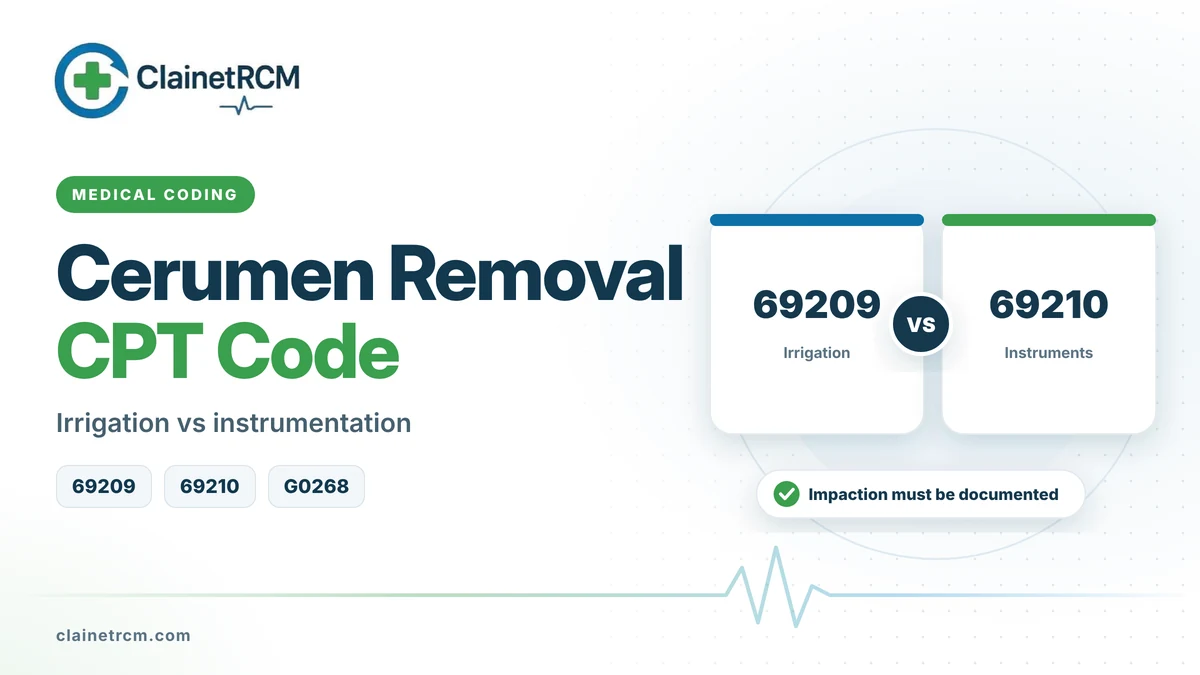
The right cerumen removal CPT code depends on how the wax was removed and whether it was truly impacted. Irrigation and instrumentation have different codes, both describe one ear, and Medicare has a separate HCPCS code when wax is removed on the same day as hearing testing. Removing wax that was not impacted is part of the office visit and is not billed separately.
Quick answer: Report 69209 for removal of impacted cerumen by irrigation or lavage and 69210 for removal of impacted cerumen with instrumentation, such as a curette, forceps or suction under direct visualization. Both codes are unilateral. For Medicare, bilateral irrigation is billed as 69209-50, while 69210 is billed once without modifier 50 even when both ears are treated; commercial payers vary. Use Medicare’s G0268 when a physician removes impacted cerumen on the same day as audiologic function testing. Document impaction with H61.21, H61.22 or H61.23, and add modifier 25 to an E/M only for a separately identifiable problem.
Cerumen Removal CPT Codes
| Code | Description | Who performs it |
|---|---|---|
| 69209 | Removal of impacted cerumen using irrigation or lavage, unilateral | Clinical staff under appropriate supervision, or the provider |
| 69210 | Removal of impacted cerumen requiring instrumentation, unilateral | Physician or other qualified health care professional |
| G0268 | Removal of impacted cerumen (one or both ears) by a physician on the same date as audiologic function testing | Physician, for Medicare patients |
What Counts as Impacted Cerumen
Impaction is more than the presence of wax. Clinical guidelines describe cerumen impaction as an accumulation of earwax that causes symptoms, such as hearing loss, fullness, pain, itching or tinnitus, or that prevents a needed examination of the ear canal, eardrum or hearing. Document:
- The symptoms or the reason the canal or eardrum needed to be visualized
- The finding of impacted cerumen and which ear or ears were affected
- The method used: irrigation, or instrumentation with a curette, forceps or suction
- The result, such as a clear canal with a visible eardrum
- Any complications or follow-up advice
Use the laterality-specific diagnosis: H61.21 (right ear), H61.22 (left ear) or H61.23 (both ears). Avoid H61.20 (unspecified ear), which some payers deny.
Bilateral Billing Rules
| Scenario | Medicare | Commercial payers |
|---|---|---|
| Irrigation, both ears | 69209-50, one unit | Often 69209-50, or RT and LT on separate lines |
| Instrumentation, both ears | 69210, one unit, no modifier 50 | Often 69210-50, or RT and LT on separate lines |
| Irrigation fails, instrumentation used in the same ear | 69210 only | 69210 only |
| Instrumentation in one ear, irrigation in the other | 69210-RT and 69209-LT, with 59 or XS if edits require | Same approach |
Never report 69209 and 69210 for the same ear on the same day. If irrigation does not clear the canal and the provider then uses instruments, report only 69210.
Billing With an E/M Visit
Cerumen removal can be billed with a same-day E/M visit when the provider also addresses a separate problem, such as an ear infection in the other ear, sinusitis or a chronic condition. Append modifier 25 to the E/M code and link each service to its own diagnosis. When the only reason for the visit is the impacted cerumen, the evaluation leading to the removal is part of the procedure, and a separate E/M is not billed.
Audiology Visits and G0268
Audiologists cannot bill cerumen removal. When a physician removes impacted cerumen on the same day the patient has audiologic function testing, Medicare uses G0268, reported once whether one or both ears are treated. For other payers, check whether they accept G0268 or want 69209 or 69210.
Example
A patient comes in for a blood pressure follow-up and mentions muffled hearing in both ears. The provider finds bilateral impacted cerumen. A medical assistant irrigates the left ear successfully; the right ear does not clear, so the physician removes the wax with a curette. The provider also adjusts the patient’s blood pressure medication.
- Procedures: 69210-RT and 69209-LT
- E/M: 99213-25 for the hypertension management
- Diagnoses: H61.23 for the cerumen, I10 for hypertension
Common Denials
- No documented impaction. “Ears cleaned” or “wax removed” without symptoms or an obstructed view does not support either code.
- Method not stated. Without the technique, a reviewer cannot tell whether 69209 or 69210 applies.
- Both codes for the same ear. Only the instrumentation code is reported when irrigation fails.
- Wrong bilateral format. Medicare and commercial payers handle bilateral claims differently.
- E/M without a separate problem. Modifier 25 needs a significant, separately identifiable service.
Who Can Perform Each Service
Irrigation (69209) is often performed by trained nurses or medical assistants under the supervision required by the payer and state rules. Instrumentation (69210) requires direct visualization and the skill of a physician or other qualified health care professional, and it should be documented by that provider.
Frequently Asked Questions
Code 69209 is removal of impacted cerumen by irrigation or lavage. Code 69210 requires instrumentation, such as a curette, forceps or suction, by a physician or other qualified health care professional.
No. Removing non-impacted cerumen is part of the E/M service. The record must document impaction to support 69209 or 69210.
Report 69210 once, with one unit and no modifier 50. Commercial payers may want modifier 50 or separate RT and LT lines.
Yes, when a significant, separately identifiable problem is addressed. Append modifier 25 to the E/M code.
G0268 is a Medicare code for physician removal of impacted cerumen on the same date as audiologic function testing, reported once for one or both ears.
Final Thoughts
The cerumen removal CPT code you choose depends on impaction, technique and payer rules, and good documentation protects all three. Learn how we support ear, nose and throat practices on our ENT billing page, or review office visit coding in our CPT code 99213 guide.
Stop Losing Small Procedures to Denials
Our coders make sure cerumen removal and other in-office procedures are documented, coded and billed with the right modifiers alongside your E/M visits.
Get Coding Help
Written by
ClainetRCM Billing Team
ClainetRCM is a Boston-based revenue cycle management company specializing in medical billing, coding, credentialing and denial management for healthcare providers across all 50 states. Our AAPC and AHIMA certified team works inside your existing EHR, files claims within 24 to 48 hours and reviews every AR bucket on a 14-day cycle.