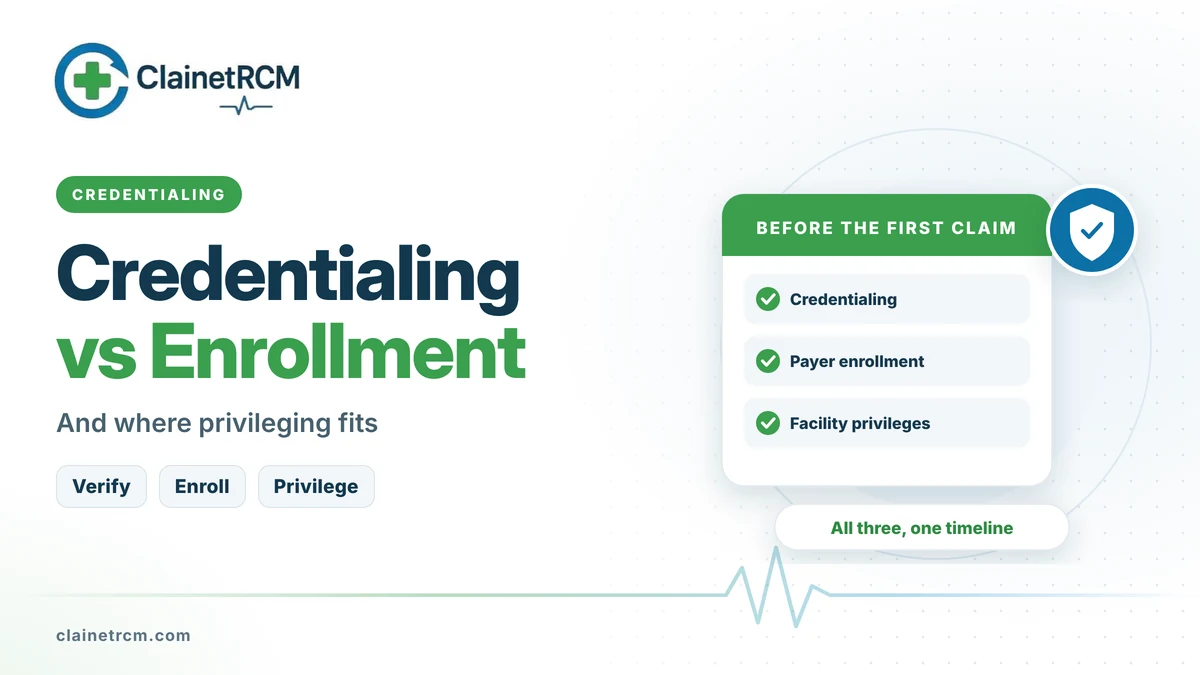
Credentialing vs enrollment is one of the most common points of confusion in a medical practice. The terms are often used interchangeably, and a third term, privileging, gets mixed in too. They are related but different processes, run by different organizations, and a provider usually needs all three before every service they perform can be paid.
Quick answer: Credentialing verifies that a provider is who they say they are and is qualified: license, education, training, board certification, malpractice history and sanctions. Enrollment (often called payer enrollment) sets the provider up to bill a specific payer, with an ID, a contract and an effective date. Privileging is a hospital or facility granting permission to perform specific procedures in that facility. Credentialing is the foundation for the other two; enrollment determines whether a payer pays; privileges determine where the provider can practice.
Credentialing vs Enrollment vs Privileging at a Glance
| Credentialing | Enrollment | Privileging | |
|---|---|---|---|
| Main question | Is this provider qualified and trustworthy? | Can this provider bill this payer and get paid? | What may this provider do in this facility? |
| Who performs it | Health plans, hospitals and credentialing verification organizations | Medicare, Medicaid and commercial payers | The hospital or facility medical staff and governing board |
| What it produces | A verified credentialing file and approval | Provider IDs, a contract, linked group and an effective date | A list of granted clinical privileges |
| How often it repeats | Recredentialing, commonly every 36 months for health plans | Medicare revalidation every five years; payer updates as needed | Reappointment on a cycle set by medical staff bylaws |
| What happens without it | The payer or facility will not approve the provider | Claims deny or process out of network | The provider cannot treat patients in that facility |
What Credentialing Verifies
Credentialing is a background check for clinical qualifications. The core of it is primary source verification: confirming each credential directly with the organization that issued it rather than trusting a copy. A typical file includes:
- State license verified with the licensing board, plus DEA and state controlled substance registrations
- Education and training verified with schools and residency programs
- Board certification verified with the certifying board
- Malpractice insurance and claims history
- A query of the National Practitioner Data Bank and checks of federal exclusion and sanction lists
- Work history, usually covering the last five years, with gaps explained
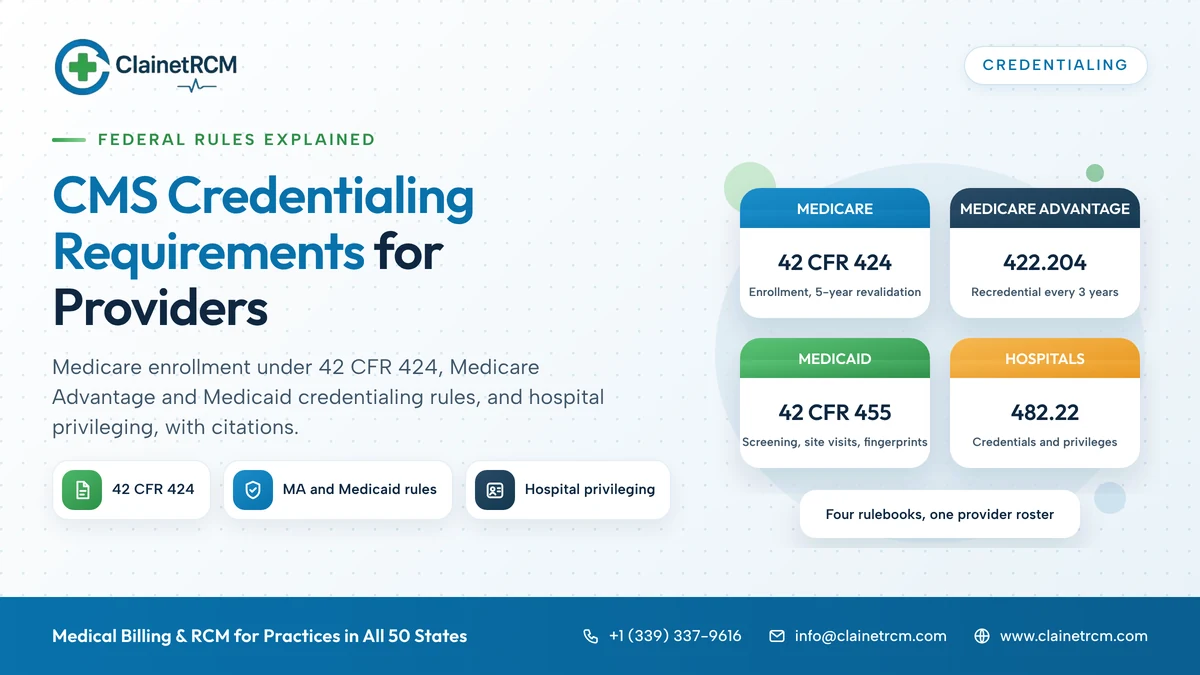
Health plans that follow NCQA standards credential providers before they join the network and recredential them at least every 36 months. Most commercial plans collect the data through CAQH; see our CAQH ProView guide for how that works.
What Enrollment Does
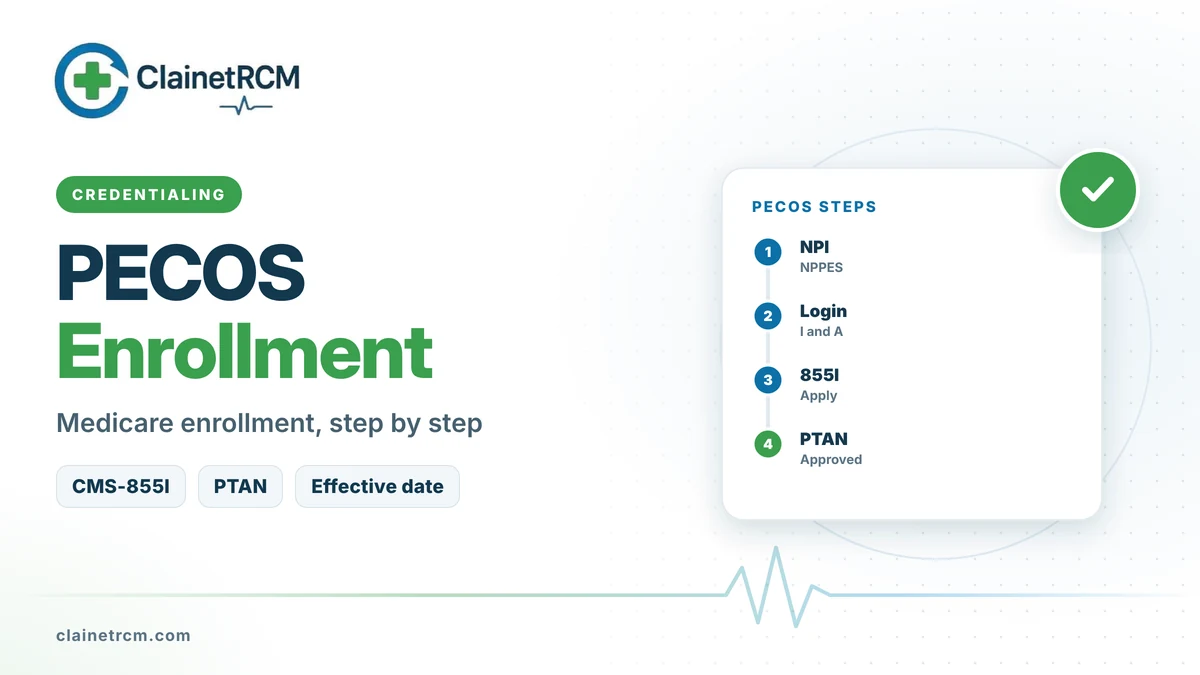
Enrollment is the business side. It tells a payer who the provider is, where they practice, which group or TIN they bill under and where to send payment. For Medicare, enrollment happens in PECOS with the CMS-855 applications; our PECOS enrollment guide walks through it. For Medicaid, each state runs its own enrollment system, and Medicaid managed care plans require state enrollment before they will contract. For commercial payers, payer enrollment ends with a signed contract, a fee schedule and the provider loaded into the claims system.
The most important output of enrollment is the effective date: the first date of service the payer will pay for that provider. A claim with a date of service before the effective date will deny even if the provider was fully credentialed.
What Privileging Covers
Privileging happens inside hospitals, ambulatory surgery centers and other facilities. The medical staff office collects the provider’s application, credentialing information and evidence of competence for each procedure requested, and the medical staff and governing board decide which privileges to grant. Hospitals must query the National Practitioner Data Bank when granting privileges and at least every two years for current medical staff.
Newly granted privileges are usually followed by a focused professional practice evaluation (FPPE), a period of closer review, and then ongoing evaluation. Privileges are reappointed on a cycle set in the medical staff bylaws. A surgeon with full insurance enrollment but no privileges at a hospital cannot operate there; a hospitalist with privileges but no enrollment cannot get paid.
How the Three Fit Together
Consider a psychiatrist joining a group that also covers a local hospital’s inpatient unit:
- Credentialing. The group and each payer verify her license, training, board certification and history through CAQH and primary sources.
- Enrollment. She enrolls in Medicare through PECOS with a reassignment to the group, enrolls with the state Medicaid program, and is added to each commercial contract under the group’s TIN.
- Privileging. The hospital’s medical staff office grants her inpatient psychiatry privileges, with an FPPE period.
If any step is missing, part of her work goes unpaid or cannot happen at all. That is why credentialing teams track all three on one timeline.
Common Denials When a Step Is Missing
- Claims for dates of service before the payer’s effective date deny as the provider not being eligible on that date.
- Claims under a group the provider is not linked to deny or reject at the front end.
- Hospital services without privileges cannot be performed in the first place, which is a compliance issue, not a billing one.
Our guide to how credentialing affects revenue explains how to estimate the cost of each gap.
Frequently Asked Questions
No. Credentialing verifies qualifications; enrollment sets up billing with a specific payer. Most payers do both, which is why the terms get blurred, but they are separate steps with separate outcomes.
The hospital or facility. The medical staff office gathers the information, and the medical staff leadership and governing board approve privileges.
If they provide telemedicine services to hospital patients, yes. Medicare rules allow a hospital to rely on the credentialing and privileging decisions of a distant-site hospital or telemedicine entity under a written agreement, often called credentialing by proxy.
Health plans that follow NCQA standards recredential at least every 36 months. Medicare revalidation is every five years, and hospital reappointment follows the medical staff bylaws.
With commercial payers, enrollment depends on credentialing approval. Medicare enrollment involves its own verification of licensure and eligibility rather than committee-style credentialing.
Final Thoughts
Credentialing vs enrollment is not an either-or choice. Credentialing proves a provider is qualified, enrollment lets a payer pay them, and privileging lets them practice in a facility. Treat all three as one project with one timeline, and the first paid claim arrives on schedule. For more detail, read our guide to CMS credentialing requirements, or let our credentialing services team coordinate everything. Practices adding providers in new states can also use our provider licensing support.
Credentialing, Enrollment and Privileges in One Place
We verify credentials, enroll providers with Medicare, Medicaid and commercial payers, and coordinate facility privileges so nothing blocks the first claim.
Talk to Our Team
Written by
ClainetRCM Billing Team
ClainetRCM is a Boston-based revenue cycle management company specializing in medical billing, coding, credentialing and denial management for healthcare providers across all 50 states. Our AAPC and AHIMA certified team works inside your existing EHR, files claims within 24 to 48 hours and reviews every AR bucket on a 14-day cycle.