CPT code 99215 is the highest-level office visit for an established patient. It pays the most of any established patient E/M code, and that is exactly why payers review it so closely. The good news is that the rules are clear. When a visit truly involves high-complexity decision making, or a long visit, 99215 is the right code, and documentation that shows it will hold up.
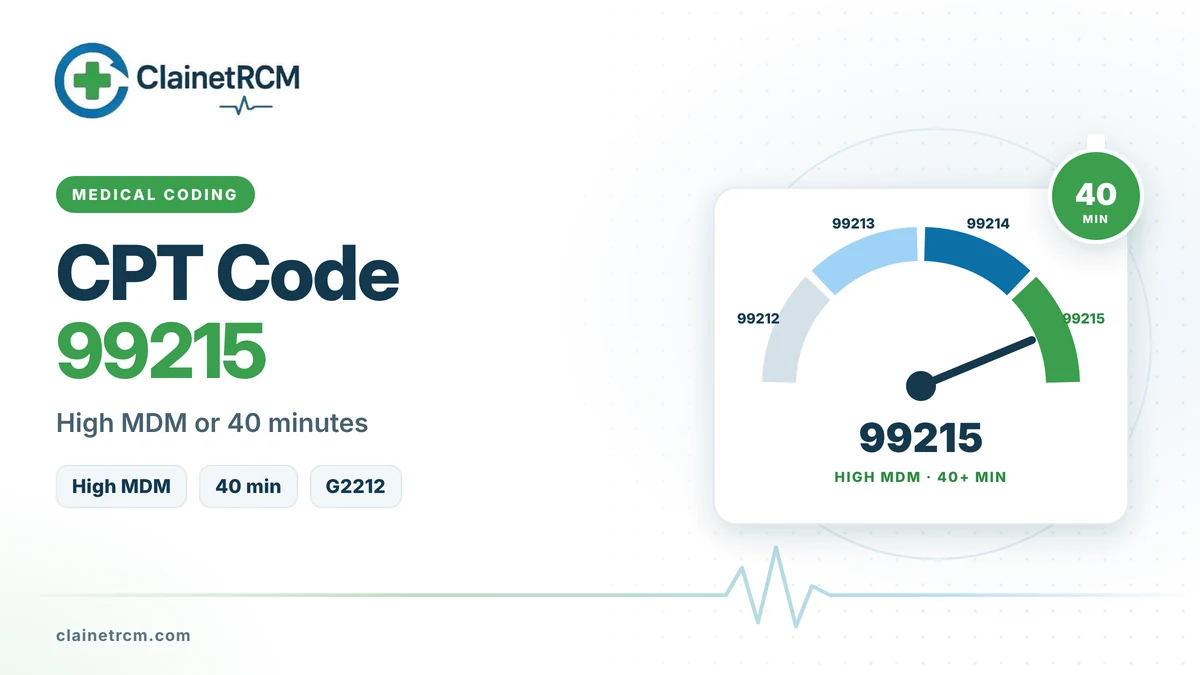
Quick answer: CPT code 99215 is supported by high medical decision making (MDM) or at least 40 minutes of total practitioner time on the date of the encounter. The 2026 Medicare national rate is $192.39 in the office and $125.59 in a facility. When time runs well past 40 minutes, commercial plans that follow CPT may pay 99417 starting at 55 minutes, while Medicare pays G2212 starting at 69 minutes.
CPT Code 99215 at a Glance
| Item | Detail |
|---|---|
| Descriptor | Office or other outpatient visit for an established patient, requiring a medically appropriate history and/or examination and high medical decision making |
| Time threshold | 40 minutes of total time on the date of the encounter, met or exceeded |
| 2026 Medicare national rate | $192.39 non-facility, $125.59 facility |
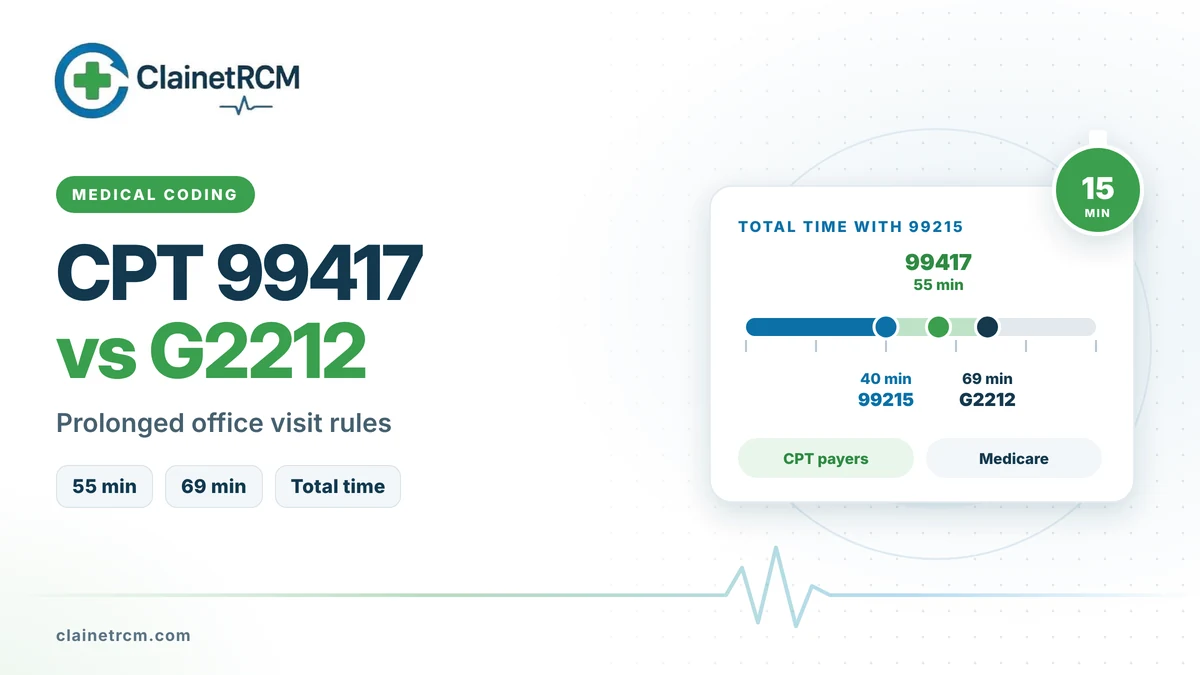
| Prolonged time (CPT) | 99417, first unit at 55 minutes |
| Prolonged time (Medicare) | G2212, first unit at 69 minutes |
| Longitudinal care add-on | G2211 (Medicare), $17.37 in 2026 |
What CPT Code 99215 Requires
As with every office visit code since 2021, the level is chosen by MDM or total time, not by counting history and exam elements. The note still needs a medically appropriate history and exam.
- By MDM: the visit must reach high complexity in two of the three MDM elements.
- By time: the billing practitioner must spend at least 40 minutes on the patient’s care on the date of the encounter.
High MDM: The Three Elements
To reach high MDM, two of these three must meet or exceed the high level:
| MDM element | What high looks like |
|---|---|
| Problems addressed | One or more chronic illnesses with severe exacerbation, progression or side effects of treatment; or one acute or chronic illness or injury that poses a threat to life or bodily function |
| Data reviewed and analyzed | Extensive: at least two of three categories: (1) any combination of three items from external notes, unique test results, unique tests ordered or an independent historian; (2) independent interpretation of a test performed by another physician; (3) discussion of management with an external physician or other qualified source |
| Risk of patient management | High: drug therapy requiring intensive monitoring for toxicity; a decision about elective major surgery with patient or procedure risk factors; a decision about emergency major surgery; a decision about hospitalization or escalation of hospital-level care; a decision not to resuscitate or to de-escalate care because of poor prognosis; or parenteral controlled substances |
A note on “intensive monitoring for toxicity.” This applies when a drug has a real risk of serious harm and you monitor for adverse effects, usually with lab testing, such as checking blood counts during chemotherapy or levels during certain immunosuppressive therapy. Routine monitoring of how well a drug is working, such as an A1C for diabetes, does not count.
Billing 99215 on Time
On time, 99215 starts at 40 minutes. What counts is the same as for every office visit: the billing practitioner’s face-to-face and non-face-to-face time on the date of the encounter, including record review, the exam, counseling, ordering, care coordination and documentation. Clinical staff time and separately billed services do not count.
When a visit runs long, the prolonged services add-on depends on the payer. This table shows the total time at which each unit can first be billed with 99215:
| Prolonged code | Who uses it | First unit | Second unit | Third unit |
|---|---|---|---|---|
| 99417 | Payers that follow CPT | 55 minutes | 70 minutes | 85 minutes |
| G2212 | Medicare and plans that follow Medicare | 69 minutes | 84 minutes | 99 minutes |
Medicare starts counting prolonged time only after the old top of the 99215 range, 54 minutes, plus a full 15 minutes. That is why G2212 starts at 69 minutes. Our 99417 vs G2212 guide walks through the details.
99215 Examples That Hold Up
Example 1: Severe exacerbation with escalation. A patient with heart failure has worsening shortness of breath, 4 kg of weight gain and edema. The physician reviews the hospital discharge summary and BNP, adjusts diuretics and decides the patient needs direct admission.
- Problems: chronic illness with severe exacerbation (high)
- Risk: decision regarding hospitalization (high)
- Result: 99215 on MDM
Example 2: Toxicity monitoring. A patient on methotrexate for rheumatoid arthritis has new mouth sores. The physician reviews the CBC and liver panel, finds a drop in white cells, holds the drug and orders repeat labs.
- Problems: chronic illness with severe side effects of treatment (high)
- Risk: drug therapy requiring intensive monitoring for toxicity (high)
- Result: 99215 on MDM
Example 3: A long counseling visit. A patient with newly diagnosed cancer and their family spend most of a visit reviewing treatment options. The physician documents 48 minutes of total time, including reviewing outside records and coordinating with the oncology team.
- Result: 99215 on time
2026 Payment for CPT Code 99215
The 2026 Medicare national rate for 99215 is $192.39 in a non-facility setting and $125.59 in a facility setting. The office rate is up about 9.5% from 2025’s $175.64. That makes it the largest percentage increase in the established patient family this year. Facility payment fell because CMS reduced the practice expense it credits to facility-based visits.
Add-ons that can apply:
- G2211 ($17.37 nationally in 2026) when you are the continuing focal point of care or manage a serious or complex condition over time. In 2027 it becomes modifier B1, which adds 16% to the E/M payment.
- G2212 (about $34 nationally in 2026) for each full 15 minutes past the Medicare threshold.
Starting January 1, 2027, the standard Medicare conversion factor drops to $32.63, so expect 2027 rates to dip slightly.
Why 99215 Draws Scrutiny
Payers have built automated downcoding programs around level 4 and 5 visits. Cigna’s Reimbursement Policy R49, effective October 1, 2025, can reduce 99215 to 99214 when the claim’s diagnoses do not appear to support the level. Aetna has also expanded its review of level 4 and 5 claims. Both programs work from the claim data, so a 99215 with one vague diagnosis code is the easiest target.
Protect your 99215s by:
- Coding every problem addressed, at full specificity, with the most serious first
- Making the high-risk decision explicit in the plan (“Discussed admission; patient agrees to direct admission”)
- Including a time statement on long visits, even when you bill on MDM, as a backup
- Comparing payments to your fee schedule so silent downcodes get appealed
Documentation Checklist for 99215
- The severity of each problem is stated, not implied (“severe exacerbation,” “threat to bodily function”)
- The data you reviewed or ordered are named, with the source of external notes
- Independent interpretation of a test, if any, is written out in your own words
- The high-risk management decision is recorded with the reasoning
- For time billing: total minutes on the date of service and a summary of the activities
Frequently Asked Questions
CPT code 99215 is an office or outpatient visit for an established patient that requires a medically appropriate history and exam and high medical decision making, or at least 40 minutes of total time on the date of the visit.
The national rate is $192.39 in a non-facility setting and $125.59 in a facility setting, before geographic adjustment.
Only when you select 99215 by time. Payers that follow CPT accept 99417 from 55 minutes of total time. Medicare and plans that follow Medicare require G2212, which starts at 69 minutes.
Not by itself. It becomes a risk when a clinician bills 99215 far more often than peers, or when the documentation does not show high MDM or 40 minutes. Accurate, specific documentation is the best defense.
Yes, when the visit meets the requirements. For Medicare, use POS 10 when the patient is at home and POS 02 for other locations. Medicare telehealth flexibilities, including care in the patient’s home, run through December 31, 2027.
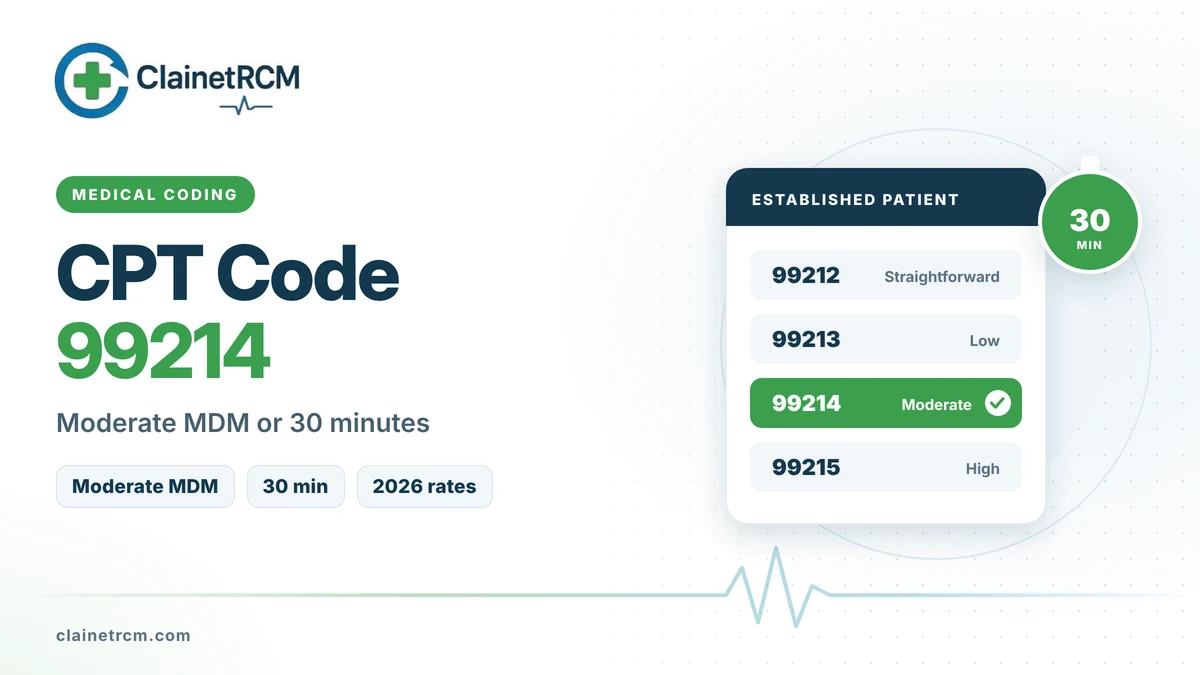
99214 requires moderate MDM or 30 minutes. 99215 requires high MDM or 40 minutes. The difference comes down to severity, the volume of data and the risk of the management decision. See our 99214 guide for the moderate level.
Final Thoughts
CPT code 99215 is not a code to avoid. It is a code to document well. When the note makes the severity, the data and the high-risk decision obvious, or records the time spent, 99215 pays what the visit is worth. Our medical coding services include E/M audits that catch both undercoded and overcoded visits, and our denial management team appeals downcoded claims with the records to back them.
Get Paid for Your Most Complex Visits
Our certified coders confirm when your notes support 99215, add the right prolonged services code, and help you appeal when payers downcode.
Get a Free E/M Audit
Written by
ClainetRCM Billing Team
ClainetRCM is a Boston-based revenue cycle management company specializing in medical billing, coding, credentialing and denial management for healthcare providers across all 50 states. Our AAPC and AHIMA certified team works inside your existing EHR, files claims within 24 to 48 hours and reviews every AR bucket on a 14-day cycle.