Long visits are common in primary care, psychiatry, oncology and any practice that manages complex patients. When the time goes well beyond a level 5 visit, there is a code for it, but which code depends on who pays the claim. CPT code 99417 and Medicare’s G2212 describe the same idea with different math, and mixing them up is one of the most common prolonged services errors.
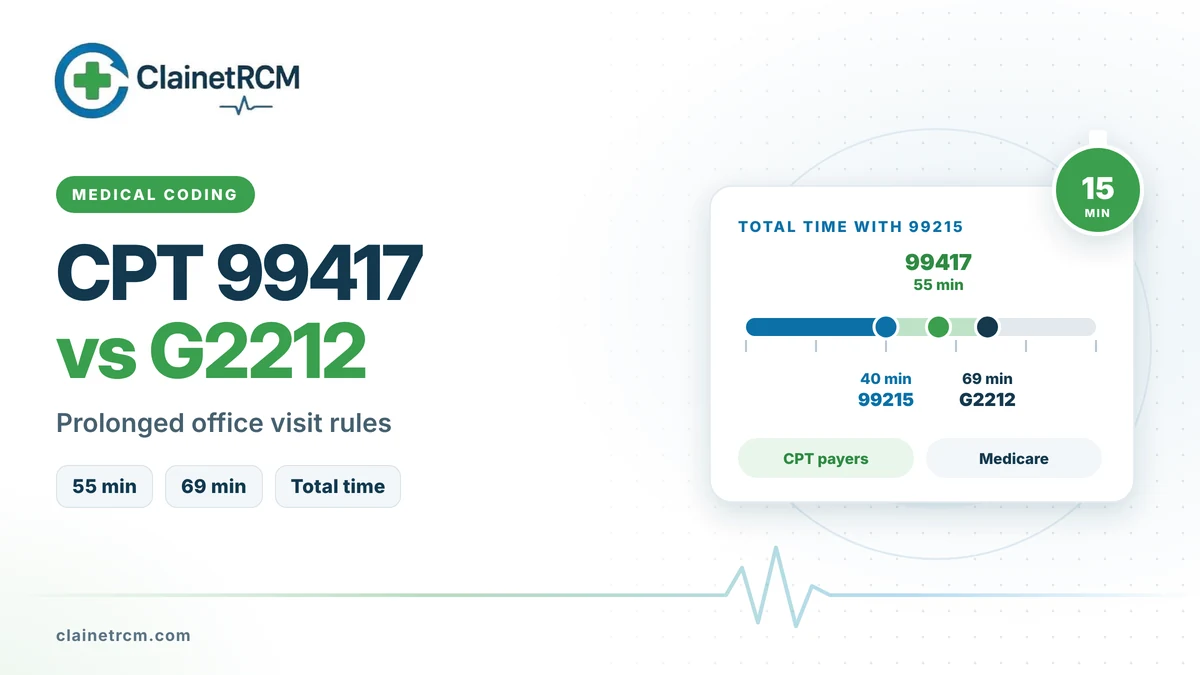
Quick answer: CPT code 99417 adds each 15 minutes of total time beyond a level 5 office visit when the level was selected by time. Payers that follow CPT accept it starting at 55 minutes with 99215 and 75 minutes with 99205. Medicare does not pay 99417. It uses G2212, which starts at 69 minutes with 99215 and 89 minutes with 99205. G2212 pays about $34 nationally in 2026.
CPT Code 99417 vs G2212 at a Glance
| Item | 99417 (CPT) | G2212 (Medicare) |
|---|---|---|
| Who uses it | Commercial plans and others that follow CPT | Medicare and plans that follow Medicare rules |
| Base office codes | 99205, 99215 | 99205, 99215 |
| Level chosen by | Total time only | Total time only |
| First unit with 99215 | 55 minutes | 69 minutes |
| First unit with 99205 | 75 minutes | 89 minutes |
| Each additional unit | Every full 15 minutes | Every full 15 minutes |
| 2026 Medicare national rate | Not payable by Medicare | About $34 |
What CPT Code 99417 Covers
CPT code 99417 reports prolonged outpatient E/M time, with or without direct patient contact, beyond the time required for the primary service, when the primary service was selected using total time. Each unit is 15 minutes, and a unit is reported only once the full 15 minutes have passed.
Key rules:
- Time-based only. If you chose 99215 on medical decision making, you cannot add 99417, however long the visit took.
- Level 5 only. In the office, 99417 attaches only to 99205 or 99215. It cannot be added to 99214 or lower levels.
- Same date. Time counts only on the date of the encounter.
- Practitioner time only. Clinical staff time does not count.
CPT also allows 99417 with a few other time-based codes, including the level 5 home or residence visits and the cognitive assessment and care plan service, 99483.
Why Medicare Uses G2212 Instead
The two codes count from different starting points.
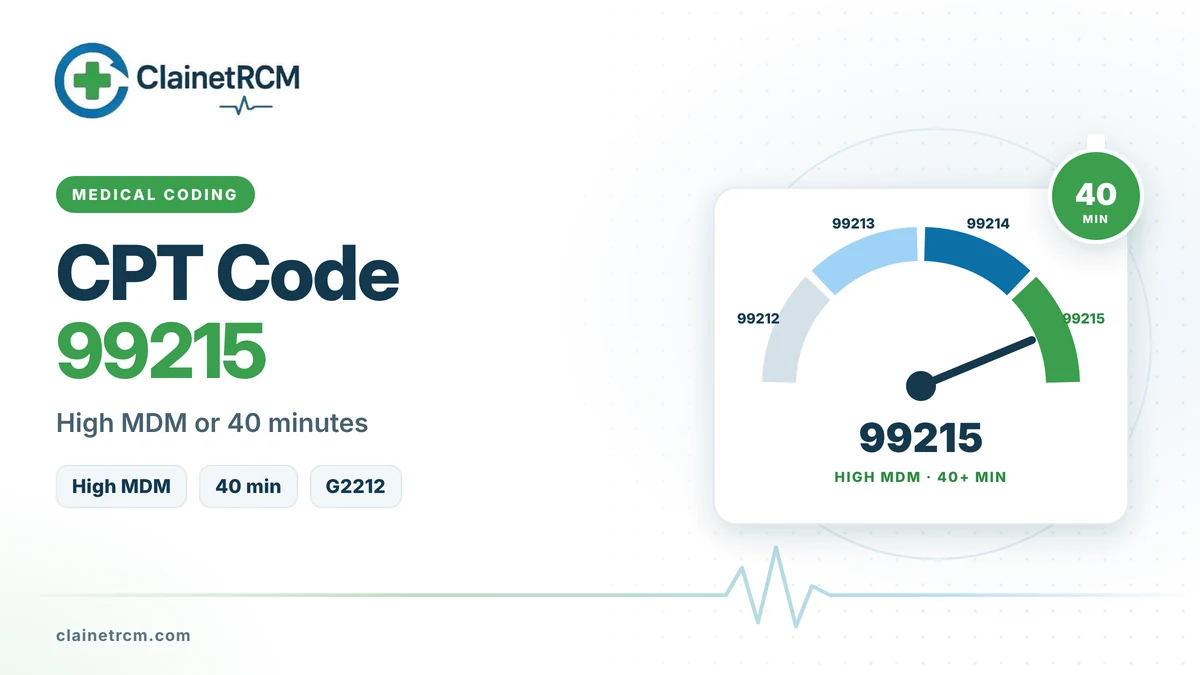
- CPT starts the prolonged clock after the minimum time of the level 5 code: 40 minutes for 99215 and 60 minutes for 99205. The first unit of 99417 is reported once 15 more minutes have passed, at 55 or 75 minutes.
- Medicare starts the clock after the top of the old time range: 54 minutes for 99215 and 74 minutes for 99205. The first unit of G2212 is reported only after a full 15 minutes beyond that, at 69 or 89 minutes.
CMS created G2212 to apply its own reading of the time rules, and it confirms the 69- and 89-minute thresholds in its current E/M services booklet.
Time Thresholds Table
| Total time with 99215 | CPT payers | Medicare |
|---|---|---|
| 40 to 54 minutes | 99215 | 99215 |
| 55 to 69 minutes | 99215 + 99417 x 1 | 99215 (G2212 x 1 at 69) |
| 70 to 84 minutes | 99215 + 99417 x 2 | 99215 + G2212 x 1 (x 2 at 84) |
| 85 to 99 minutes | 99215 + 99417 x 3 | 99215 + G2212 x 2 (x 3 at 99) |
| Total time with 99205 | CPT payers | Medicare |
|---|---|---|
| 60 to 74 minutes | 99205 | 99205 |
| 75 to 89 minutes | 99205 + 99417 x 1 | 99205 (G2212 x 1 at 89) |
| 90 to 104 minutes | 99205 + 99417 x 2 | 99205 + G2212 x 1 (x 2 at 104) |
| 105 to 119 minutes | 99205 + 99417 x 3 | 99205 + G2212 x 2 (x 3 at 119) |
Example: A 100-minute new patient visit is billed 99205 + 99417 x 2 to a commercial plan that follows CPT, but 99205 + G2212 x 1 to Medicare.
Worked Examples
Example 1: Established patient, commercial plan. A patient with several chronic conditions and a recent hospital stay is seen for follow-up. The physician spends 62 minutes on the date of service reviewing discharge records, adjusting medications, counseling the family and documenting. The plan follows CPT. Bill: 99215 + 99417 x 1. The first unit of 99417 is reached at 55 minutes, and the second would require 70.
Example 2: The same visit for a Medicare patient. The total time is again 62 minutes. Bill: 99215 only. G2212 is not reportable until 69 minutes.
Example 3: Long new patient visit, Medicare. A new patient with complex outside records is evaluated over 95 minutes of total time. Bill: 99205 + G2212 x 1. The second unit would require 104 minutes.
What Counts Toward Prolonged Time
Prolonged time uses the same total time rules as the base visit. The billing practitioner’s time on the date of the encounter counts, including:
- Reviewing records and test results before or after the visit
- The history, exam and counseling
- Ordering tests, medications and referrals
- Talking with other clinicians, when not billed separately
- Documenting in the record
- Care coordination, when not billed separately
It does not include clinical staff time, travel, time spent on separately billed services or work on a different day. In the office setting, split or shared visits do not apply. The billing practitioner’s own time is what counts.
Prolonged Services in Other Settings
The office codes do not cover every setting. For Medicare:
- G0316 reports prolonged hospital inpatient or observation care
- G0317 reports prolonged nursing facility care
- G0318 reports prolonged home or residence care
CPT uses 99418 for prolonged inpatient and observation services and 99417 for home or residence visits. Check which code set each payer follows before you bill.
Which Payers Accept 99417
- Traditional Medicare: G2212 only. A 99417 line is denied.
- Medicare Advantage: most follow Medicare and require G2212, but check each plan.
- Commercial plans: many accept 99417 under CPT rules. Some follow Medicare and want G2212, and a few do not pay prolonged services at all.
- Medicaid: varies by state.
Build payer-specific rules into your billing system so the correct code is applied automatically. Many EHRs can convert 99417 to G2212 for Medicare claims.
Documentation Tips
- Write a total time statement. “I spent a total of 72 minutes on this patient’s care today” is the core of the claim.
- List the activities. A short summary, such as reviewing outside records, counseling the patient and family or coordinating with the surgeon, shows the time was medically necessary.
- Start and stop times are not required for office visits, but the total must be clear.
- Keep separately billed work out of the count. If you bill an EKG interpretation, do not count that time again.
- Make sure the level was chosen by time. A note that supports 99215 on MDM but also lists 70 minutes should state that the level was chosen by time if you add 99417 or G2212.
Frequently Asked Questions
CPT code 99417 is an add-on for each 15 minutes of prolonged total time beyond a level 5 office or outpatient visit (99205 or 99215) when the visit level was chosen by time.
No. Medicare uses G2212 for prolonged office and outpatient visits. A 99417 line on a Medicare claim is denied.
When total time on the date of service reaches at least 69 minutes. Add another unit at 84 minutes, and again at 99 minutes.
No. In the office setting, 99417 attaches only to 99205 and 99215. If a 99214 visit runs long enough, it supports 99215 by time instead.
About $34 per unit nationally in 2026, before geographic adjustment.
No. Only the billing physician’s or qualified health care professional’s own time counts.
Final Thoughts
Prolonged services are worth billing when the time is real and documented, but the code and threshold must match the payer. Use 99417 where CPT rules apply, G2212 for Medicare, and a clear time statement for both. For the base visit rules, see our 99215 guide. Our medical coding services include payer-specific rules for every add-on code.
Get Paid for Every Long Visit
We apply the right prolonged services code for each payer, check your time statements and recover underpaid long visits.
Talk to a Coding Expert
Written by
ClainetRCM Billing Team
ClainetRCM is a Boston-based revenue cycle management company specializing in medical billing, coding, credentialing and denial management for healthcare providers across all 50 states. Our AAPC and AHIMA certified team works inside your existing EHR, files claims within 24 to 48 hours and reviews every AR bucket on a 14-day cycle.