New patient CPT codes pay more than established patient codes at the same level, so two questions decide whether a first visit gets paid correctly: is the patient really new, and which level did the visit reach? Both questions have clear rules, and both cause a steady stream of denials when practices guess.
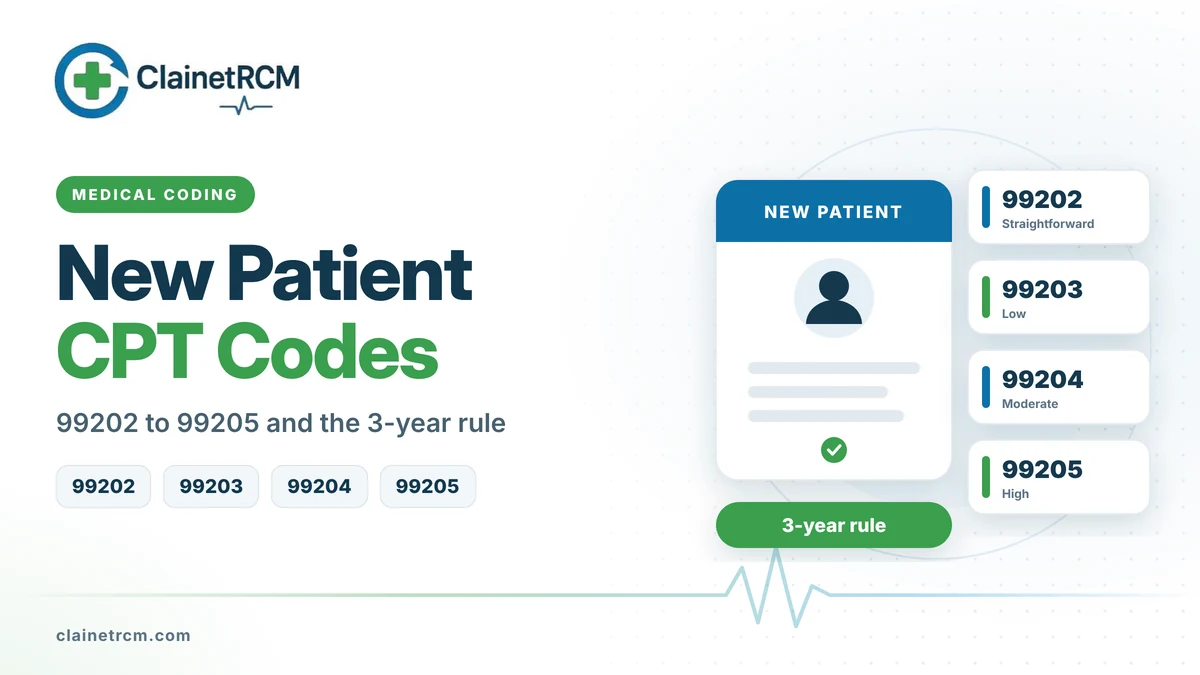
Quick answer: The new patient CPT codes for office visits are 99202, 99203, 99204 and 99205. A patient is new if they have not received professional services from the physician, or another physician of the exact same specialty and subspecialty in the same group, within the past three years. The level is chosen by medical decision making (MDM) or total time: 15, 30, 45 or 60 minutes for levels 2 through 5. Code 99201 was deleted in 2021.
New Patient CPT Codes at a Glance
| Code | MDM level | Total time (met or exceeded) | 2026 Medicare national (office) | 2026 Medicare national (facility) |
|---|---|---|---|---|
| 99202 | Straightforward | 15 minutes | $75.15 | $41.08 |
| 99203 | Low | 30 minutes | $117.57 | $71.48 |
| 99204 | Moderate | 45 minutes | $177.36 | $116.90 |
| 99205 | High | 60 minutes | $236.81 | $160.32 |
Each code requires a medically appropriate history and exam, but the history and exam no longer set the level.
Who Counts as a New Patient: The Three-Year Rule
CPT defines a new patient as one who has not received any professional services from the physician or other qualified health care professional, or from another physician or QHP of the exact same specialty and subspecialty who belongs to the same group practice, within the past three years.
What that means in practice:
- Professional services are face-to-face services rendered by a physician or QHP and reported with a CPT or HCPCS code. Interpreting a test without seeing the patient, such as reading an EKG, does not make the patient established.
- Same group, same specialty counts. If a patient saw Dr. Lee two years ago, they are established for Dr. Patel if both are internists in the same group.
- Different specialty, same group can be new. A patient seen by the group’s cardiologist can be a new patient for the group’s dermatologist.
- NPs and PAs are treated as the same specialty as the physicians they work with, so a visit with a group’s nurse practitioner makes the patient established for that specialty.
- Covering physicians classify the patient as they would have been classified by the physician who is unavailable.
- Telehealth visits count. A video visit within the past three years makes the patient established.
- Moving to a new group does not automatically make a patient new. If the physician sees the patient at the new practice within three years, the patient is established for that physician.
“New problem” is not the same as “new patient.” An established patient with a brand-new complaint is still billed with established patient codes, 99212 to 99215.
Choosing the Level by Medical Decision Making
MDM has three elements: problems addressed, data reviewed and analyzed, and risk of patient management. The visit level is set by the two highest-scoring elements.
| Code | Problems (examples) | Data | Risk (examples) |
|---|---|---|---|
| 99202 | One self-limited or minor problem | Minimal or none | Minimal |
| 99203 | One stable chronic illness; one acute uncomplicated illness or injury; two or more minor problems | Limited | Low, such as over-the-counter drugs |
| 99204 | Chronic illness with exacerbation; two or more stable chronic illnesses; undiagnosed new problem with uncertain prognosis; acute illness with systemic symptoms | Moderate | Moderate, such as prescription drug management |
| 99205 | Chronic illness with severe exacerbation; illness posing a threat to life or bodily function | Extensive | High, such as a decision about hospitalization or major surgery with risk factors |
New patients often supply outside records, so the data element tends to score higher than at follow-up visits. Reviewing notes from each unique outside source counts, as does ordering and reviewing unique tests.
Choosing the Level by Time
Total time is the billing practitioner’s time on the date of the encounter, face-to-face and non-face-to-face. It includes reviewing outside records, the history and exam, counseling, ordering, care coordination and documentation. It does not include clinical staff time or time on separately billed services.
| Code | Time threshold |
|---|---|
| 99202 | 15 minutes |
| 99203 | 30 minutes |
| 99204 | 45 minutes |
| 99205 | 60 minutes |
When a new patient visit runs past 99205, add prolonged time:
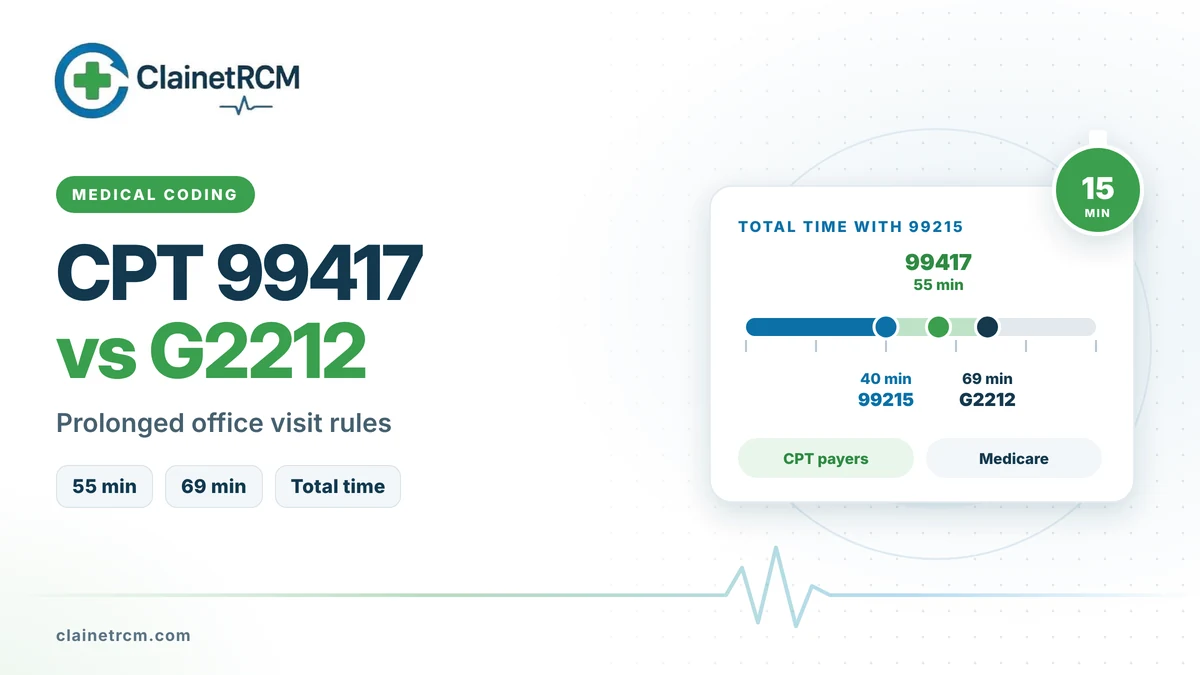
- 99417 for payers that follow CPT: first unit at 75 minutes, then each additional 15 minutes
- G2212 for Medicare: first unit at 89 minutes, then each additional 15 minutes
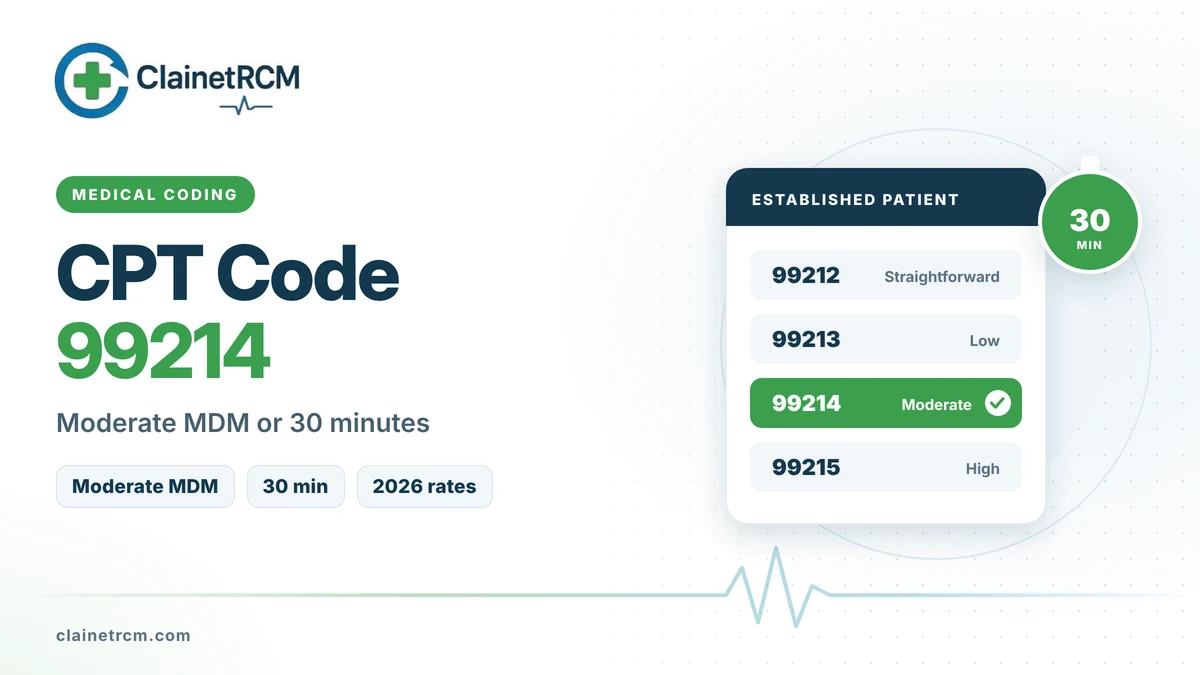
Our 99417 vs G2212 guide explains why the thresholds differ.
99201 Is Gone, and Consult Codes Are Limited
CPT deleted 99201 effective January 1, 2021, so the new patient series now starts at 99202. A claim with 99201 will be rejected.
Consultation codes are another trap. Medicare stopped paying office consultation codes in 2010. For Medicare patients, bill the new patient code (or established patient code, if applicable) instead. Some commercial plans still pay consultation codes, so check the payer before you choose.
2026 Payment for New Patient Visits
Medicare raised 2026 office rates for every new patient level: 99202 rose from $69.87 to $75.15, 99203 from $109.01 to $117.57, 99204 from $163.35 to $177.36 and 99205 from $215.75 to $236.81. Facility rates fell by about 9% to 10% because CMS reduced the practice expense it credits to facility-based visits.
Other payment points:
- G2211 can be added to a new patient visit when the practitioner will be the continuing focal point of the patient’s care or will manage a serious or complex condition over time. It pays $17.37 nationally in 2026 and becomes modifier B1, worth 16% of the E/M payment, in 2027.
- 2027 conversion factor. The standard Medicare conversion factor falls to $32.63 on January 1, 2027.
Common New Patient Coding Errors
- Billing a new patient code for a patient seen by a same-specialty colleague within three years. Check the practice management system for prior visits across the whole group, not just the treating provider.
- Treating a new problem as a new patient.
- Using 99201. It no longer exists.
- Billing consultation codes to Medicare.
- Ignoring specialty enrollment. Payers compare specialties based on how each provider is enrolled. A physician credentialed as internal medicine is the same specialty as other internists in the group, even with a subspecialty interest.
- Leveling by habit. Many practices bill 99204 for nearly every new patient. A patient with one minor problem is a 99202 or 99203, however long the intake paperwork took.
Frequently Asked Questions
The office and outpatient new patient codes are 99202, 99203, 99204 and 99205. They range from straightforward to high medical decision making, or 15 to 60 minutes of total time.
A patient is new until they receive professional services from the physician or a same-specialty colleague in the same group. After that, they are established for three years from the last professional service.
Yes, if the doctors are in different specialties or subspecialties. If they share the exact same specialty and subspecialty, the patient is established for both.
Yes. Nurse practitioners and physician assistants are treated as working in the same specialty as the physicians they work with, so their visits count toward the three-year rule.
Nothing replaced it. 99201 was deleted in 2021, and 99202 is now the lowest level new patient office visit.
The 2026 national rate for 99204 is $177.36 in the office and $116.90 in a facility setting, before geographic adjustment.
Final Thoughts
New patient visits are worth getting right twice: once for the status and once for the level. A quick look-back across the whole group and a clear MDM or time statement solve most problems before they become denials. For the follow-up visits that come next, see our 99214 guide. Our medical billing services check patient status and visit levels before claims go out.
Start Every New Patient Relationship With a Clean Claim
Our team checks new versus established status, the visit level and payer rules before claims go out, so first visits get paid the first time.
Talk to a Coding Expert
Written by
ClainetRCM Billing Team
ClainetRCM is a Boston-based revenue cycle management company specializing in medical billing, coding, credentialing and denial management for healthcare providers across all 50 states. Our AAPC and AHIMA certified team works inside your existing EHR, files claims within 24 to 48 hours and reviews every AR bucket on a 14-day cycle.