CPT code 99214 is the level 4 office visit for an established patient, and it is one of the codes practices bill most often. It is also one of the codes payers watch most closely. Bill it when the visit truly reached moderate complexity, and you get paid fairly for the work. Bill it out of habit, and you invite downcoding, audits and refunds.
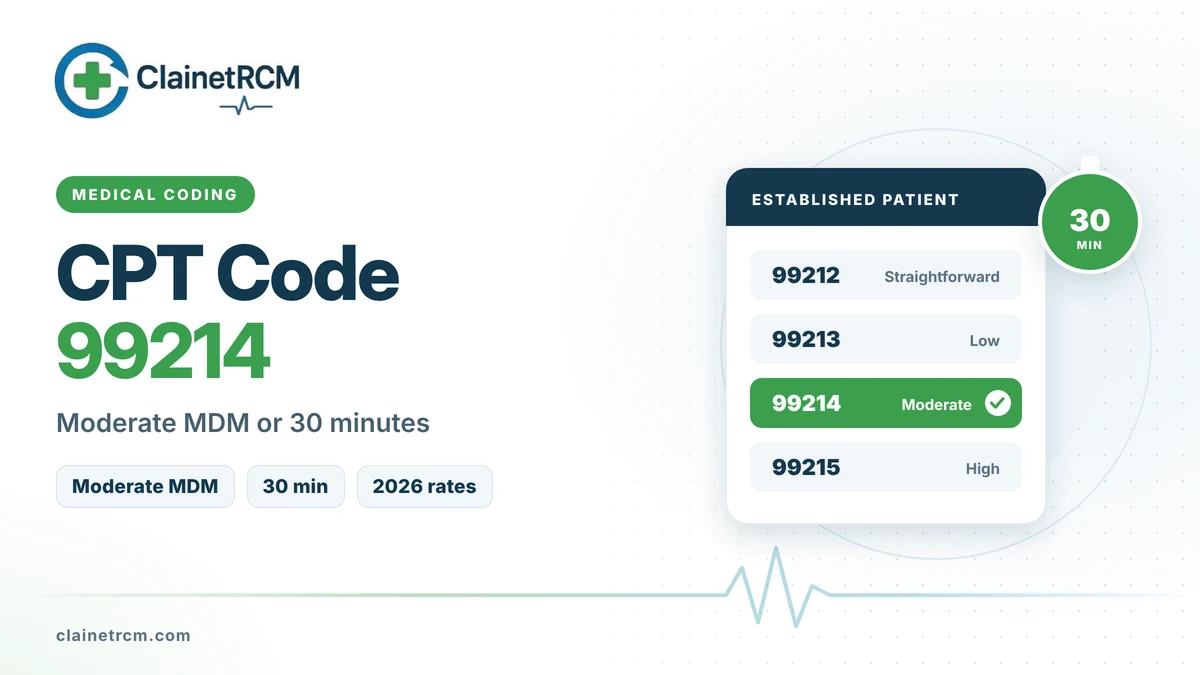
Quick answer: CPT code 99214 is supported when an established patient visit involves moderate medical decision making (MDM) or at least 30 minutes of total practitioner time on the date of the encounter. In 2026, the Medicare national rate is $135.61 in the office and $84.50 in a facility setting. You choose the level by MDM or by time, whichever better reflects the visit, and the note has to show it.
This guide explains both paths to 99214, gives documentation examples, compares 99214 with 99213 and 99215, and covers the payer policies that are reshaping how level 4 visits are paid.
CPT Code 99214 at a Glance
| Item | Detail |
|---|---|
| Descriptor | Office or other outpatient visit for an established patient, requiring a medically appropriate history and/or examination and moderate medical decision making |
| Time threshold | 30 minutes of total time on the date of the encounter, met or exceeded |
| Patient type | Established (seen by your group, same specialty, within three years) |
| 2026 Medicare national rate | $135.61 non-facility, $84.50 facility |
| Common add-on | G2211 for longitudinal care (Medicare), $17.37 in 2026 |
| Prolonged time add-on | Not allowed with 99214; prolonged codes attach only to 99215 |
What CPT Code 99214 Requires
Since the 2021 office visit overhaul, history and exam no longer drive the level. The note must include a “medically appropriate” history and exam, but the level is chosen in one of two ways:
- Medical decision making. The visit meets moderate MDM.
- Total time. The billing practitioner spends at least 30 minutes on the patient’s care on the date of the encounter.
You pick whichever method supports the visit better. A complex visit that took only 25 minutes can still be a 99214 on MDM, and a straightforward visit that took 35 minutes because of extensive counseling can be a 99214 on time. In 2024, CPT replaced the old time ranges with single thresholds, so 30 minutes is now the line to meet or exceed rather than a range of 30 to 39 minutes.
Meeting 99214 With Medical Decision Making
MDM has three elements. To reach moderate MDM, the visit must meet or exceed moderate in two of the three:
| MDM element | What moderate looks like |
|---|---|
| Number and complexity of problems addressed | One or more chronic illnesses with exacerbation, progression or side effects of treatment; two or more stable chronic illnesses; one undiagnosed new problem with uncertain prognosis; one acute illness with systemic symptoms; or one acute complicated injury |
| Amount and complexity of data reviewed and analyzed | At least one of three categories: (1) any combination of three items from reviewing external notes, reviewing results of unique tests, ordering unique tests or using an independent historian; (2) independent interpretation of a test performed by another physician; or (3) discussion of management with an external physician or other qualified source |
| Risk of complications from patient management | Examples include prescription drug management, a decision about minor surgery with patient or procedure risk factors, a decision about elective major surgery without risk factors, or diagnosis or treatment significantly limited by social determinants of health |
Two points trip up many practices:
- “Addressed” means evaluated or treated. A problem that is only listed in the chart, or noted as being managed by another clinician, does not count toward the visit’s complexity.
- Prescription drug management is a risk element, not a problem element. It covers starting, stopping, continuing or adjusting a prescription after weighing the risks and benefits. Documenting that decision is what earns the moderate risk credit.
Meeting 99214 With Total Time
Time-based selection counts the billing practitioner’s total time on the date of the encounter, face-to-face and non-face-to-face. Thirty minutes or more supports 99214.
Time that counts: - Preparing to see the patient, such as reviewing tests and records - Obtaining or reviewing a separately obtained history - Performing the exam and evaluation - Counseling and educating the patient, family or caregiver - Ordering medications, tests or procedures - Referring and communicating with other professionals, when not separately reported - Documenting in the electronic health record - Independently interpreting results and communicating them, when not separately reported - Care coordination, when not separately reported
Time that does not count: - Clinical staff time, such as a nurse’s intake or education - Time spent on separately billed services, such as a procedure or EKG interpretation billed on its own - Travel time - Work done on a different date
A short time statement such as “I spent 34 minutes on this patient’s care today, including record review, counseling and documentation” is the cleanest support.
99213 vs 99214 vs 99215
| Code | MDM level | Time threshold | 2026 Medicare national (office) |
|---|---|---|---|
| 99213 | Low | 20 minutes | $95.19 |
| 99214 | Moderate | 30 minutes | $135.61 |
| 99215 | High | 40 minutes | $192.39 |
The jump from 99213 to 99214 is worth $40.42 per visit at national Medicare rates, so getting the level right matters in both directions. Undercoding leaves money behind on every visit. Overcoding builds an audit pattern.
99214 Documentation Examples
Example 1: Two stable chronic illnesses with drug management. A patient with hypertension and type 2 diabetes returns for follow-up. Both are stable. The physician reviews the A1C and metabolic panel, continues metformin and lisinopril after weighing kidney function, and orders a urine albumin test.
- Problems: two stable chronic illnesses (moderate)
- Data: reviewed two unique test results and ordered one test (moderate, Category 1)
- Risk: prescription drug management (moderate)
- Result: 99214 on MDM
Example 2: Acute illness with systemic symptoms. A patient presents with three days of productive cough, fever and body aches. The physician examines the patient, orders a chest X-ray, diagnoses community-acquired pneumonia and prescribes an antibiotic.
- Problems: acute illness with systemic symptoms (moderate)
- Risk: prescription drug management (moderate)
- Result: 99214 on MDM, even if the visit was brief
Example 3: A visit that is really a 99213. A patient with well-controlled hypothyroidism comes in for a refill. Labs are normal, and the dose is continued.
- Problems: one stable chronic illness (low)
- Data: one test reviewed (limited)
- Risk: prescription drug management (moderate)
- Result: only one element reaches moderate, so MDM is low and the visit is a 99213 unless total time reaches 30 minutes
2026 Payment for CPT Code 99214
Medicare’s 2026 national payment for 99214 is $135.61 in a non-facility setting, such as a physician-owned office, and $84.50 when the visit takes place in a facility setting, such as a hospital outpatient department. The office rate rose about 8% from 2025, while facility rates fell because CMS reduced the practice expense it credits to facility-based visits. Your actual payment depends on your locality’s geographic adjustment.
Two Medicare add-ons and changes affect 99214 revenue:
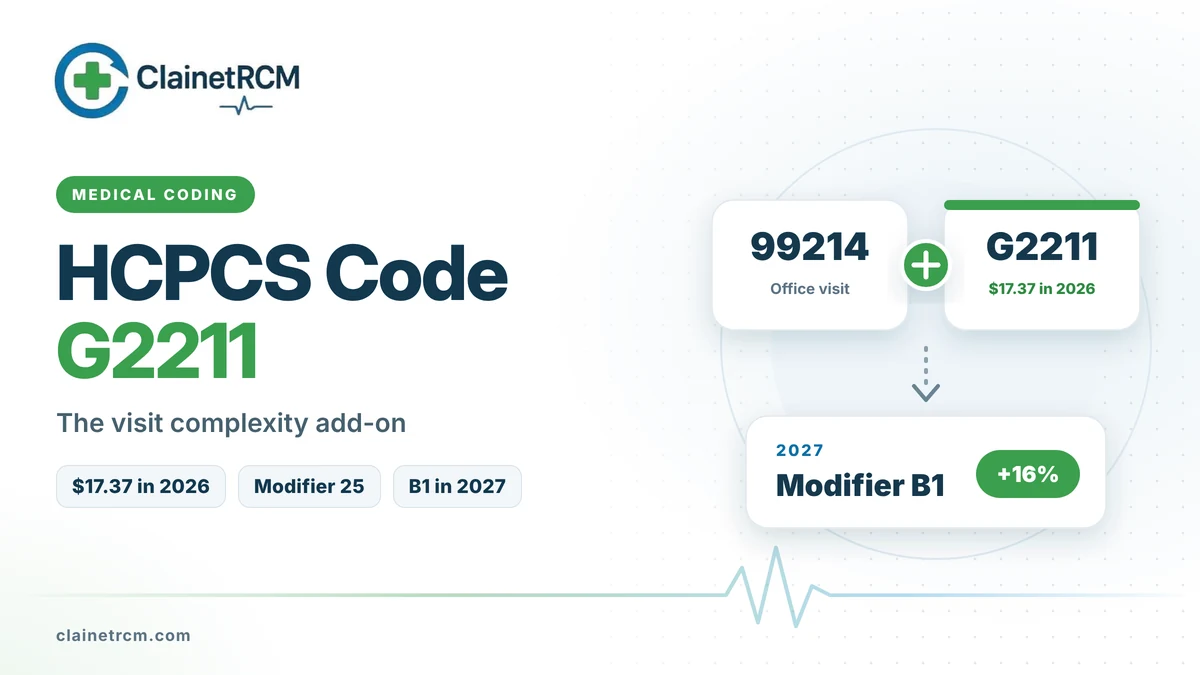
- G2211. When you are the continuing focal point of the patient’s care, or you manage a single serious or complex condition over time, Medicare pays the G2211 add-on with 99214. It is worth $17.37 nationally in 2026. See our G2211 guide for the rules.
- 2027 changes. The CY 2027 Physician Fee Schedule final rule lowers the standard conversion factor from $33.4009 to $32.63 starting January 1, 2027. It also replaces G2211 with modifier B1, which raises the E/M payment by 16% instead of adding a flat amount.
Commercial plans set their own rates, often as a percentage of Medicare, so check your contracts after each Medicare update.
Payer Scrutiny: Downcoding and Audits
Level 4 and 5 visits are now the main target of payer coding programs:
- Cigna Reimbursement Policy R49. Effective October 1, 2025, Cigna may reduce 99204-99205, 99214-99215 and 99244-99245 by one level when the claim’s diagnoses do not appear to support the billed level. Cigna says the policy targets clinicians whose coding patterns run higher than their peers. It paused the policy in California, and in March 2026 Maryland’s insurance regulator fined Cigna and ordered it to stop automatic downcoding in that state.
- Aetna’s Claim and Code Review Program. Aetna has expanded its review of level 4 and 5 E/M claims, which can also result in downcoded payments.
What to do about it:
- Make the diagnosis codes tell the story. Automated programs read the claim, not the chart. List every problem you addressed, coded to full specificity, in the order of the work.
- Watch your remits. A 99214 paid at the 99213 rate does not show up as a denial. Compare the paid amount with your fee schedule.
- Appeal with records. Send the note, highlight the MDM elements or the time statement, and cite the AMA E/M guidelines.
Common 99214 Mistakes
- Counting problems that were listed but not addressed
- Claiming moderate risk without documenting the prescription decision
- Billing on time without a time statement, or counting clinical staff time
- Using 99214 for every follow-up as a default, which creates an outlier pattern
- Adding a prolonged services code to 99214 (prolonged time attaches only to 99215)
- Leaving the diagnosis codes vague, which invites automated downcoding
Frequently Asked Questions
CPT code 99214 is an office or outpatient visit for an established patient that requires a medically appropriate history and exam and moderate medical decision making, or at least 30 minutes of total time on the date of the visit.
The 2026 national Medicare rate is $135.61 in a non-facility setting and $84.50 in a facility setting. Your local rate varies with geographic adjustments.
When you select the level by time, the billing practitioner must spend at least 30 minutes on the patient’s care on the date of the encounter. The old 30-to-39-minute range was replaced with a single threshold in 2024.
No. Use one or the other. Choose whichever method better supports the visit, and document it clearly.
Yes, if the E/M is significant and separately identifiable from the procedure. Append modifier 25 to the 99214 and keep the documentation for the visit distinct from the pre-procedure work. Starting in 2027, Medicare will pay 20% less for the lower-paid service when an E/M with modifier 25 falls on the same day as a 0-day global procedure.
Yes. Nurse practitioners and physician assistants can bill 99214 under their own NPI. Medicare pays them 85% of the physician fee schedule amount unless the service meets incident-to rules.
Final Thoughts
CPT code 99214 rewards documentation that shows the thinking behind the visit: the problems you addressed, the data you used and the risk of the plan you chose. When the note makes those three elements obvious, or records the time you spent, your 99214s hold up against both auditors and automated downcoding. For a second look at your E/M patterns, our medical coding team reviews documentation against the current AMA guidelines, and our family medicine billing specialists know where primary care visits lose money.
Code Every Visit at the Level It Earned
Our certified coders review your E/M documentation, catch undercoded and overcoded visits, and help you defend your 99214s when payers push back.
Get a Free E/M Audit
Written by
ClainetRCM Billing Team
ClainetRCM is a Boston-based revenue cycle management company specializing in medical billing, coding, credentialing and denial management for healthcare providers across all 50 states. Our AAPC and AHIMA certified team works inside your existing EHR, files claims within 24 to 48 hours and reviews every AR bucket on a 14-day cycle.