Anesthesia base units are the starting point for how anesthesia services are paid. Unlike most physician services, anesthesia is not paid from a flat fee per code. Payment adds the code’s base units to units for the time the anesthesia provider spent with the patient, and sometimes extra units for patient risk, then multiplies the total by an anesthesia conversion factor. Missing minutes or the wrong modifier changes payment on every case.
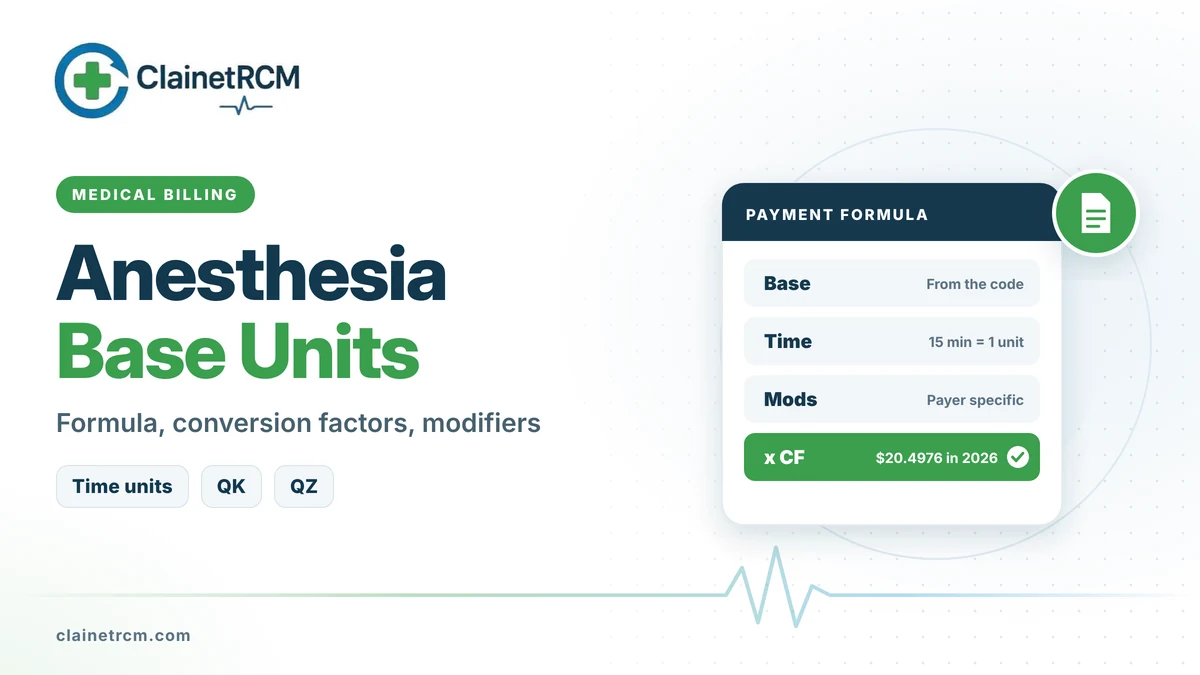
Quick answer: Payment equals (base units + time units + any modifying units) × the anesthesia conversion factor, adjusted for locality. Base units come from the anesthesia code. Medicare counts one time unit per 15 minutes, reported in actual minutes. The 2026 national anesthesia conversion factor is $20.4976 for most clinicians ($20.5998 for qualifying APM participants), and the final 2027 factor drops to $20.1056 ($20.3068 for qualifying APM participants). Modifiers such as AA, QK, QX, QY and QZ tell the payer who performed the service and whether it was medically directed.
The Anesthesia Payment Formula
| Element | What it is | Where it comes from |
|---|---|---|
| Base units | The relative value of the anesthesia code | CMS anesthesia base unit file (Medicare) or the ASA Relative Value Guide (many commercial payers) |
| Time units | Minutes of anesthesia time divided by 15 | Start and stop times in the anesthesia record |
| Modifying units | Extra units for physical status or qualifying circumstances | Payer policy; Medicare does not pay them |
| Conversion factor | Dollars per unit | Medicare national or locality factor, or the commercial contract |
Examples of Anesthesia Base Units
| Anesthesia code | Procedure area | Typical CMS base units |
|---|---|---|
| 00142 | Lens surgery | 4 |
| 00731 | Upper GI endoscopy, not otherwise specified | 5 |
| 00811 | Lower GI endoscopy, not otherwise specified | 4 |
| 00812 | Screening colonoscopy | 3 |
| 01402 | Total knee arthroplasty | 7 |
| 01214 | Total hip arthroplasty | 8 |
Base units are updated periodically, so always pull values from the current CMS file or your contracted relative value guide.
Time Units
For Medicare, anesthesia time starts when the anesthesia practitioner begins preparing the patient for anesthesia in the operating room or an equivalent area and ends when the patient is safely placed under postoperative supervision and the practitioner is no longer in personal attendance. Claims report the total minutes, and Medicare converts them to units at 15 minutes per unit. Commercial payers may round time differently, so follow each contract.
Time must be continuous and documented. Breaks in personal attendance are subtracted, and overlapping cases affect concurrency.
Conversion Factors for 2026 and 2027
| Conversion factor | 2026 | Final 2027 |
|---|---|---|
| Anesthesia, most clinicians | $20.4976 | $20.1056 (down 1.91%) |
| Anesthesia, qualifying APM participants | $20.5998 | $20.3068 (down 1.42%) |
The 2027 cut reflects the end of the one-year 2.5% increase that applied only in 2026. Each Medicare locality has its own adjusted anesthesia conversion factor.
Worked Example
A total knee arthroplasty (01402, 7 base units) with 90 minutes of anesthesia time (6 time units) totals 13 units.
- 2026, national, most clinicians: 13 × $20.4976 = $266.47
- 2027, national, most clinicians: 13 × $20.1056 = $261.37
The final allowed amount is then adjusted for the locality and for the modifiers below.
Anesthesia Modifiers
| Modifier | Meaning | Payment effect |
|---|---|---|
| AA | Anesthesia performed personally by an anesthesiologist | Full allowance |
| QK | Medical direction of two, three or four concurrent procedures | Anesthesiologist paid 50% |
| QY | Medical direction of one CRNA | Anesthesiologist paid 50% |
| QX | CRNA service with medical direction by a physician | CRNA paid 50% |
| QZ | CRNA service without medical direction | Full allowance to the CRNA |
| AD | Medical supervision of more than four concurrent procedures | Sharply reduced payment |
| QS | Monitored anesthesia care | Informational; paired with a payment modifier |
| G8, G9 | Monitored anesthesia care for complex procedures or severe cardiopulmonary history | Supports medical necessity |
An anesthesiologist who personally performs the entire case reports modifier AA, while a CRNA working without medical direction reports QZ. Medical direction requires the anesthesiologist to meet each required step, including the pre-anesthetic exam, the anesthesia plan, personal participation in the most demanding parts such as induction and emergence, frequent monitoring and immediate availability for emergencies. If any step is missed, the service may not qualify as medically directed.
Physical Status Modifiers and Qualifying Circumstances
Many commercial payers add units for patient risk, but Medicare does not.
- Physical status: P1 and P2 add no units; P3 adds 1, P4 adds 2 and P5 adds 3 under the ASA Relative Value Guide. P6 identifies an organ donor.
- Qualifying circumstances: add-on codes such as 99100 (extreme age), 99116 (total body hypothermia), 99135 (controlled hypotension) and 99140 (emergency conditions) add units for some payers and are bundled by Medicare.
Common Anesthesia Billing Errors
- Rounded or missing times. Report exact start and stop times; estimated times invite denials and audits.
- Wrong concurrency modifier. QK applies to two to four concurrent cases; more than four requires AD.
- Missing CRNA claim. When a case is medically directed, both the anesthesiologist and the CRNA must bill with matching information.
- Expecting Medicare to pay modifying units. Physical status and qualifying circumstance units are commercial-payer items.
- Outdated base units. Load the current year’s CMS base unit file into your billing system every January.
Frequently Asked Questions
Each anesthesia CPT code has an assigned number of base units that reflects its complexity. Medicare publishes them in its anesthesia base unit file, and many commercial payers use the ASA Relative Value Guide.
Medicare uses actual minutes from the start of anesthesia preparation to the point the patient is safely handed off for postoperative care, and converts them at 15 minutes per unit.
The final 2027 national anesthesia conversion factor is $20.1056 for most clinicians and $20.3068 for qualifying APM participants, down from $20.4976 and $20.5998 in 2026.
No. Medicare does not add units for P1 to P6 or for qualifying circumstance codes, but many commercial plans do.
Each party bills the case with its own modifier, QK or QY for the anesthesiologist and QX for the CRNA, and Medicare splits the allowance 50% to each.
Final Thoughts
Anesthesia base units are only one piece of the payment; time, modifiers and the conversion factor matter just as much. Learn how we support anesthesia groups on our anesthesiology billing page, or read our specialty medical billing guide.
Capture Every Anesthesia Unit You Earn
We audit anesthesia records for time, base units, concurrency and modifiers so your anesthesiologists and CRNAs are paid correctly by every payer.
Get Anesthesia Billing Help
Written by
ClainetRCM Billing Team
ClainetRCM is a Boston-based revenue cycle management company specializing in medical billing, coding, credentialing and denial management for healthcare providers across all 50 states. Our AAPC and AHIMA certified team works inside your existing EHR, files claims within 24 to 48 hours and reviews every AR bucket on a 14-day cycle.