If you searched for the endometrial biopsy CPT code, you probably want one number fast, and then you want to know why your claim keeps getting kicked back. So here it is, plain and simple, before we go anywhere else.
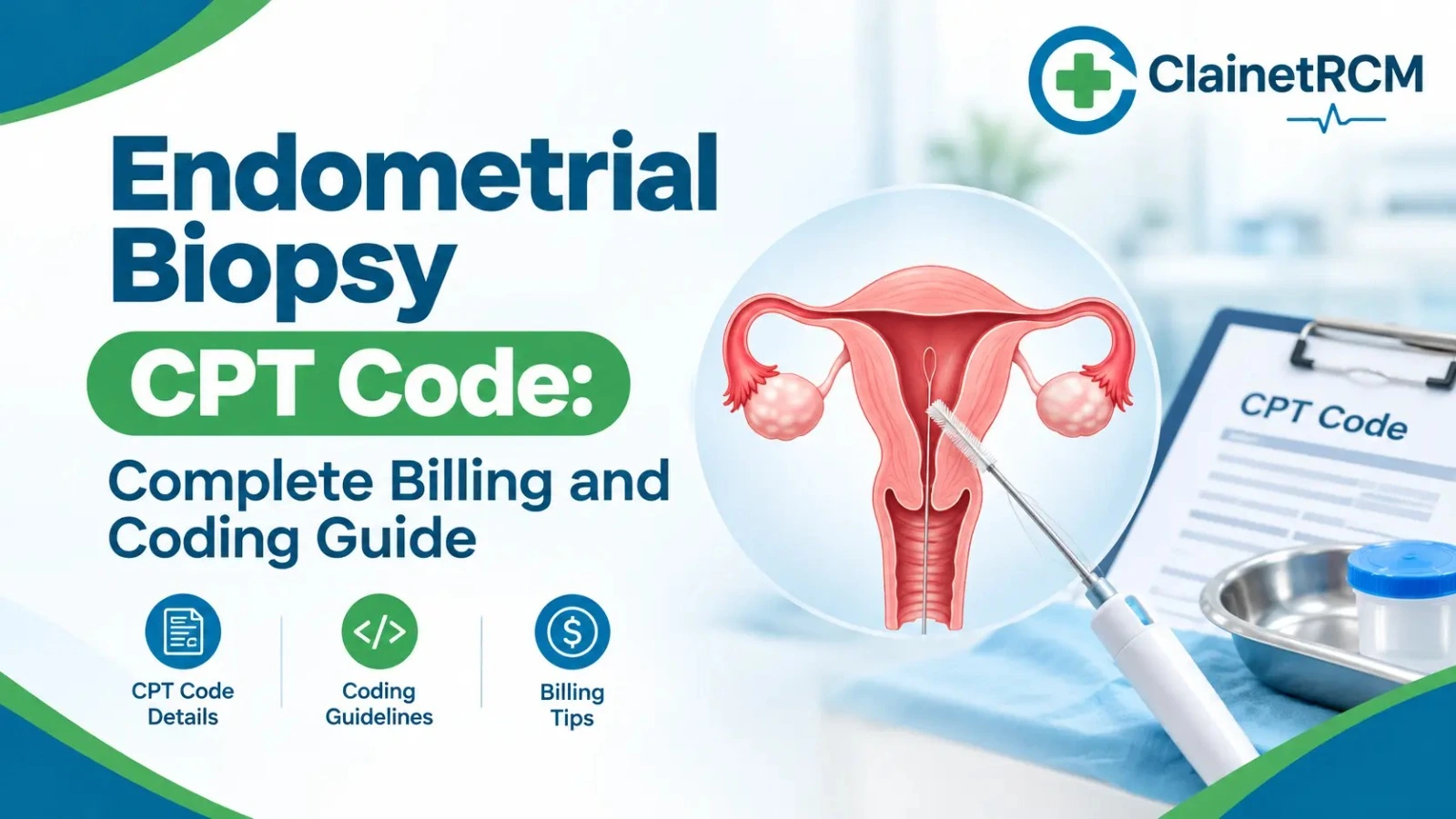
The endometrial biopsy CPT code is 58100. Its full descriptor reads: "Endometrial sampling (biopsy) with or without endocervical sampling (biopsy), without cervical dilation, any method (separate procedure)." It's a zero-day global period code, it's billed once per session regardless of how many passes the provider makes, and it's one of the most frequently underpaid and misbilled codes in OB-GYN practices across the country.
That last part is really why this guide exists. Getting the code right is the easy 5% of the job. The other 95% is the modifier logic, the ICD-10 pairing, the CCI edits, and the documentation trail that actually gets the claim paid the first time instead of the third time. We'll walk through every piece of that below, using real denial patterns and payer behavior we see in OB-GYN accounts every week.
What CPT Code 58100 Actually Covers
CPT 58100 is used for an in-office diagnostic procedure where the provider collects a small tissue sample from the lining of the uterus. The physician inserts a thin, flexible catheter (commonly a Pipelle device or a similar suction curette) through the cervical canal without stretching or dilating the cervix, and gently suctions or scrapes a tissue sample from the endometrium. If needed, a sample from the endocervical canal is taken during the same visit, and that's still billed under the same single code, not two.
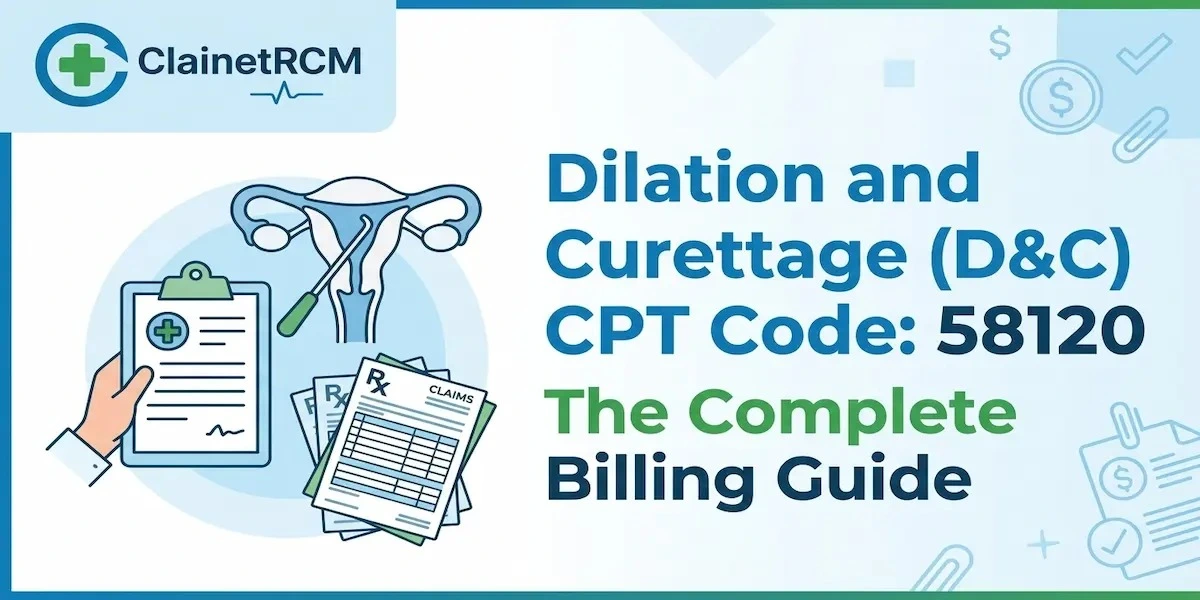
The key phrase in the descriptor is "without cervical dilation." That single phrase is what separates 58100 from its closest cousin, 58120, and it's also the most common source of coding confusion in gynecology billing. If the physician had to dilate the cervix to complete the sampling, 58100 is the wrong code, even if everything else about the procedure looks identical.
The procedure itself is quick. Most encounters run 10 to 15 minutes from speculum placement to specimen collection, and general anesthesia isn't required. That's exactly why payers scrutinize it so closely: a short, low-complexity office procedure is easy to audit against the documentation, and any mismatch between what was billed and what was written stands out immediately.
Why Providers Order It
An endometrial biopsy is almost always ordered to investigate one of these clinical pictures:
- Abnormal uterine bleeding in a premenopausal patient
- Postmenopausal bleeding, which always warrants tissue evaluation to rule out malignancy
- Suspected endometrial hyperplasia or endometrial cancer, often flagged on a prior ultrasound showing a thickened endometrial stripe
- Monitoring a patient already on tamoxifen or unopposed estrogen therapy
- Infertility workups where endometrial receptivity is in question
Knowing the clinical intent behind the order matters for coding because it drives which ICD-10 code belongs on the claim, and payers use that diagnosis-procedure pairing as their first denial checkpoint.
CPT 58100 vs. 58120 vs. 58558: Don't Mix These Up
This is where a huge share of denials originate, so it's worth putting side by side.
| Code | Descriptor | Cervical Dilation? | Setting | Global Period |
|---|---|---|---|---|
| 58100 | Endometrial sampling (biopsy), with or without endocervical sampling | No dilation | Office, no anesthesia | 0 days |
| 58120 | Dilation and curettage (D&C), diagnostic and/or therapeutic | Requires dilation | Office or outpatient surgical setting | 10 days |
| 58558 | Hysteroscopy, surgical, with sampling (biopsy) of endometrium and/or polypectomy, with or without D&C | Visual guidance via hysteroscope | Outpatient surgical setting, often with sedation | 10 days |
A few rules to hold onto:
58100 and 58120 are not billed together. If the physician dilates the cervix to complete the sampling, whether due to cervical stenosis in a postmenopausal patient or any other reason, the correct code is 58120, not 58100 plus a modifier to force both through. CCI edits bundle these, and appending modifier 59 without a genuinely separate, medically distinct reason will trigger a denial or, worse, an audit flag.
58558 already includes the biopsy. If the provider performs a hysteroscopy and takes a tissue sample during that same hysteroscopic procedure, you bill 58558 alone. You do not add 58100 on top of it. The hysteroscopy code absorbs the sampling component by definition.
Documentation has to say which one happened. "Endometrial biopsy performed" isn't enough on its own if the note doesn't specify whether dilation was required. Coders should never have to guess between 58100 and 58120 from a vague procedure note, and payers will deny first and ask questions never.
ICD-10 Codes That Pair With 58100
Medical necessity is proven by the diagnosis code on the claim, and Medicare Administrative Contractors publish Local Coverage Determinations that list exactly which ICD-10 codes support 58100. The most commonly used pairings include:
- N93.9: Abnormal uterine and vaginal bleeding, unspecified
- N95.0: Postmenopausal bleeding
- N92.0 to N92.6: Excessive, frequent, or irregular menstruation (various subtypes)
- N85.00 to N85.9: Endometrial hyperplasia (with and without atypia)
- N88.2: Stricture and stenosis of cervix uteri (often used to justify why 58120 was needed instead of 58100)
- Z12.31: Encounter for screening mammogram is not relevant here, but its screening-code cousins for gynecological malignancy screening sometimes apply in surveillance cases
- C54.1: Malignant neoplasm of endometrium, when the biopsy is being repeated for known disease monitoring rather than initial diagnosis
The coder's job isn't just to pick a code from this list. It's to match the specific diagnosis on the claim to the specific reason documented in the note. A biopsy ordered for postmenopausal bleeding should carry N95.0, not a generic N93.9, because the more specific code is both more accurate and less likely to trigger a payer's medical necessity review.
Modifiers: Where Most of the Denial Risk Actually Lives
CPT 58100 has a zero-day global period, which gives billers more flexibility than a surgical code with a 10 or 90-day package, but that flexibility only helps if the modifiers are applied correctly.
Modifier 25 is used when a significant, separately identifiable evaluation and management service is performed on the same day as the biopsy, by the same provider. This is legitimate when the patient is seen for a new or worsening problem, the physician performs and documents a distinct history and exam, and then makes an independent clinical decision to proceed with the biopsy that same day. It is not legitimate when the E/M note is just a restatement of "patient here for scheduled biopsy, procedure performed." The Office of Inspector General has specifically flagged modifier 25 as a high-risk area, and audits of sampled claims have found that a large share lacked documentation to support the separate E/M service. If the only clinical work on the page is the indication for the procedure itself, modifier 25 should not be appended.
Modifier 59 (or the more specific X-modifiers like XU) indicates a distinct procedural service when 58100 is billed alongside another procedure that would otherwise be bundled under NCCI edits. This modifier is frequently misused to force payment on a bundled pair rather than to reflect a genuinely separate service, and CMS reviews have found that a large percentage of modifier 59 claims on bundled code pairs fail on documentation review. Use it only when the medical record clearly describes two distinct services, at different sites, sessions, or for different clinical reasons.
Modifier 52 applies when the sampling is attempted but incomplete due to anatomical limitations, such as an inability to fully access the endometrial cavity. This should be a rare use case and needs a clear procedural note explaining what was and wasn't accomplished.
Modifier 26 / TC separates the professional and technical components, which becomes relevant only in specific facility billing arrangements where the equipment and the physician's work are billed by different entities.
2026 Reimbursement: What CPT 58100 Actually Pays
Reimbursement for 58100 is RVU-based under the Medicare Physician Fee Schedule, and the national payment amount is calculated by multiplying the code's total RVUs by the year's conversion factor. For 2026, CMS finalized two separate conversion factors: $33.40 for services not furnished under a qualifying Alternative Payment Model, and $33.57 for services that are. That conversion factor, combined with the code's specific work, practice expense, and malpractice RVUs, is what produces the national non-facility payment rate.
A few practical notes for practices billing this code:
- Non-facility (office) rates are typically higher than facility rates for 58100, because the physician's practice absorbs the overhead of supplies, staff time, and specimen handling when performed in-office rather than in a hospital outpatient department.
- Locality adjustments move the number. CMS applies Geographic Practice Cost Indices on top of the national rate, so the same code pays differently in Manhattan than it does in rural Nebraska.
- Commercial payer rates are contract-driven and often benchmark off a percentage of the Medicare rate, which is exactly why credentialing and payer contracting terms matter as much as the coding itself. A perfectly coded claim still underpays if the underlying contract rate was never negotiated properly.
- Medicaid rates vary by state and are usually lower than Medicare, sometimes significantly, which affects practices with a high Medicaid mix differently than those that are mostly commercial.
The practical upshot: don't assume a fixed dollar figure is universal. Always verify the current rate against your specific Medicare Administrative Contractor locality and your payer contracts rather than relying on a number quoted in any single article, this one included.
The Most Common Reasons CPT 58100 Claims Get Denied
Practices that run into repeated denials on this code almost always trace it back to one of these patterns:
- Bundling conflicts under NCCI edits. Billing 58100 with 58120 or with a hysteroscopy code on the same date, without a truly distinct clinical circumstance to justify separate reporting.
- Modifier 25 used routinely rather than selectively. Appending it to every E/M-plus-procedure visit without documentation that stands on its own as a separate, medically necessary evaluation.
- Diagnosis-procedure mismatch. Billing a generic abnormal bleeding code when the note actually supports a more specific, better-reimbursed diagnosis, or using a diagnosis the payer's LCD doesn't recognize as medically necessary for this code.
- Vague procedure notes. Documentation that doesn't clearly state whether cervical dilation occurred, which pathology specimens were sent, or what the clinical indication was, leaving the coder to guess.
- Global period conflicts. Performing the biopsy during the global period of a prior, related procedure without the correct modifier to indicate the service is unrelated.
- Missing prior authorization on certain commercial plans that require it, even though traditional Medicare rarely does for this code.
A Documentation Checklist That Prevents Most of These Denials
A clean 58100 claim starts with a note that answers these questions without ambiguity:
- What was the clinical indication (bleeding pattern, imaging finding, surveillance need)?
- Was cervical dilation required? State it explicitly either way.
- What method was used to obtain the sample?
- Was an endocervical sample also obtained during the same encounter?
- Where was the specimen sent, and what is the expected turnaround for pathology?
- If an E/M service is billed the same day, does the note contain a separate history, exam, and medical decision-making that stands independently of the procedure note?
Practices that build this checklist into their EHR templates see meaningfully fewer denials than practices relying on free-text notes, simply because the coder never has to infer information that should have been documented in the first place.
Frequently Asked Questions
The CPT code is 58100, described as endometrial sampling (biopsy) with or without endocervical sampling, without cervical dilation.
Yes. The descriptor for 58100 explicitly includes endocervical sampling when it's performed during the same encounter, so it isn't billed as a separate line.
Yes, when a significant and separately identifiable evaluation is performed and documented, using modifier 25 on the E/M code. It cannot be billed this way when the E/M note simply restates the reason for the scheduled procedure.
58100 is used when the cervix is not dilated during the procedure. 58120 (dilation and curettage) is used when cervical dilation is required to complete the sampling. The two are not billed together for the same encounter.
Generally no. If a hysteroscopy with biopsy (58558) is performed, that code already includes the sampling component, so 58100 is not billed in addition.
Common pairings include N93.9 (abnormal uterine bleeding), N95.0 (postmenopausal bleeding), N92.0 to N92.6 (menstrual irregularities), and N85.00 to N85.9 (endometrial hyperplasia), matched to the specific clinical reason documented in the note.
Zero days. This allows separate billing for related services before or after the procedure when medically necessary and properly documented.
Getting Paid Correctly, Every Time
CPT 58100 looks simple on the surface, one code, a short office procedure, a quick turnaround for the patient. But the billing side carries real risk: bundling conflicts, modifier misuse, and vague documentation are responsible for a large share of the denials OB-GYN practices see on this exact code, and each denial means delayed cash flow and staff time spent reworking a claim that should have gone through the first time.
This is precisely the kind of coding and denial pattern our team handles daily inside OB-GYN medical billing accounts. From accurate code selection and modifier application to tracking payer-specific LCDs, a specialty-trained billing partner catches the details that generic billing teams tend to miss. If your practice is also managing payer enrollment for gynecology providers, our OB-GYN credentialing team makes sure your contracted rates and panel status are current before claims even go out the door.
If denials on procedures like 58100 or 58120 have become a recurring headache, it's worth having a coding and denial management review done on your last few months of claims. Most practices are surprised by how much of the pattern traces back to just two or three fixable root causes. Our broader medical coding team can also audit your current coding workflow against the payer rules that actually apply to your patient mix, rather than a generic industry average.
For related billing questions our team gets asked often, see our guides on the CPT code 52000 for cystourethroscopy and the EGD CPT code guide, and if claim rework is eating into your front office time, our piece on preventing claim denials walks through the same root-cause approach we use for OB-GYN accounts.
Stop Losing Revenue on Preventable Denials
Every reworked claim costs your practice time, staff hours, and delayed cash flow, on a procedure that should be simple to bill correctly the first time.
Talk to a Billing Specialist
Written by
ClainetRCM Billing Team
ClainetRCM is a Boston-based revenue cycle management company specializing in medical billing, coding, and denial management for healthcare providers across all 50 states. Our AAPC and AHIMA certified coders bill 52 specialties, including OB-GYN and gynecologic procedures.