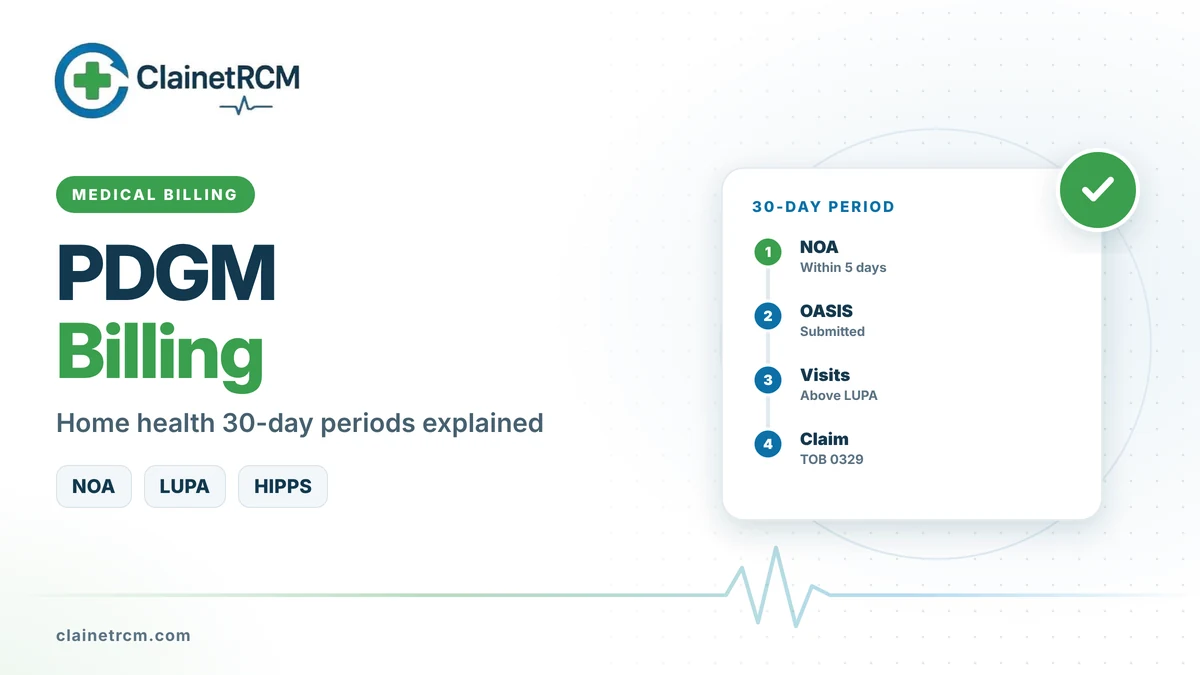
PDGM billing is how Medicare pays home health agencies. Under the Patient-Driven Groupings Model, payment depends on the patient’s characteristics, not the number of therapy visits, and each 60-day certification is billed as two 30-day periods. Getting paid in full depends on timely notices, accurate OASIS data, the right principal diagnosis and enough visits to avoid a low-utilization adjustment.
Quick answer: Since January 1, 2020, Medicare has paid home health agencies for each 30-day period of care under the Patient-Driven Groupings Model. Each period is assigned to one of 432 case-mix groups based on admission source and timing, the clinical group from the principal diagnosis, the functional impairment level from the OASIS, and a comorbidity adjustment. The group appears on the claim as a HIPPS code. Agencies must file a Notice of Admission within 5 calendar days of the start of care and submit one final claim per period on type of bill 032x. Periods with fewer visits than the group’s threshold are paid as a LUPA. The 2026 national 30-day base rate is $2,038.22.
How PDGM Billing Works
| PDGM factor | Categories | How it is determined |
|---|---|---|
| Admission source | Community or institutional | Institutional if the patient had an acute or post-acute stay in the 14 days before the period |
| Timing | Early or late | The first 30-day period is early; later periods are late |
| Clinical group | 12 groups | The principal diagnosis on the claim |
| Functional impairment level | Low, medium or high | OASIS functional items and hospitalization risk |
| Comorbidity adjustment | None, low or high | Secondary diagnoses from specific subgroups |
Multiplying these categories (2 x 2 x 12 x 3 x 3) produces the 432 case-mix groups. Each has a weight that adjusts the national base rate, which is then adjusted for local wages.
The 12 Clinical Groups
The principal diagnosis places the period in one of these groups:
- Musculoskeletal rehabilitation
- Neuro rehabilitation
- Wounds
- Complex nursing interventions
- Behavioral health
- Medication management, teaching and assessment (MMTA), divided into surgical aftercare, cardiac and circulatory, endocrine, gastrointestinal and genitourinary, infectious disease, neoplasms and blood-forming diseases, respiratory, and other
Symptom codes and some vague diagnoses are not accepted as principal diagnoses under PDGM, and a claim with an unacceptable principal diagnosis is returned. Code the condition driving the home health plan of care to the highest specificity.
Notice of Admission (NOA)
Agencies must submit a Notice of Admission on type of bill 032A within 5 calendar days after the start of care. A late NOA reduces payment for each day from the start of the period until the NOA is submitted, and these reductions cannot be billed to the patient. One NOA covers all consecutive 30-day periods until the patient is discharged.
The Final Claim
Each 30-day period is billed on its own final claim, type of bill 0329, after the period ends. The claim includes:
- The HIPPS code with revenue code 0023
- Visit lines by discipline, such as skilled nursing (055x), physical therapy (042x), occupational therapy (043x), speech-language pathology (044x), medical social services (056x) and home health aide (057x), with the visit G-codes and 15-minute units
- The principal and secondary diagnoses that drive the clinical group and comorbidity adjustment
- Occurrence codes and dates that identify admission source and timing
Medicare matches the claim to the patient’s OASIS assessment, so submit the OASIS before the final claim. Our guide to type of bill 111 explains how bill types are built.
Low-Utilization Payment Adjustments (LUPA)
Each case-mix group has a LUPA threshold, from two to six visits in a 30-day period. If a period has fewer visits than its threshold, Medicare pays per visit instead of the full period payment. CMS recalibrates the thresholds every year. Track scheduled versus completed visits during the period so missed visits do not unintentionally trigger a LUPA.
Requirements Before Billing
- Homebound status documented in the record
- A need for skilled services, such as intermittent skilled nursing or therapy
- A certified plan of care signed by the physician or allowed practitioner
- A face-to-face encounter related to the primary reason for home health, within 90 days before or 30 days after the start of care
- OASIS completed and submitted
- Recertification every 60 days when care continues
2026 and 2027 Payment Updates
For 2026, CMS applied a 2.4% payment update, a permanent PDGM behavior adjustment of -1.023% and a temporary -3.0% adjustment, producing a national 30-day base rate of $2,038.22 and an estimated 1.3% decrease in aggregate payments. The CY 2027 final rule, released in November 2026, projects an aggregate increase of about 2.4% for home health agencies, along with updated case-mix weights, LUPA thresholds and functional impairment levels.
Review Choice Demonstration States
Agencies in Illinois, Ohio, Texas, North Carolina, Florida and Oklahoma participate in Medicare’s Review Choice Demonstration, choosing pre-claim review or another review option. Claims in those states need affirmed reviews or will be subject to the selected review process, so build review status into billing workflows.
Common PDGM Denials and Payment Problems
| Problem | Cause | Fix |
|---|---|---|
| Payment reduction | Late NOA | File the NOA within 5 calendar days of start of care |
| Returned claim | Unacceptable principal diagnosis | Code the condition driving the plan of care |
| OASIS mismatch | Claim submitted before or without matching OASIS | Submit OASIS first and confirm acceptance |
| LUPA | Missed or unscheduled visits | Monitor visits against thresholds during the period |
| Denial for documentation | Face-to-face or homebound documentation missing | Audit certifications before billing |
| Overlap edit | Another agency or hospice billing the same dates | Verify eligibility and existing episodes at intake |
Frequently Asked Questions
The Patient-Driven Groupings Model, Medicare’s home health payment system since 2020, which pays per 30-day period based on patient characteristics.
432, based on admission source, timing, clinical group, functional impairment level and comorbidity adjustment.
Within 5 calendar days after the start of care. Late NOAs reduce payment.
A low-utilization payment adjustment. When a period has fewer visits than its threshold, Medicare pays per visit instead of the full period amount.
Yes. Each 30-day period is billed on its own final claim after the period ends.
Final Thoughts
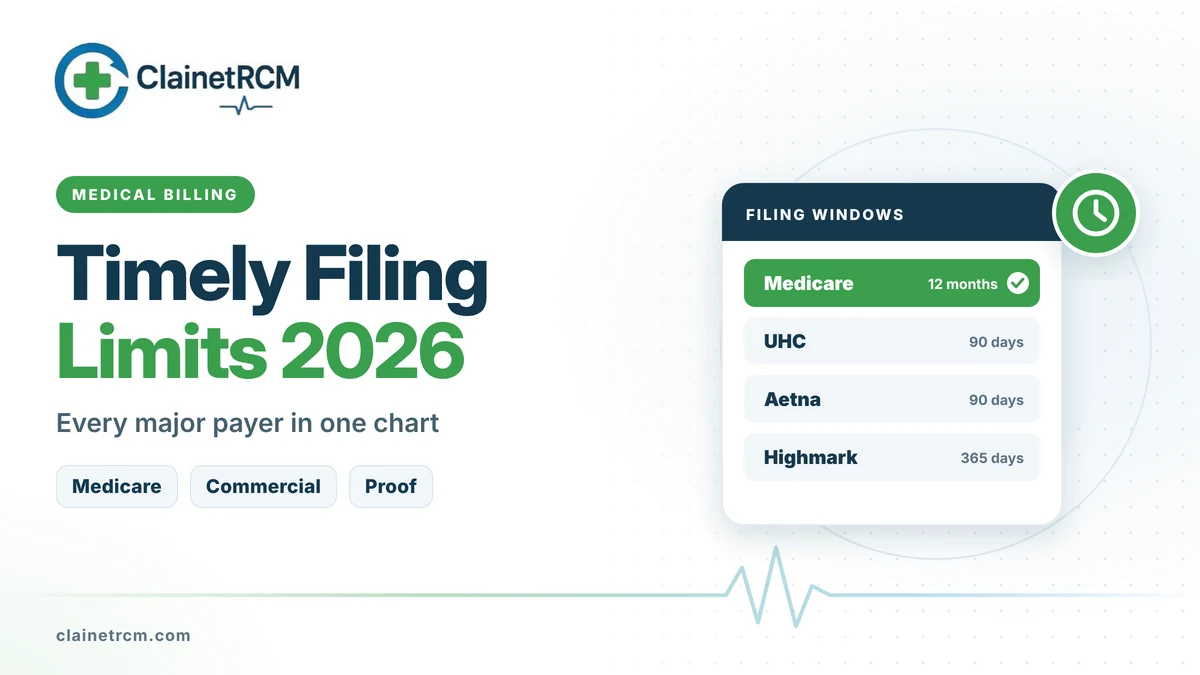
PDGM billing rewards agencies that file NOAs on time, code accurately, keep OASIS and claims aligned and watch visit counts. Our home health and hospice billing team manages Medicare home health claims end to end, and we support agencies of every size through our home health and hospice services. For deadlines, see our timely filing limits chart.
Home Health Billing Without the Surprises
We file NOAs on time, match claims to OASIS, watch LUPA thresholds and resolve PDGM denials so your agency gets paid for every period.
Talk to Our Home Health Team
Written by
ClainetRCM Billing Team
ClainetRCM is a Boston-based revenue cycle management company specializing in medical billing, coding, credentialing and denial management for healthcare providers across all 50 states. Our AAPC and AHIMA certified team works inside your existing EHR, files claims within 24 to 48 hours and reviews every AR bucket on a 14-day cycle.