Allergy testing CPT codes are billed per test, not per visit, so the number on each line matters as much as the code itself. Allergy practices also bill for preparing antigen extracts and giving injections, and Medicare counts antigen units differently from CPT. Most allergy denials come from miscounted units, unsupported test volumes or confusion over what can be billed on the same day.
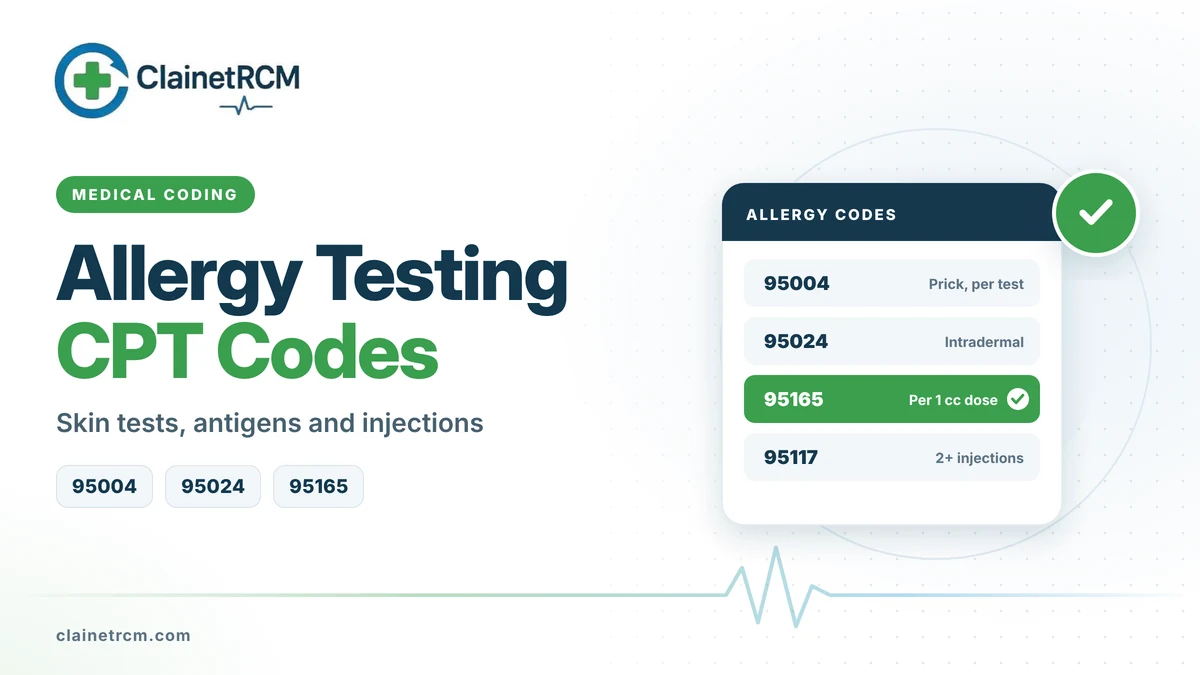
Quick answer: Report percutaneous (prick or scratch) tests with 95004 and intradermal tests with 95024 (immediate reaction) or 95027 (sequential and incremental testing for airborne allergens), with one unit per test. Patch tests are 95044, venom and drug testing 95017 or 95018, and ingestion challenge testing 95076 plus 95079 for each additional hour. For immunotherapy, report antigen preparation with 95165 (multidose vials) and injections with 95115 (one injection) or 95117 (two or more). Medicare counts a 95165 dose as a 1 cc aliquot, up to 10 doses per vial.
Allergy Testing CPT Codes
| Code | Description | Unit |
|---|---|---|
| 95004 | Percutaneous tests (scratch, puncture, prick), immediate reaction | Per test |
| 95017 | Percutaneous and intracutaneous tests for venoms and drugs, sequential and incremental | Per test |
| 95018 | Percutaneous and intracutaneous tests for drugs or biologicals | Per test |
| 95024 | Intracutaneous (intradermal) tests, immediate reaction | Per test |
| 95027 | Intracutaneous tests, sequential and incremental, airborne allergens | Per test |
| 95028 | Intracutaneous tests, delayed reaction | Per test |
| 95044 | Patch or application tests | Per test |
| 95060, 95065 | Ophthalmic and nasal mucous membrane tests | Per test |
| 95070 | Inhalation bronchial challenge testing | Per session |
| 95076, 95079 | Ingestion challenge test: first 120 minutes, each additional 60 minutes | Time based |
Report the number of tests performed on each line. Medicare also applies daily unit limits (MUEs), such as 40 units for 95024 and 90 for 95027, so unusually large test panels need strong documentation.
Immunotherapy Codes
| Code | Description |
|---|---|
| 95115 | Professional services for allergen immunotherapy, single injection |
| 95117 | Two or more injections |
| 95144 | Antigen preparation in single-dose vials, per vial |
| 95145 to 95149 | Antigen preparation for stinging insect venoms (one to five venoms) |
| 95165 | Antigen preparation in multidose vials, non-venom, per dose |
| 95170 | Antigen preparation for whole-body extract of biting insects |
Medicare does not recognize the complete-service codes 95120 to 95134, which bundle the extract and injection. Bill the preparation and injection codes separately instead.
How Medicare Counts 95165 Doses
CPT defines a dose as the amount of antigen given in a single injection, but Medicare uses a billing definition: one dose equals a 1 cc aliquot from a multidose vial, with a maximum of 10 doses per vial.
- A 10 cc vial is billed as 10 units, even if more than 10 injections are drawn from it.
- A vial filled to 5 cc is billed as 5 units.
- Two 10 cc vials are billed as 20 units.
- Medicare applies a daily limit of 30 units for 95165 and 95144.
Many commercial payers follow CPT’s per-injection definition or set their own limits, so confirm each contract before billing.
Same-Day Billing Rules
- Testing and immunotherapy. They are generally not billed on the same day unless the physician tests for additional allergens during an immunotherapy visit.
- Potency testing. Testing a vial’s strength before an injection is part of immunotherapy and is not billed as allergy testing.
- E/M visits. Report an E/M with modifier 25 only when a significant, separately identifiable evaluation is performed, such as a new problem or a medication change. Interpreting the test results is part of the testing codes.
Documentation Requirements
- The history and clinical indication supporting the number and type of tests
- The allergens tested, results and test interpretation
- For immunotherapy, the prescription, the vial contents, concentrations and volumes prepared
- For each injection, the dose, the site and post-injection observation
- The physician’s review of reactions and changes to the schedule
Example
A new patient with seasonal rhinitis has 40 percutaneous tests followed by 12 intradermal tests for allergens that were negative or equivocal on prick testing. Weeks later, the allergist prepares two 10 cc multidose vials for immunotherapy, and the patient begins weekly injections, receiving one injection from each vial.
- Testing visit: 95004 ×40 and 95024 ×12, plus an E/M visit if a separate evaluation is documented
- Preparation: 95165 ×20 for Medicare
- Injection visits: 95117 for two injections per visit
Common Denials
- Too many tests for the history. Large panels need a documented history that explains each allergen group tested.
- Units over the daily limit. Split testing across visits when medically appropriate, or document why more tests were needed.
- Using CPT dose counts for Medicare 95165. Medicare pays by 1 cc aliquots, not by injections.
- Billing the complete-service codes to Medicare. Use preparation and injection codes instead.
- Testing billed with every immunotherapy visit. Routine safety checks of vials are part of immunotherapy.
Venom Immunotherapy
Stinging insect venom preparation is billed per number of venoms in the vial with 95145 to 95149, and injections are still reported with 95115 or 95117. Venom testing uses 95017, and the documentation should describe the reaction history that supports testing.
Frequently Asked Questions
Bill the code for the test type with units equal to the number of tests performed, such as 95004 ×40 for 40 percutaneous tests.
Code 95024 is an intradermal test for an immediate reaction. Code 95027 is sequential and incremental intradermal testing for airborne allergens.
Medicare defines one dose as a 1 cc aliquot from a multidose vial, up to 10 doses per vial, regardless of how many injections are drawn from it.
Yes, when the physician performs a significant, separately identifiable evaluation. Add modifier 25 to the E/M code; reviewing and interpreting the tests is included in the testing codes.
No. Medicare does not recognize those complete-service codes. Bill antigen preparation (such as 95165) and injections (95115 or 95117) separately.
Final Thoughts
Allergy testing CPT codes depend on accurate counts, payer-specific dose definitions and clear documentation. Learn how we support allergy practices on our allergy and immunology billing page, or read our specialty medical billing guide.
Bill Allergy Testing and Immunotherapy With Confidence
Our allergy billing team counts tests, calculates antigen units by payer and keeps injection claims clean so your practice is paid for every vial and visit.
Get Allergy Billing Help
Written by
ClainetRCM Billing Team
ClainetRCM is a Boston-based revenue cycle management company specializing in medical billing, coding, credentialing and denial management for healthcare providers across all 50 states. Our AAPC and AHIMA certified team works inside your existing EHR, files claims within 24 to 48 hours and reviews every AR bucket on a 14-day cycle.