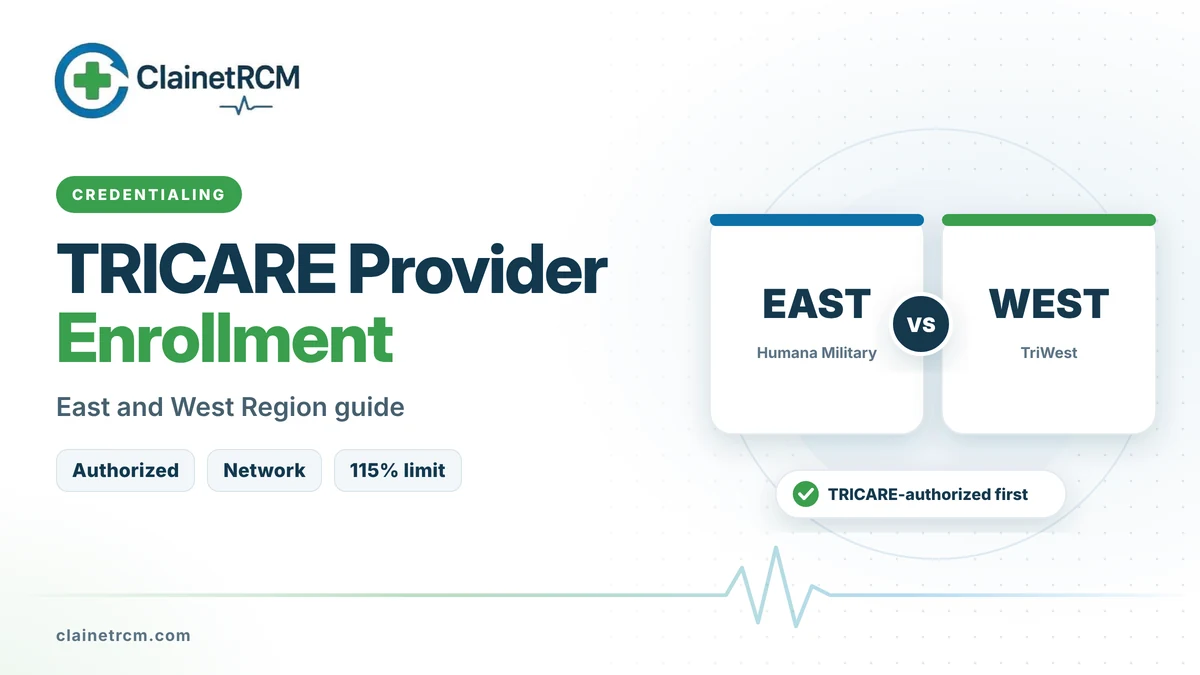
TRICARE provider enrollment opens your practice to active-duty service members, retirees and their families. TRICARE is the health program of the uniformed services, managed by the Defense Health Agency, and civilian care in the United States runs through two regional contractors: Humana Military in the East Region and TriWest Healthcare Alliance in the West Region. Every provider must first be TRICARE-authorized. From there, you choose whether to join the network or treat patients as a non-network provider.
Quick answer: Become TRICARE-authorized through the regional contractor for your state, then decide your status. Network providers sign a contract with Humana Military or TriWest, complete credentialing and accept negotiated rates. Non-network providers have no contract. They can participate claim by claim, accepting the TRICARE allowable as payment in full, or not participate and charge the patient up to 115% of the allowable. File claims within one year of the date of service.
TRICARE Regions and Contractors
| Region | Contractor | Main phone | Notes |
|---|---|---|---|
| East Region | Humana Military | 800-444-5445 | Kept the East Region under the current contracts |
| West Region | TriWest Healthcare Alliance | 888-874-9378 | Took over the West Region on January 1, 2025 |
| TRICARE For Life | WPS, after Medicare | Through Medicare crossover | Medicare pays first for TRICARE beneficiaries who have Medicare |
On January 1, 2025, six states moved from the East Region to the West Region: Arkansas, Illinois, Louisiana, Oklahoma, Texas and Wisconsin, with some ZIP code exceptions near region borders. Provider agreements with Humana Military in those states were assigned to TriWest, so confirm which contractor now serves each of your locations.
TRICARE Provider Enrollment Options: Network vs Non-Network
| Provider type | Contract | Payment | Claims | Balance billing |
|---|---|---|---|---|
| Network provider | Signed agreement with the regional contractor and credentialed | Negotiated rate, no more than the TRICARE allowable | You file | Not allowed beyond the patient’s cost share |
| Non-network, participating | None; accepts assignment claim by claim | TRICARE allowable as payment in full | You file | Not allowed |
| Non-network, non-participating | None; does not accept assignment | Patient pays you; TRICARE reimburses the patient | Patient often files | Up to 115% of the allowable |
The 115% limit is set by federal law and applies line by line on the claim. When your billed charge is below 115% of the allowable, you can only collect up to your billed charge.
Step 1: Become TRICARE-Authorized
TRICARE pays only TRICARE-authorized providers. Authorization confirms that you hold the right license and meet TRICARE’s standards for your provider type, which are set out in the TRICARE Policy Manual. You complete certification through the regional contractor for your state. Some provider types, especially certain mental health counselors and other non-physician clinicians, must meet extra education or supervision requirements before they can be authorized.
Step 2: Decide Whether to Join the Network
Joining the network brings referrals from TRICARE Prime beneficiaries, a listing in the contractor’s directory, and steady volume near military installations. In exchange, you accept negotiated rates and network rules. Non-network status avoids a contract, but Prime patients usually need referrals to network providers, so your volume may be lower.
Step 3: Apply to the Network
- East Region: Request network participation through Humana Military’s provider resources.
- West Region: Use TriWest’s Join the TriWest Healthcare Alliance Network page.
- Credentialing: Expect a full credentialing review of your license, education, board status, malpractice coverage and sanctions history. TriWest states that all West Region network providers must be Medicare participating providers, citing the TRICARE Policy Manual.
- Health information exchange: During credentialing, TriWest checks whether your health information exchange connection is compatible with the one the Defense Health Agency uses, and can help you set one up.
Step 4: Set Up Billing
Confirm the payer IDs and claims address for your region, enroll in electronic payments and remittances, and get access to the contractor’s provider portal for eligibility, referrals and claim status. TriWest also works with Availity for provider access. Test your first claims and review the remittances closely.
TRICARE Billing Rules to Know
- Allowable amounts: TRICARE pays professional services based on the CMAC (CHAMPUS Maximum Allowable Charge), which generally tracks Medicare rates.
- Timely filing: File claims within one year of the date of service, or one year from inpatient discharge.
- Other health insurance: TRICARE pays after a patient’s other health insurance, but before Medicaid.
- Referrals and authorizations: TRICARE Prime patients need referrals for most specialty care, and some services need prior authorization under every plan. Get them from the regional contractor before the visit.
- TRICARE For Life: For beneficiaries with Medicare Part A and Part B, bill Medicare first. Medicare forwards the claim to the TRICARE For Life contractor, WPS, which pays as second payer.
- Medicare status matters: Because TRICARE For Life depends on Medicare, providers who serve older retirees should be enrolled with Medicare too.
Watch Your Remittances
The move to the current regional contracts brought claims problems in both regions, and the East Region reported in mid-2026 that a system error had processed some network provider claims as if they came from non-network providers. Compare each payment with your contracted rate and appeal or request reprocessing when amounts are wrong.
Frequently Asked Questions
No. You can treat TRICARE patients as a non-network provider if you are TRICARE-authorized. Network status brings referrals and directory listing; non-network status avoids a contract.
It depends on the region, your provider type and how complete your file is. Plan for several weeks for authorization and longer for network credentialing and contracting.
TriWest requires West Region network providers to be Medicare participating providers. Medicare enrollment also matters for TRICARE For Life patients, because Medicare pays first.
Claims for care in the United States must be filed within one year of the date of service or inpatient discharge.
Yes, but only up to 115% of the TRICARE allowable charge. Network providers and participating non-network providers cannot balance bill beyond the patient’s cost share.
Bill Medicare first. Medicare processes its share and forwards the claim to the TRICARE For Life contractor, which pays the remaining covered amount.
Final Thoughts
TRICARE provider enrollment starts with authorization and then turns on one choice: network or non-network. Know your regional contractor, follow the 115% balance billing rule and file within one year to keep TRICARE claims paying. If you want help with authorization, credentialing and claim setup, our credentialing services cover TRICARE along with commercial and government payers. For the Medicare side, review our guide to CMS credentialing requirements.
Serve Military Families Without the Paperwork
We handle TRICARE authorization, network applications with Humana Military or TriWest, and claim setup so your first TRICARE claims pay.
Start TRICARE Enrollment
Written by
ClainetRCM Billing Team
ClainetRCM is a Boston-based revenue cycle management company specializing in medical billing, coding, credentialing and denial management for healthcare providers across all 50 states. Our AAPC and AHIMA certified team works inside your existing EHR, files claims within 24 to 48 hours and reviews every AR bucket on a 14-day cycle.