A CLIA certificate of waiver lets a physician office, clinic or other site run laboratory tests that the FDA has categorized as waived: simple tests with a low risk of an incorrect result, such as urine dipsticks, urine pregnancy tests and many rapid strep and flu tests. Waived does not mean exempt. Under the Clinical Laboratory Improvement Amendments (CLIA), any site that tests human specimens to diagnose, prevent or treat disease needs a CLIA certificate, even if it runs just one waived test.
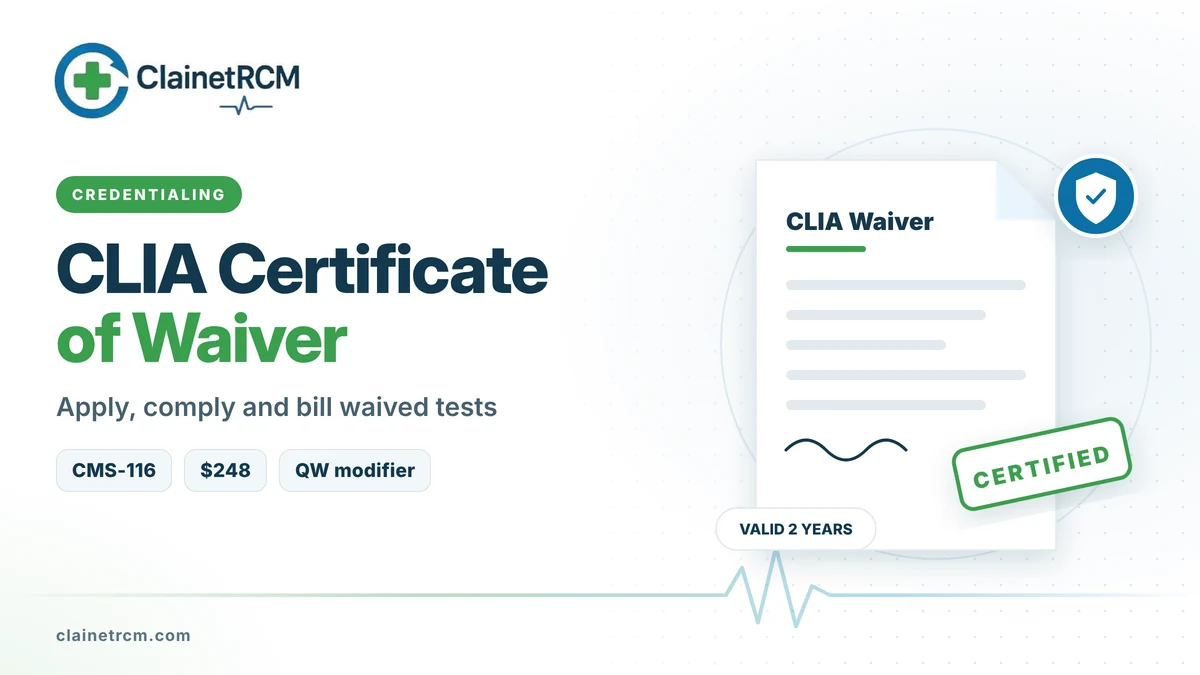
Quick answer: Confirm every test you plan to run is waived, then submit Form CMS-116 to your State Agency. Pay the $248 certificate fee online once you receive the fee coupon; since March 1, 2026, CMS sends fee coupons and certificates only by email and accepts fees only online through pay.gov. The certificate lasts two years. Put your CLIA number on every lab claim and add the QW modifier to waived test codes that Medicare requires it on.
Who Needs a CLIA Certificate of Waiver
You need one if your site performs only waived tests on patient specimens. Common examples include:
- Urine dipstick or tablet urinalysis and urine pregnancy tests
- Fecal occult blood tests
- Blood glucose by monitoring devices cleared by the FDA for home use
- Rapid strep, influenza and COVID-19 tests that the FDA categorized as waived
- Some hemoglobin A1c, cholesterol and prothrombin time systems
- Spun microhematocrit and non-automated erythrocyte sedimentation rate
The waived status belongs to the specific test system, not the type of test. One manufacturer’s A1c analyzer can be waived while another’s is moderate complexity. Check the FDA’s CLIA database for the exact device before you buy it.
CLIA Certificate Types
| Certificate | What it allows | Inspections |
|---|---|---|
| Certificate of Waiver | Waived tests only | No routine surveys, but CMS can inspect or investigate complaints |
| Provider-Performed Microscopy (PPM) | Waived tests plus certain microscopy done by physicians and qualified providers during the visit | No routine surveys |
| Registration, then Compliance | Moderate and high complexity testing | Routine surveys by the State Agency |
| Accreditation | Moderate and high complexity testing under an approved accreditor | Surveys by the accrediting organization |
If you plan to do wet mounts or urine sediment exams, you need a provider-performed microscopy certificate, not a waiver.
How to Apply for a CLIA Certificate of Waiver
- List your tests and devices. Confirm each one is waived in the FDA’s database.
- Complete Form CMS-116. For a certificate of waiver, complete the sections the form marks for that certificate type, including facility details, the director, hours, the tests you will perform and a business email address that more than one staff member can access.
- Send it to your State Agency. CMS directs applications to the CLIA State Agency for your state.
- Watch your email for the fee coupon. It shows your CLIA identification number and the amount due.
- Pay online. Pay the $248 fee through pay.gov. Checks are no longer accepted.
- Receive your certificate by email. Start patient testing only after the certificate is effective.
- Add your CLIA number to payer records and to your billing system so it prints on lab claims.
Fees and Renewal
The certificate of waiver fee is $248, and the certificate is valid for two years. Before it expires, CMS emails a fee coupon for the next cycle, and paying it keeps the certificate active. Keep the email address on file current. Since March 1, 2026, the CLIA program no longer mails paper coupons or certificates, so an old email address can let a certificate lapse without anyone noticing.
Staying Compliant
- Follow the manufacturer instructions exactly. Changing a waived test’s procedure, specimen type or timing makes it a high complexity test that your certificate does not cover.
- Run only waived tests. Adding a single moderate complexity test requires a different certificate.
- Keep records. Document quality control, lot numbers, patient results and staff training, even when the manufacturer’s steps are simple.
- Report changes within 30 days. Changes such as ownership, name, location, laboratory director or certificate type must be reported to your State Agency, usually with an updated Form CMS-116, within 30 days.
- Get a certificate for each location. CLIA generally requires a separate certificate for each location where testing happens, with limited exceptions such as some mobile units and certain multiple-site arrangements.
- Expect possible visits. CMS and State Agencies can survey waiver sites and investigate complaints, and substantiated complaints carry their own fees.
Billing Waived Tests
- Report your CLIA number. On the CMS-1500 it goes in item 23. On electronic 837P claims it goes in the REF segment with qualifier X4 in loop 2300 or 2400.
- Add the QW modifier for Medicare. Most waived test codes need the QW modifier in the first modifier position so Medicare recognizes them as waived. A short list of codes is recognized as waived without QW: 81002, 81025, 82270, 82272, 82962, 83026, 84830, 85013 and 85651.
- Bill only tests your certificate covers. Medicare edits lab claims against your certificate level, so a moderate complexity test billed from a waiver site will deny.
- Watch for new waived tests. CMS publishes new waived test systems and their codes regularly, so update your billing rules when you add a device.
- Check other payers. Many Medicaid programs and commercial plans also require the CLIA number, and some follow Medicare’s QW rules.
Common Mistakes
- Buying a device that is waived for one specimen type and using it with another
- Letting the certificate lapse because the fee email went to a former employee
- Moving to a new address without reporting the change
- Leaving the CLIA number off claims or using the number from another location
- Adding QW to codes that do not need it, or leaving it off codes that do
Frequently Asked Questions
It depends on your State Agency’s workload. Many offices receive the fee coupon within a few weeks of submitting Form CMS-116, and the certificate follows after payment.
The fee is $248 for a two-year certificate, paid online after you receive the fee coupon.
Generally yes. Each testing location needs its own certificate unless it meets one of the limited exceptions in the CLIA rules.
Yes. It is valid for two years and renews when you pay the next fee coupon CMS sends by email.
QW tells Medicare that a lab test was performed using a CLIA-waived test system. Most waived test codes need it; a short list of codes does not.
No. Provider-performed microscopy, such as wet mounts, requires a PPM certificate.
Final Thoughts
A CLIA certificate of waiver is one of the simplest registrations a practice holds, but small slips, such as a lapsed fee, an unreported move or a missing QW modifier, can stop lab payments. Keep your tests truly waived, your contact email current and your CLIA number on every claim. Our healthcare business registration services handle CLIA applications, updates and renewals. For the Medicare enrollment side, read our guide to CMS credentialing requirements.
Get Your CLIA Certificate Set Up Right
We complete your CMS-116, track the fee coupon and certificate, add your CLIA number to payer files and set up QW billing for waived tests.
Get CLIA Help
Written by
ClainetRCM Billing Team
ClainetRCM is a Boston-based revenue cycle management company specializing in medical billing, coding, credentialing and denial management for healthcare providers across all 50 states. Our AAPC and AHIMA certified team works inside your existing EHR, files claims within 24 to 48 hours and reviews every AR bucket on a 14-day cycle.