The ICD-10 code for ADHD is chosen by the presentation the clinician documents: predominantly inattentive, predominantly hyperactive-impulsive or combined. The same F90 codes apply to children and adults, and the diagnosis supports a range of services, from screening instruments and psychological testing to therapy and medication management. Getting the code and the CPT pairing right keeps claims and authorizations moving.
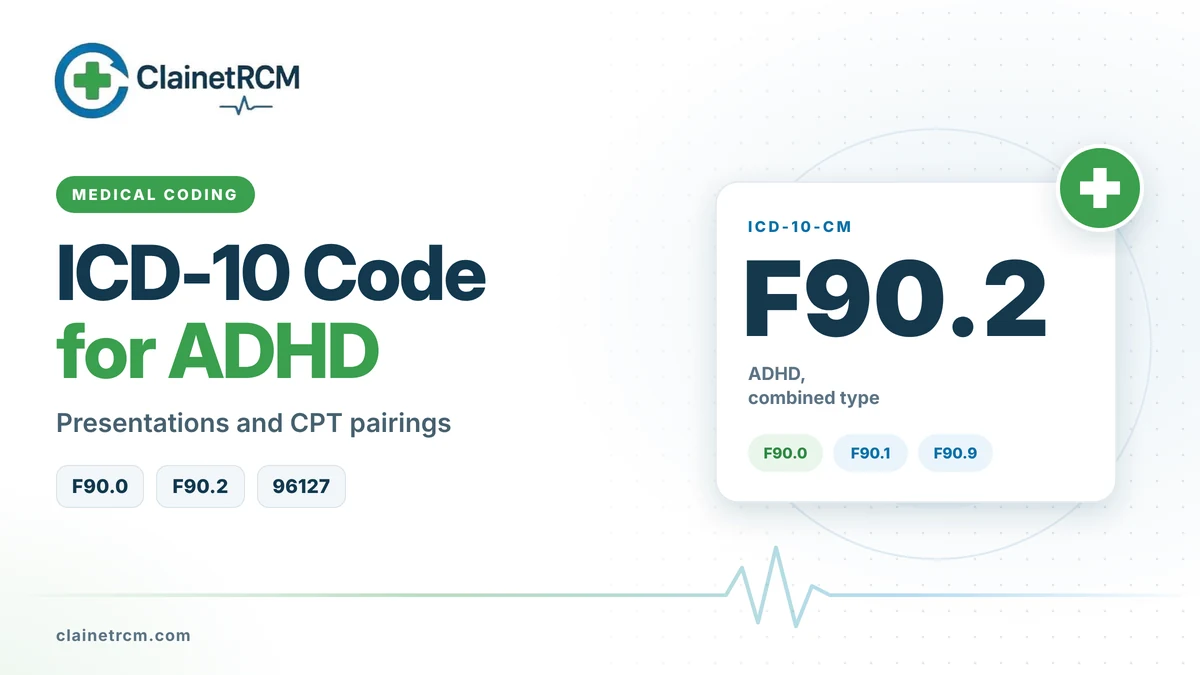
Quick answer: Use F90.0 for ADHD, predominantly inattentive type; F90.1 for predominantly hyperactive type; and F90.2 for combined type. Use F90.8 for other specified ADHD and F90.9 when the presentation is not specified. The same codes apply to adults. If attention problems are documented without an ADHD diagnosis, use R41.840 instead. Common pairings include 96127 for rating scales such as the Vanderbilt or adult self-report scales, 90791 for diagnostic evaluations, 96130 and related codes for psychological testing and E/M codes for medication management.
ICD-10 Code for ADHD by Presentation
| Code | Description | DSM-5-TR presentation |
|---|---|---|
| F90.0 | ADHD, predominantly inattentive type | Predominantly inattentive presentation |
| F90.1 | ADHD, predominantly hyperactive type | Predominantly hyperactive-impulsive presentation |
| F90.2 | ADHD, combined type | Combined presentation |
| F90.8 | ADHD, other type | Other specified ADHD |
| F90.9 | ADHD, unspecified type | Unspecified ADHD |
Specifiers such as “in partial remission” or severity levels do not have separate codes; code the documented presentation.
Adult ADHD
There is no separate adult code. An adult with ADHD is coded with the same F90 code for the presentation documented by the clinician. Many payers expect the record to show symptoms in more than one setting and their effect on work, school or relationships. Adult evaluations often rely on self-report scales, collateral information and a review of childhood history, all of which support the diagnosis and the services billed.
Symptom Codes vs a Diagnosis
When the record describes attention or concentration problems but the clinician has not diagnosed ADHD, use R41.840 (attention and concentration deficit). It cannot be reported with an F90 code. Once ADHD is diagnosed, the F90 code replaces the symptom code.
Common Co-Occurring Conditions
Code every condition the clinician documents and addresses, such as oppositional defiant disorder (F91.3), anxiety (F41.-), depression, specific learning disorders (F81.-), autism spectrum disorder (F84.0) and tic disorders (F95.-). Screening encounters without a diagnosis can use Z13.39 or other screening codes as appropriate.
Documentation for ADHD Evaluations
- The symptoms observed and reported, and the settings where they occur, such as home, school or work
- Onset of symptoms in childhood, which supports an adult diagnosis
- Standardized rating scales completed by the patient, parents or teachers, with scores
- Conditions that were considered and ruled out, such as sleep problems or anxiety
- The presentation and the impact on daily functioning
Medication Management and Prior Authorization
Many plans require prior authorization for some ADHD medications, especially long-acting or brand-name stimulants. Documenting the diagnosis, the presentation, the treatments tried and the monitoring plan, including any prescription monitoring program check, supports both the authorization and the E/M level, because prescription drug management counts as moderate risk in medical decision-making.
Pairing With CPT Codes
| Service | CPT codes |
|---|---|
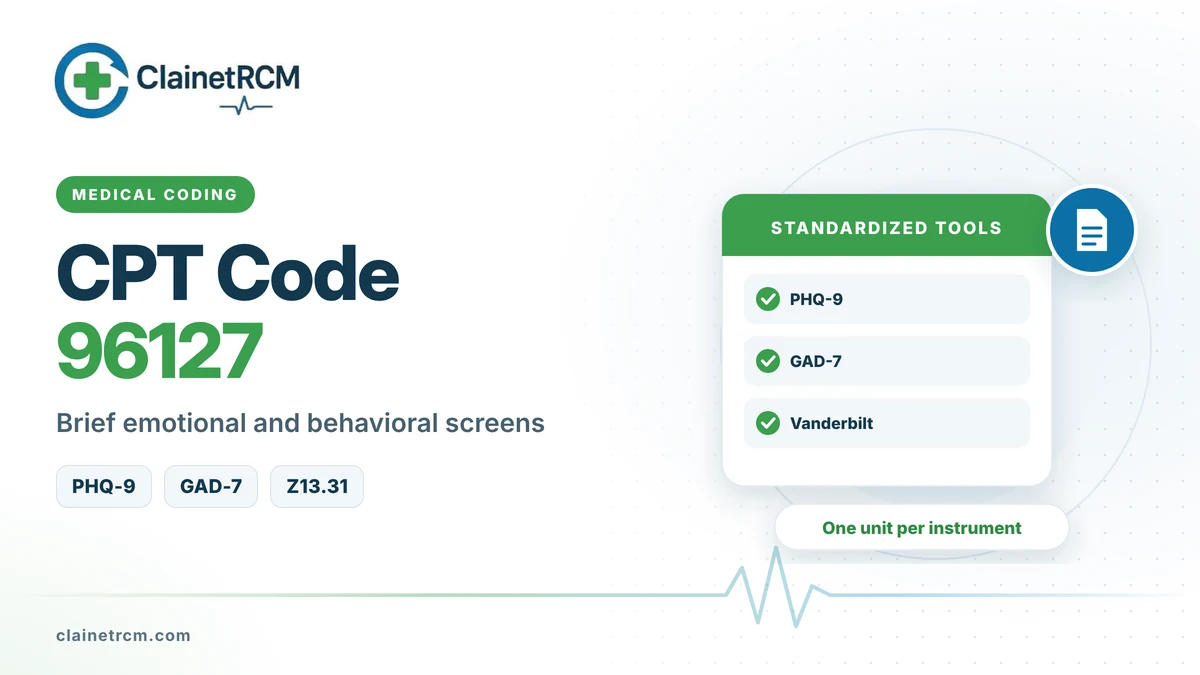
| Rating scales and screening instruments | 96127, per standardized instrument |
| Psychiatric diagnostic evaluation | 90791, or 90792 with medical services |
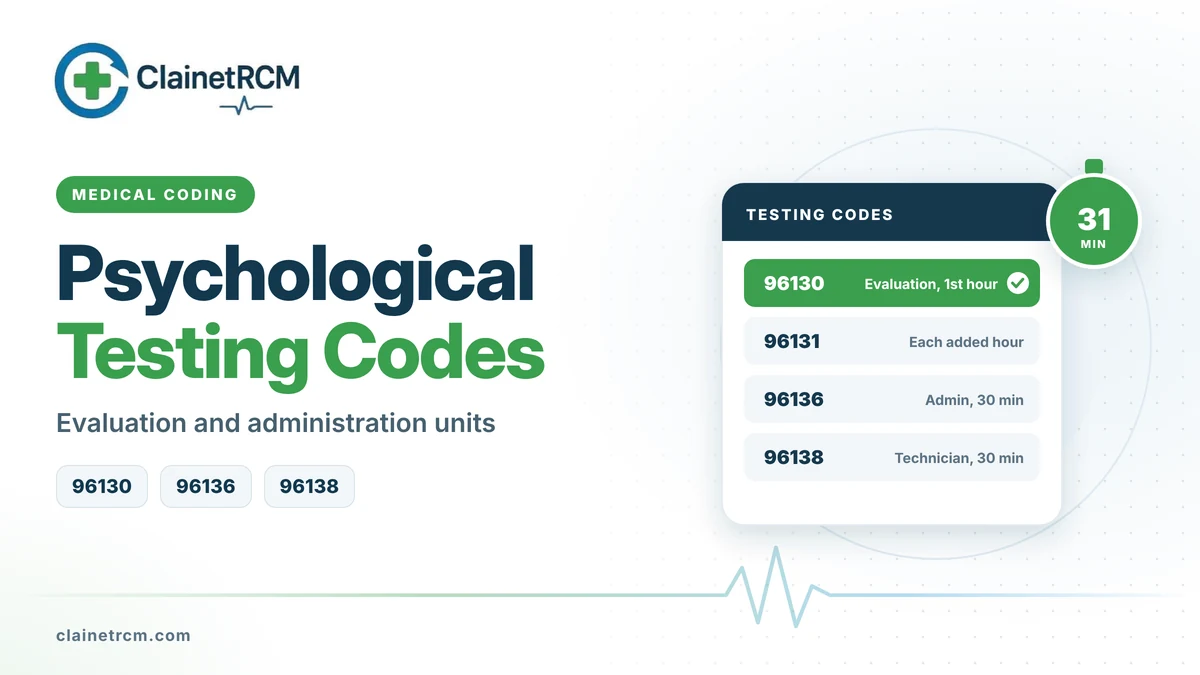
| Psychological testing evaluation | 96130, 96131 |
| Test administration and scoring | 96136, 96137 (psychologist) or 96138, 96139 (technician) |
| Medication management | 99212 to 99215, with 90833, 90836 or 90838 for added psychotherapy |
| Psychotherapy | 90832, 90834, 90837 |
| Family therapy and parent training | 90846, 90847; 96202, 96203 for group caregiver behavior management training |
For example, parent and teacher rating scales completed for a child’s follow-up are typically reported as two units of 96127, one for each standardized instrument, when scored and documented.
Telehealth and Stimulant Prescribing
Medicare’s in-person requirement for mental health telehealth visits is waived through 2027, so ADHD evaluations and follow-ups can continue by telehealth for Medicare patients. Prescribing stimulants, which are Schedule II controlled substances, depends on DEA rules: the telemedicine flexibilities that allow prescribing without an in-person visit run through December 31, 2026, and a permanent special registration rule was still under review in late 2026. Confirm the current DEA requirements before prescribing stimulants by telehealth in 2027.
Coding Examples
| Scenario | Codes |
|---|---|
| Child, combined type, medication follow-up with parent and teacher scales | 99214, 96127 ×2, F90.2 |
| Adult, new diagnostic evaluation, inattentive type | 90791, F90.0 |
| Child with ADHD and ODD, family therapy session | 90847, F90.2, F91.3 |
| Attention problems, ADHD not yet diagnosed | R41.840 |
Common Errors
- Coding F90.9 when the presentation is documented
- Reporting R41.840 with an F90 code
- Billing 96127 without a standardized instrument and score
- Missing co-occurring conditions that the clinician addressed
- Assuming telehealth stimulant prescribing rules will stay the same after 2026
Frequently Asked Questions
It depends on the presentation: F90.0 for predominantly inattentive, F90.1 for predominantly hyperactive-impulsive, F90.2 for combined, F90.8 for other specified and F90.9 for unspecified.
No. Adults are coded with the same F90 codes as children, based on the documented presentation.
Yes. Report one unit of 96127 for each standardized instrument administered, scored and documented, subject to payer limits.
Yes. Pediatricians and other primary care clinicians commonly diagnose and manage ADHD and use the same F90 codes, often with rating scales billed as 96127.
There is no separate remission code. Code the documented presentation while the condition is being managed; if the clinician states that it has resolved, a personal history code may apply instead.
Use R41.840 when attention or concentration problems are documented but ADHD has not been diagnosed.
Yes, for most services and payers. For Medicare, the mental health in-person requirement is waived through 2027. Stimulant prescribing by telehealth also depends on DEA rules, which are set to change after 2026.
Final Thoughts
The ICD-10 code for ADHD is simple once the presentation is documented, and the real value comes from pairing it with the right services. Learn how we support behavioral health practices on our mental health billing page, or read our oppositional defiant disorder ICD-10 guide.
Code Behavioral Health Visits With Confidence
Our behavioral health coders match ADHD diagnoses to evaluations, screenings, therapy and medication visits so claims and authorizations go through cleanly.
Get Behavioral Health Coding Help
Written by
ClainetRCM Billing Team
ClainetRCM is a Boston-based revenue cycle management company specializing in medical billing, coding, credentialing and denial management for healthcare providers across all 50 states. Our AAPC and AHIMA certified team works inside your existing EHR, files claims within 24 to 48 hours and reviews every AR bucket on a 14-day cycle.