Transitional care management CPT codes pay for the 30 days after a patient leaves the hospital or a facility, a period when readmissions are common and coordination matters most. TCM pays more than a routine follow-up visit, but only if the practice makes contact within two business days, sees the patient within the right window and documents medication reconciliation.
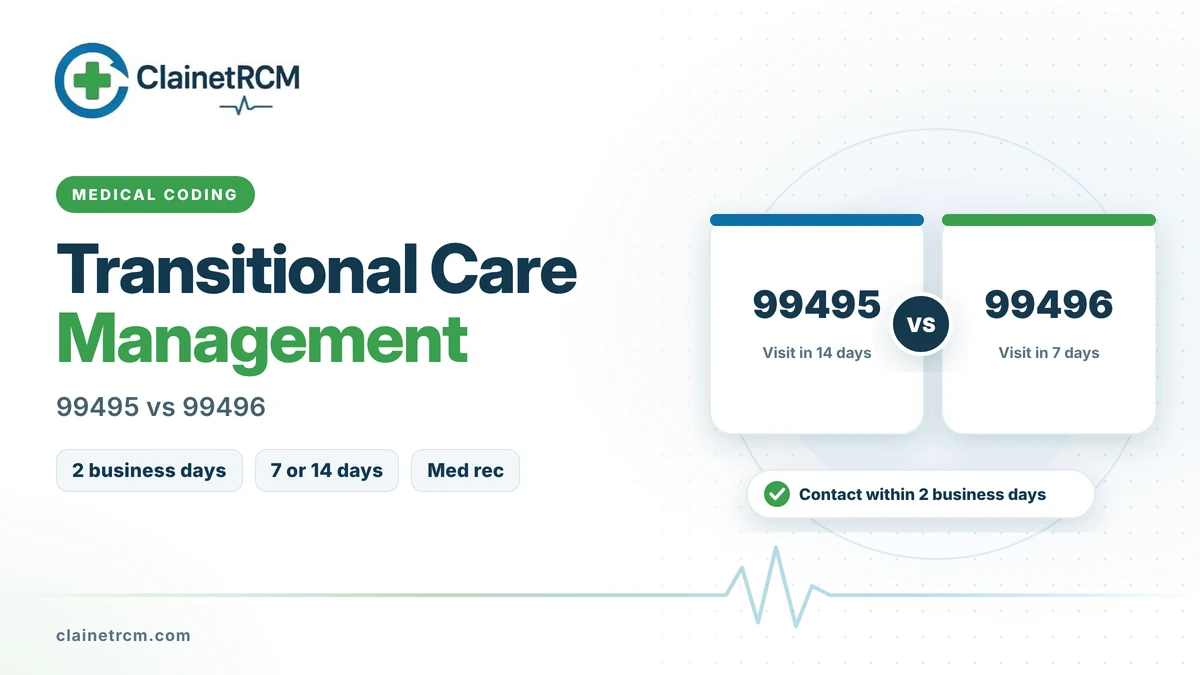
Quick answer: 99495 requires an interactive contact with the patient or caregiver within 2 business days of discharge, a face-to-face visit within 14 calendar days, and at least moderate medical decision making. 99496 requires the same contact, a face-to-face visit within 7 calendar days, and high-complexity medical decision making. TCM covers a 30-day period starting on the day of discharge, includes medication reconciliation no later than the face-to-face visit, and can be billed only once per patient per 30 days.
Transitional Care Management CPT Codes: 99495 vs 99496
| Requirement | 99495 | 99496 |
|---|---|---|
| Interactive contact | Within 2 business days of discharge | Within 2 business days of discharge |
| Face-to-face visit | Within 14 calendar days | Within 7 calendar days |
| Medical decision making | At least moderate complexity | High complexity |
| Service period | 30 days starting on the discharge date | 30 days starting on the discharge date |
If the visit happens within 7 days but medical decision making is moderate, bill 99495. Both the timing and the complexity must be met for 99496.
Qualifying Discharges
TCM applies after discharge from:
- Inpatient hospital, including acute, psychiatric, long-term care and rehabilitation hospitals
- Observation status or partial hospitalization
- Skilled nursing facility
- Community mental health center partial hospitalization
The patient must return to a community setting, such as home, domiciliary care, an assisted living facility or rest home.
The Three Required Components
1. Interactive Contact Within 2 Business Days
The practitioner or clinical staff must make direct, interactive contact with the patient or caregiver by phone, secure messaging, email or in person within two business days after discharge. Business days are Monday through Friday, excluding holidays. If two or more separate attempts are made and documented within the window but are unsuccessful, and all other requirements are met, TCM can still be billed.
2. Face-to-Face Visit
The visit must take place within 7 or 14 calendar days, depending on the code. It is part of the TCM service, so do not bill a separate E/M visit for it. Medicare allows the face-to-face visit by telehealth when it meets telehealth requirements.
3. Non-Face-to-Face Services
During the 30 days, the practice provides services such as:
- Reviewing discharge information and the need for follow-up tests
- Interacting with other clinicians who will care for the patient
- Educating the patient and caregivers on self-management
- Arranging community resources and referrals
- Medication reconciliation and management, completed no later than the date of the face-to-face visit
Billing Rules
- One TCM per 30 days. Only one practitioner can bill TCM for a patient in the 30-day period, and only once.
- Date of service. Medicare allows the claim to be submitted once the face-to-face visit is completed; it does not have to wait until day 30.
- Discharging physician. The physician who discharged the patient can bill TCM, but not on the same day as the discharge service.
- Additional visits. E/M visits after the TCM face-to-face visit during the 30 days are billed separately when medically necessary.
- Care management in the same month. CCM, PCM and remote monitoring can be billed in the same period when the requirements for each are met and time is not counted twice.
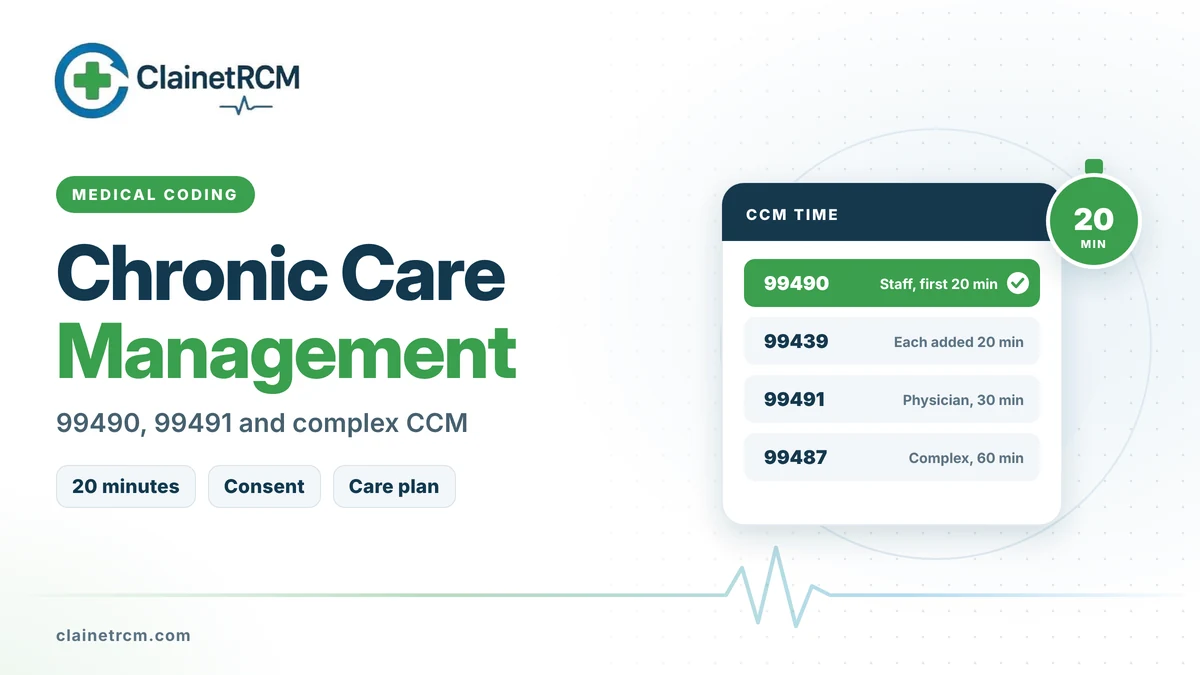
Our guide to chronic care management CPT codes explains how to combine the services.
Documentation Checklist
- Discharge date and facility
- Date, method and content of the interactive contact, or the documented attempts
- Date of the face-to-face visit
- Medication reconciliation
- The medical decision making supporting moderate or high complexity
- Coordination activities during the 30 days
Billing Example
A patient with heart failure is discharged on Monday. A nurse reaches the patient by phone on Tuesday, reviews symptoms and schedules a visit. The physician sees the patient that Friday, four days after discharge, reconciles medications, adjusts diuretics and documents high-complexity decision making. Bill 99496 with the Friday date of service. If the visit had taken place 10 days after discharge, the practice would bill 99495.
A Practical TCM Workflow
- Get discharge alerts. Use hospital notifications, health information exchange feeds or daily census reports.
- Call within one business day. That leaves a cushion if the patient is hard to reach.
- Schedule the visit at the first call. Aim for 7 days for complex patients.
- Reconcile medications before or at the visit.
- Bill TCM after the face-to-face visit, using the code that matches timing and complexity.
Common TCM Denials
| Denial | Cause | Fix |
|---|---|---|
| Duplicate TCM | Another practitioner already billed TCM for the period | Coordinate with specialists and check history |
| Missing contact | No documented contact or attempts within 2 business days | Document every attempt with date and time |
| Visit outside window | Face-to-face visit after day 14 | Bill an E/M visit instead |
| Separate E/M billed | The TCM visit billed again as an office visit | Do not bill the TCM face-to-face visit separately |
Frequently Asked Questions
99496 requires a face-to-face visit within 7 days and high-complexity medical decision making. 99495 requires a visit within 14 days and at least moderate complexity.
After the face-to-face visit is completed. You do not need to wait until the end of the 30-day period.
Only one TCM can be billed per patient in a 30-day period. Plan the next TCM after the next qualifying discharge outside that period.
Yes, when it meets Medicare’s telehealth requirements.
It must be completed no later than the date of the face-to-face visit.
Final Thoughts
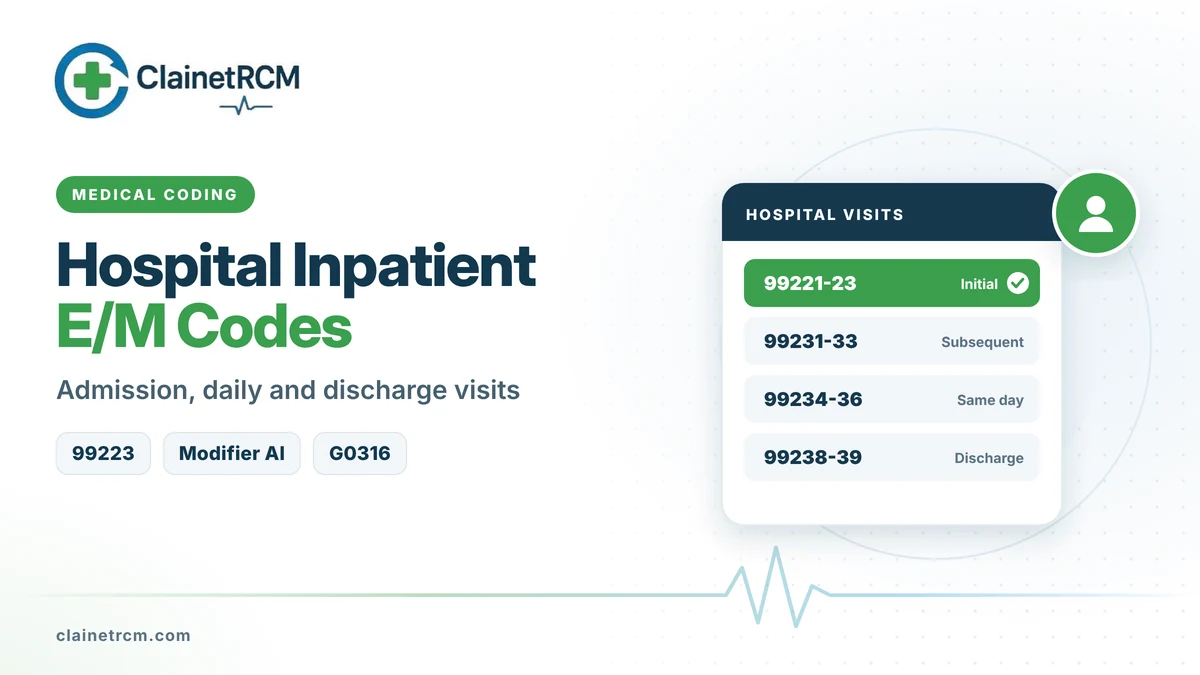
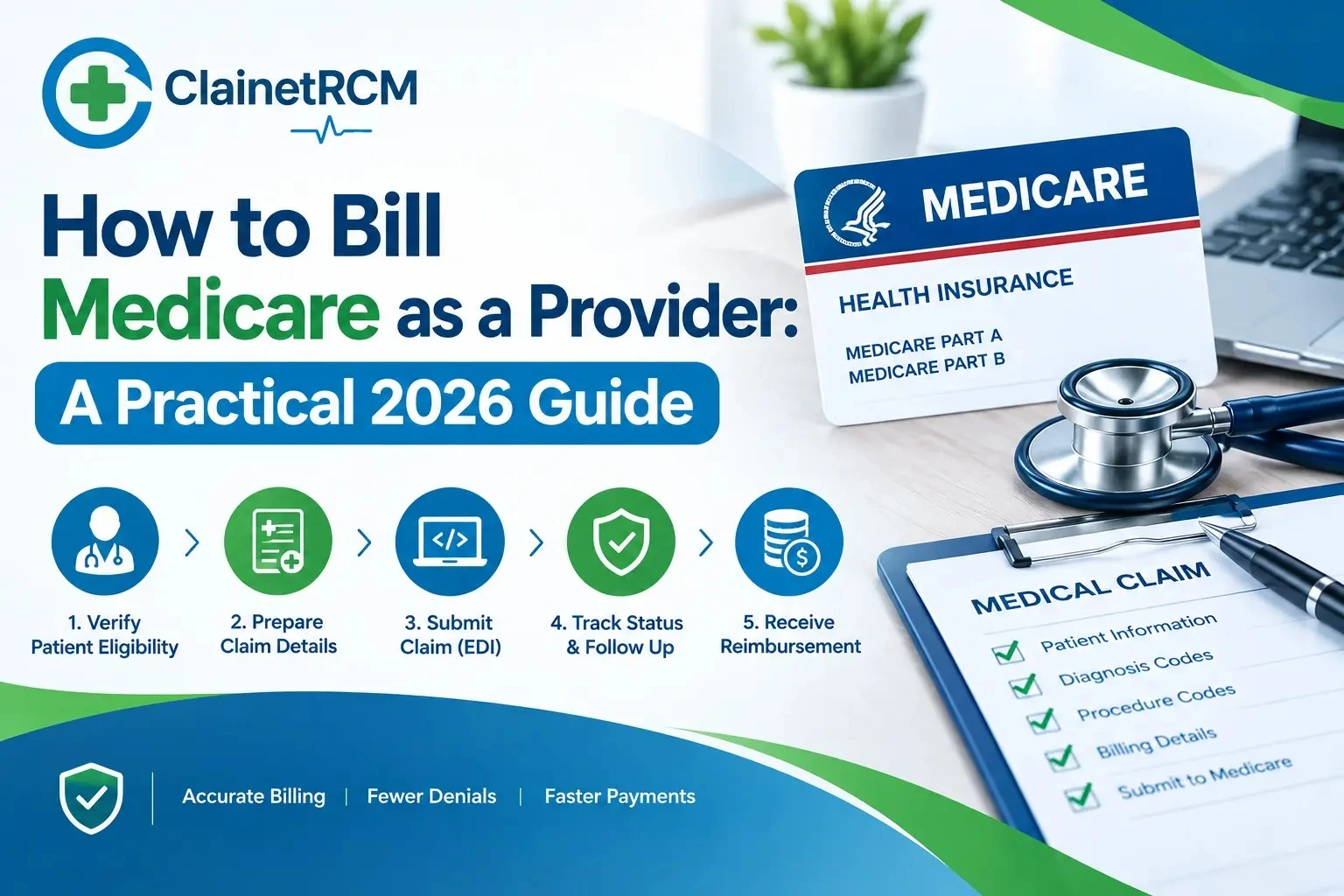
Transitional care management CPT codes reward fast, organized follow-up after discharge. Build a discharge alert and two-business-day contact routine, and choose the code that matches both timing and complexity. Our internal medicine billing team helps practices capture TCM consistently, and our guide on how to bill Medicare as a provider covers Medicare claim basics. For hospital visit coding, see our guide to hospital inpatient E/M codes.
Capture Every Eligible TCM Visit
We track discharges, contact deadlines and visit windows so your practice bills TCM correctly instead of a standard follow-up visit.
Set Up TCM Tracking
Written by
ClainetRCM Billing Team
ClainetRCM is a Boston-based revenue cycle management company specializing in medical billing, coding, credentialing and denial management for healthcare providers across all 50 states. Our AAPC and AHIMA certified team works inside your existing EHR, files claims within 24 to 48 hours and reviews every AR bucket on a 14-day cycle.