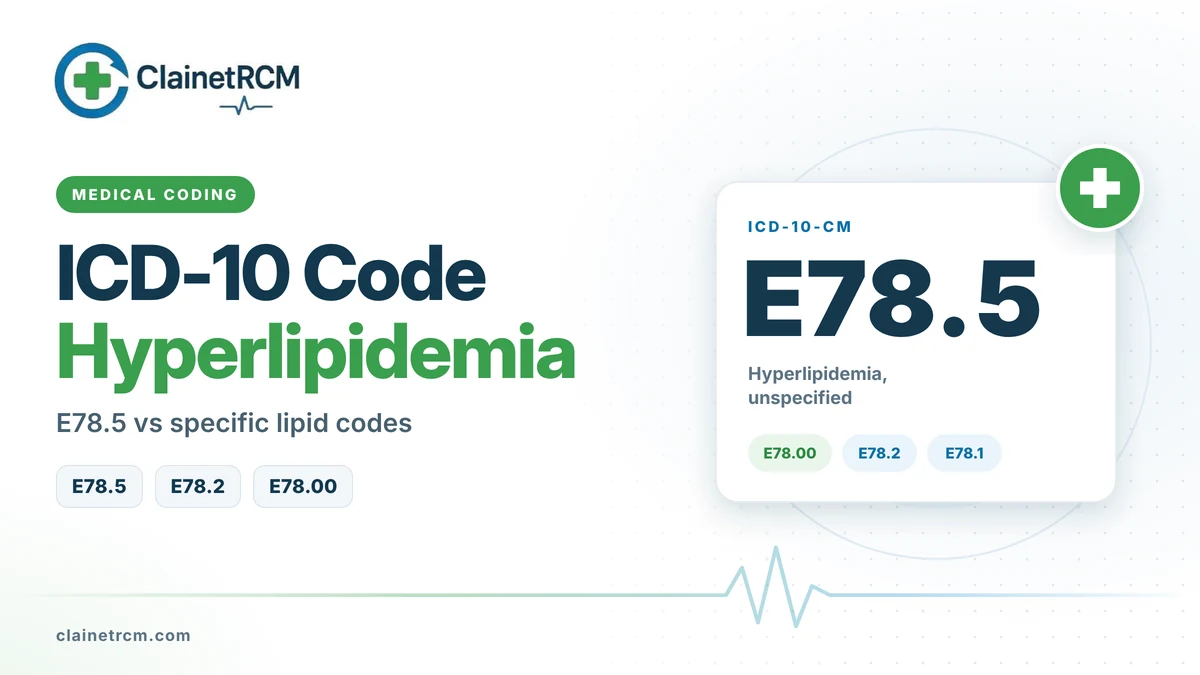
The ICD-10 code for hyperlipidemia is E78.5 when the provider documents hyperlipidemia or dyslipidemia without more detail. ICD-10-CM has more specific codes for high cholesterol, high triglycerides, mixed hyperlipidemia and familial disorders, and payers increasingly expect the most specific code the record supports. Screening and long-term statin therapy have their own codes as well.
Quick answer: Use E78.5 for hyperlipidemia or dyslipidemia, unspecified. Use E78.00 for pure hypercholesterolemia (high cholesterol or high LDL), E78.01 for familial hypercholesterolemia, E78.1 for pure hyperglyceridemia (high triglycerides), E78.2 for mixed hyperlipidemia, E78.41 for elevated lipoprotein(a) and E78.49 for other hyperlipidemia. For screening, Medicare uses Z13.6 with lipid tests covered once every five years, and many commercial payers use Z13.220. There is no statin-specific drug code; use Z79.899 for other long-term drug therapy when relevant.
ICD-10 Code for Hyperlipidemia: Code Options
| Code | Description | Common documentation |
|---|---|---|
| E78.00 | Pure hypercholesterolemia, unspecified | High cholesterol, elevated LDL |
| E78.01 | Familial hypercholesterolemia | Genetically confirmed or clinically diagnosed familial disease |
| E78.1 | Pure hyperglyceridemia | High triglycerides, hypertriglyceridemia |
| E78.2 | Mixed hyperlipidemia | High cholesterol and high triglycerides, combined hyperlipidemia |
| E78.3 | Hyperchylomicronemia | Very high triglycerides with chylomicronemia |
| E78.41 | Elevated lipoprotein(a) | Elevated Lp(a) |
| E78.49 | Other hyperlipidemia | Familial combined hyperlipidemia and other specified types |
| E78.5 | Hyperlipidemia, unspecified | Hyperlipidemia or dyslipidemia without detail |
| E78.6 | Lipoprotein deficiency | Low HDL as a documented disorder |
Choosing Between E78.5 and a Specific Code
E78.5 is acceptable when the provider writes only “hyperlipidemia” or “dyslipidemia.” When the note describes the lipid abnormality, such as “elevated LDL on statin” or “hypertriglyceridemia,” code the specific type. Coders should not assign a more specific code based on lab values alone; the provider must document the diagnosis. If the record is unclear and the specificity matters, query the provider.
Screening Codes
| Payer | Diagnosis code | Notes |
|---|---|---|
| Medicare | Z13.6 (screening for cardiovascular disorders) | Lipid panel (80061) or its components covered once every five years without cost-sharing |
| Commercial | Z13.220 (screening for lipoid disorders) | Coverage follows the plan’s preventive benefits |
When the test is ordered to monitor known hyperlipidemia or therapy, use the hyperlipidemia code, not a screening code.
Related Z Codes
- Z79.899, other long-term (current) drug therapy, for statins and other lipid-lowering drugs when the drug therapy is relevant
- Z83.42, family history of familial hypercholesterolemia
- Z82.49, family history of ischemic heart disease
- Treated is current. Hyperlipidemia controlled with medication is a current condition coded with E78, not a personal history code
Hyperlipidemia With Diabetes and Heart Disease
There is no combination code for hyperlipidemia with hypertension or coronary artery disease, so code each condition the provider addresses. Hyperlipidemia is also not one of the conditions ICD-10-CM presumes to be a diabetic complication. Code E78.- separately for a patient with diabetes unless the provider documents that the lipid disorder is caused by the diabetes, in which case E11.69 plus the E78 code may apply.
Monitoring Frequency
Medicare’s national coverage policy for lipid testing allows a lipid panel to monitor patients on lipid-lowering diet or drug therapy, and generally treats annual monitoring as reasonable for stable patients, with more frequent testing when therapy changes or results are abnormal. Commercial payers often follow similar logic. Link monitoring tests to the E78 code, not to a screening code, and document why repeat testing was needed when it happens sooner.
Quality Measures
Health plans track statin therapy for patients with cardiovascular disease and for patients with diabetes. Accurate lipid, cardiovascular and diabetes coding, along with documented exclusions such as statin intolerance, helps your practice receive credit for these measures.
Lab and Visit Pairings
Common lab services include the lipid panel (80061), direct LDL (83721), total cholesterol (82465), HDL (83718), triglycerides (84478) and lipoprotein(a) (83695). Link each test to the diagnosis that explains why it was ordered. Hyperlipidemia often appears with hypertension and diabetes; code each condition that the provider addresses at the visit.
Coding Examples
| Scenario | Codes |
|---|---|
| Hyperlipidemia on atorvastatin, no further detail | E78.5, Z79.899 |
| Mixed hyperlipidemia with high LDL and triglycerides | E78.2 |
| Elevated LDL without high triglycerides | E78.00 |
| Familial hypercholesterolemia with family history | E78.01, Z83.42 |
| Medicare patient with a routine lipid screening | Z13.6 |
Documentation Tips
- State the type of lipid disorder when known, not just “HLD.”
- Record the current therapy and response, such as LDL on treatment.
- Note related cardiovascular risk factors and conditions addressed at the visit.
- For familial disorders, document the basis for the diagnosis.
Common Errors
- Using a screening code for monitoring tests in a patient with known hyperlipidemia
- Coding a specific type from lab values without a provider diagnosis
- Reporting E78.5 when the provider clearly documented mixed hyperlipidemia or high triglycerides
- Billing Medicare lipid screening more often than every five years
Frequently Asked Questions
E78.5 is the code for hyperlipidemia, unspecified. Use a more specific E78 code when the provider documents the type.
High cholesterol is coded E78.00, pure hypercholesterolemia, unspecified, unless a familial form (E78.01) is documented.
E78.2 is mixed hyperlipidemia, with both elevated cholesterol and triglycerides. E78.5 is used when the provider does not specify the type.
There is no statin-specific code. Use Z79.899 for other long-term drug therapy when it is relevant to the encounter.
Yes. Hyperlipidemia that is treated and monitored is a current condition. Code the documented E78 type and add Z79.899 when the long-term drug therapy is relevant to the visit.
Hypertriglyceridemia is E78.1, pure hyperglyceridemia. If cholesterol is also elevated and the provider documents mixed hyperlipidemia, use E78.2.
Use Z13.6 for Medicare cardiovascular screening blood tests, which are covered once every five years.
Final Thoughts
The ICD-10 code for hyperlipidemia is only as specific as the provider’s documentation, so small improvements in the note pay off. Learn how we support cardiology practices on our cardiology billing page, or review symptom coding in our generalized weakness ICD-10 guide.
Code Chronic Conditions to Full Specificity
Our coders match lipid diagnoses to the provider’s documentation and screening rules so lab, visit and preventive claims pay without medical necessity denials.
Get Coding Help
Written by
ClainetRCM Billing Team
ClainetRCM is a Boston-based revenue cycle management company specializing in medical billing, coding, credentialing and denial management for healthcare providers across all 50 states. Our AAPC and AHIMA certified team works inside your existing EHR, files claims within 24 to 48 hours and reviews every AR bucket on a 14-day cycle.