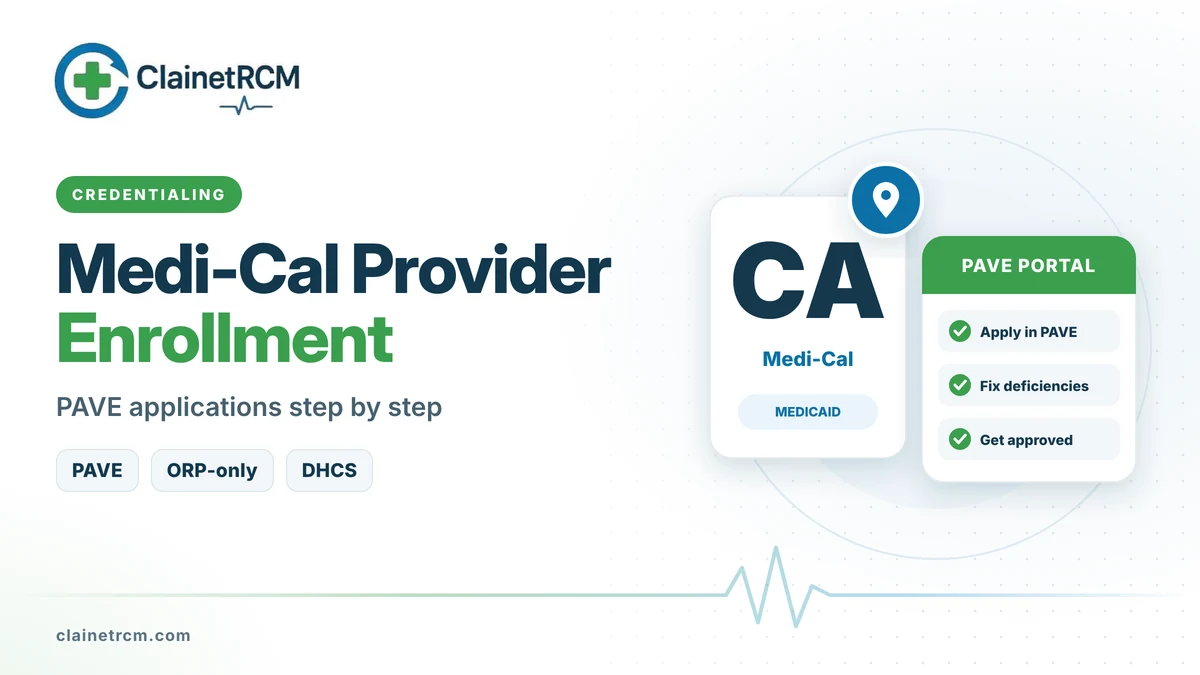
Medi-Cal provider enrollment is how California’s Department of Health Care Services (DHCS) approves a clinician, group or facility to serve and bill Medi-Cal, the state’s Medicaid program. Nearly every application now runs through PAVE, the state’s online enrollment portal, and enrollment is also the gateway to most Medi-Cal managed care networks. Choosing the right application type and sending complete documents the first time is the difference between a smooth approval and months of back-and-forth.
Quick answer: Create an account in PAVE (the Provider Application and Validation for Enrollment portal at pave.dhcs.ca.gov) and choose the application that matches your role: billing group, individual rendering provider or ordering, referring and prescribing (ORP) only. Upload your license, NPI and identity documents, sign electronically and pay the federal application fee if your provider type owes it. DHCS reviews the file, may send a deficiency notice that you must answer by the deadline it sets, and then issues an approval with an effective date. Plan on roughly three to six months for a full application; ORP-only enrollment is simpler.
Who Needs Medi-Cal Provider Enrollment
- Billing providers. Groups, clinics and other organizations that receive Medi-Cal payment must be enrolled under their Type 2 NPI.
- Rendering providers. Physicians, nurse practitioners, psychologists and other clinicians who treat patients under a group’s billing number must enroll individually and be affiliated with that group.
- Ordering, referring and prescribing providers. Federal rules (42 CFR 455.410(b)) require states to enroll every physician or other professional who orders or refers services. Pharmacies, labs, imaging centers and equipment suppliers cannot be paid when the ordering clinician is not enrolled, and DHCS has been phasing in claim edits to enforce this.
- Managed care network providers. Federal rules require the state to screen and enroll every Medi-Cal managed care network provider, so even clinicians who never bill fee-for-service usually need Medi-Cal enrollment before managed care plans can keep them in network.
PAVE Application Types at a Glance
| Application | Who uses it | What it allows |
|---|---|---|
| Group or organization | Practices, clinics and facilities billing under a Type 2 NPI | Receives Medi-Cal payment for affiliated rendering providers |
| Individual rendering provider | Clinicians who treat patients and bill through a group | Services billed under the group’s number |
| Individual billing provider | A clinician billing under their own NPI | Bills Medi-Cal directly |
| ORP only | Clinicians who order, refer or prescribe but do not bill | Lets other providers’ claims for those orders pay |
| Supplemental changes | Providers who are already enrolled | Adds locations or affiliations and updates information |
If you are unsure which path applies, start from what the clinician actually does. A hospitalist who only writes orders needs ORP-only enrollment; a therapist joining a group practice needs a rendering application tied to that group.
Documents and Information to Prepare
- NPI numbers that match NPPES exactly, including legal name, addresses and taxonomy
- A current California license and, for prescribers, DEA registration
- Government-issued photo identification
- IRS documentation for the group’s EIN, such as a CP-575 or 147C letter
- Ownership, control and managing employee disclosures for organizations
- Board certification or specialty documentation when the provider type requires it
- Proof of the practice location, such as a lease, when DHCS requests it
Mismatches are the most common problem. If the name or address in PAVE differs from NPPES or the license, expect DHCS to send the file back with questions.
How to Complete Medi-Cal Provider Enrollment in PAVE
- Clean up NPPES first. Update names, practice addresses and taxonomy codes in NPPES before you start so DHCS validation matches.
- Create the PAVE account and business profile. The person submitting can be the provider, an office manager or an authorized agent.
- Select the application type. Groups typically enroll before or alongside their rendering providers so affiliations can be completed.
- Complete each section and upload documents. PAVE walks you through identification, licensing, locations, ownership and disclosures.
- Sign and pay. The federal application fee ($750 for 2026) applies to institutional provider types; individual physicians, non-physician practitioners and groups of practitioners are generally exempt.
- Answer deficiency notices quickly. If DHCS needs more information, it sends a deficiency notice with a response deadline, often 60 days. Missing that deadline can lead to denial, and you would have to reapply.
- Receive approval and confirm the details. Review the approval letter for the effective date, provider type and locations, then set up billing and managed care contracts.
Processing Times and What Slows Them Down
State law gives DHCS a set review window that is shorter for physician applications than for most other provider types, so a complete physician application usually moves faster than a clinic or facility file. Realistically, plan on three to six months for a full enrollment. Each round of deficiencies adds weeks.
| Delay | Why it happens | How to prevent it |
|---|---|---|
| Deficiency notice | Missing, expired or unreadable documents | Upload clear, current copies of every required document |
| Data mismatch | Name, address or taxonomy differs from NPPES or the license | Align NPPES, the license and PAVE before you submit |
| Site visit | Required for some provider types and risk levels | Keep the location ready and staff informed |
| Wrong application type | Rendering filed as an individual billing provider or vice versa | Confirm the billing arrangement before you apply |
| Missing affiliation | Rendering provider not linked to the group | Submit the affiliation with the rendering application |
ORP Enforcement and Claim Denials
ORP enrollment affects revenue you might not expect. When a clinician orders labs, imaging, durable medical equipment or prescriptions for a Medi-Cal patient, the claim from the lab, imaging center, supplier or pharmacy carries the ordering provider’s NPI. If that NPI is not enrolled, the claim can deny and the patient’s care can be delayed. Residents, hospital-based clinicians and providers who only see managed care members should confirm they have at least ORP-only enrollment.
Keeping Your Enrollment Active
- Report changes promptly. New locations, address changes, ownership changes and new affiliations go through PAVE as supplemental changes.
- Watch for revalidation notices. Federal rules require revalidation at least every five years, and DHCS sends notices with a due date. Missing it can deactivate the enrollment.
- Coordinate with managed care plans. Once enrolled, contract and credential with each Medi-Cal managed care plan you want to join; most plans use CAQH data for their own credentialing.
Frequently Asked Questions
PAVE is the Provider Application and Validation for Enrollment portal, the DHCS online system for Medi-Cal applications, supplemental changes and revalidation. Most provider types must use it instead of paper forms.
Plan on roughly three to six months for a full application. Physician applications have a shorter legal review window than most other provider types, and ORP-only enrollment is usually faster. Deficiency notices and site visits extend the timeline.
In most cases, yes. Federal rules require states to screen and enroll managed care network providers, so plans expect you to be enrolled with DHCS before or while they contract with you.
It is a limited enrollment for clinicians who order, refer or prescribe for Medi-Cal patients but do not bill Medi-Cal themselves. It allows the pharmacy, lab or supplier that fills the order to be paid.
The federal application fee applies to institutional provider types such as clinics, labs and suppliers, and it is $750 for 2026. Individual physicians, non-physician practitioners and groups of practitioners are generally exempt.
At least every five years under federal rules, and sooner if DHCS asks. Watch for the revalidation notice and submit through PAVE before the due date.
Final Thoughts
Medi-Cal provider enrollment rewards preparation: clean NPPES data, the right PAVE application type and fast responses to deficiency notices. If you serve patients across California, see how we support practices on our California page, compare the process with our Texas Medicaid enrollment guide, or let our credentialing team handle the application for you.
Get Enrolled in Medi-Cal Without the Back-and-Forth
We prepare and submit PAVE applications, answer DHCS deficiency notices and coordinate managed care plan credentialing so your providers can see Medi-Cal patients sooner.
Start Medi-Cal Enrollment
Written by
ClainetRCM Billing Team
ClainetRCM is a Boston-based revenue cycle management company specializing in medical billing, coding, credentialing and denial management for healthcare providers across all 50 states. Our AAPC and AHIMA certified team works inside your existing EHR, files claims within 24 to 48 hours and reviews every AR bucket on a 14-day cycle.