
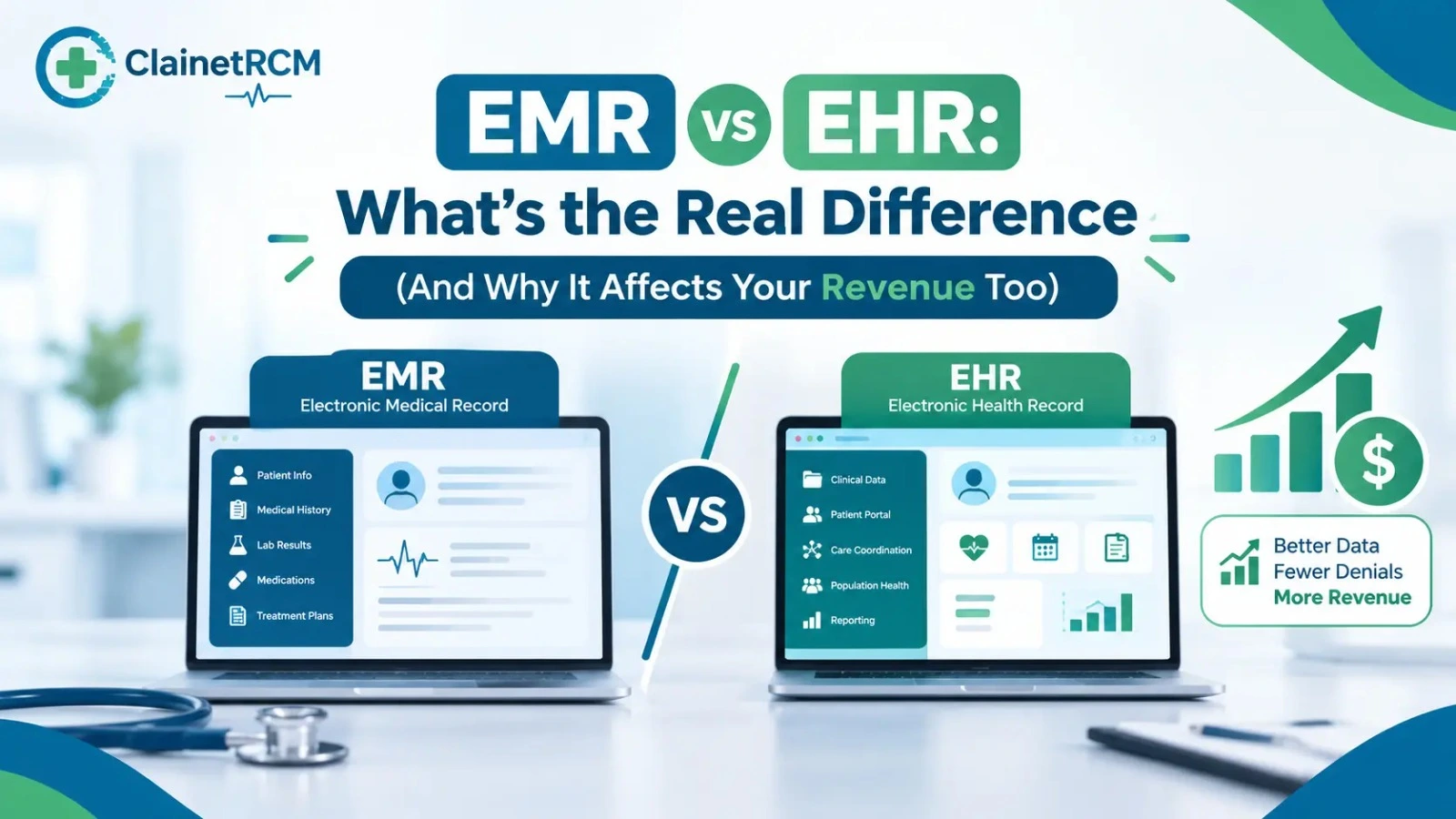
If you have spent any time around a medical office, you have probably heard "EMR" and "EHR" used as if they mean the exact same thing. Most staff say them interchangeably. Most vendors do too. But they are not the same, and the difference matters far more than a vocabulary lesson. It affects how your practice shares patient data, how smoothly your claims move through payers, and how much administrative work your billing team ends up doing every single day.
In short: an EMR (Electronic Medical Record) is a digital chart used inside one practice. An EHR (Electronic Health Record) is a broader, shareable record designed to move with the patient across multiple providers, labs, pharmacies, and hospitals. Every EHR technically contains what an EMR does, but not every EMR has the interoperability that makes something an EHR.
That one-line answer is where most articles on this topic stop. This guide goes further, because after years of sitting inside the billing and claims side of healthcare, we have seen firsthand how the EMR vs EHR decision quietly shapes denial rates, coding accuracy, credentialing timelines, and collections. That is the part almost nobody talks about, and it is exactly what we are going to cover here.
EMR vs EHR at a Glance
| Feature | EMR (Electronic Medical Record) | EHR (Electronic Health Record) |
|---|---|---|
| Scope | Single practice or provider | Multiple providers, facilities, and specialties |
| Data sharing | Limited or none outside the practice | Built for interoperability and data exchange |
| Patient access | Rarely available to patients directly | Often includes a patient portal |
| Primary use | Diagnosis, treatment notes, charting | Coordinated, longitudinal patient care |
| View of the patient | A single visit or episode of care | The patient's full health history over time |
| Best fit for | Small, single-location practices | Multi-provider groups, health systems, value-based care models |
| Impact on billing | Data often stays siloed, more manual entry | Cleaner data flow, fewer coding gaps, faster claims |
What Is an EMR, Exactly?
An EMR is the digital replacement for the paper chart that used to sit in a file room. It holds a patient's history, diagnoses, medications, treatment plans, immunization dates, and progress notes, but it was built to serve one provider or one practice. Think of it as a chart that lives on a computer instead of a shelf.
The earliest EMR systems date back to the 1970s, developed to help practices move away from handwritten notes. For decades, if a patient switched doctors or needed a specialist, the only way to move their record was to print it, fax it, or physically hand it over. That single limitation is the entire reason the industry eventually pushed toward something bigger.
What an EMR typically includes:
- Patient demographics and contact information
- Diagnosis and treatment history
- Clinical notes from the treating provider
- Lab and test results
- Medication lists and allergy records
- Visit-by-visit documentation
Where an EMR falls short:
- Data usually cannot travel easily to another provider's system
- Limited or no direct patient access to their own records
- Little to no support for care coordination across specialties
- Can create documentation gaps when a patient sees multiple providers who cannot see each other's notes
What Is an EHR, Exactly?
An EHR takes everything an EMR does and extends it outward. Instead of being locked inside one practice's four walls, an EHR is designed to move with the patient. If a patient sees their primary care physician, gets lab work done, visits a specialist, and picks up a prescription, an EHR is built to let all of those touchpoints see a more complete version of that patient's health story, not just the piece that happened in one office.
This is the interoperability piece that defines an EHR. Authorized providers across different organizations can pull up the same record, add to it, and rely on it being current. That matters most when a patient is being treated by more than one provider at the same time, which describes a large share of real-world patient care.
What an EHR typically adds on top of EMR functionality:
- Interoperability across practices, hospitals, labs, and pharmacies
- Patient portals for appointment requests, results, and messaging
- Support for care coordination between specialists and primary care
- Built-in support for population health tracking and value-based care reporting
- Alerts for drug interactions, overdue screenings, or care gaps pulled from a wider data set
The One Difference That Actually Matters: Interoperability
Every other difference between EMR and EHR is really just a downstream effect of this one thing: whether the data can leave the building.
An EMR was designed to answer the question, "What happened to this patient in my office?" An EHR was designed to answer a bigger question: "What is happening to this patient across their entire care journey?" Once you understand that, the rest of the comparison falls into place on its own. Patient portals, care coordination, population health reporting, and cross-provider data sharing all exist because the underlying record was built to be shared in the first place.
This is also the reason EMR and EHR get used interchangeably so often in daily conversation. Functionally, the screens can look almost identical to a front desk employee entering a patient's date of birth or a physician typing a progress note. The difference only becomes obvious the moment that data needs to leave the practice and land somewhere useful.
Why This Distinction Matters for Billing and Revenue Cycle Management
This is the section most EMR vs EHR articles skip entirely, and it is where the real financial impact shows up.
1. Coding accuracy and clean claims
When a system does not share data well, coders and billers often work with incomplete information. A referral note that never made it into the system, a lab result that lives in a separate portal, or a specialist's update that never synced back to the primary chart all create gaps. Those gaps lead to under-coding, missed modifiers, or claims sent out with information that does not match what actually happened during the encounter. An EHR's ability to pull a fuller clinical picture directly supports more accurate medical coding, which supports cleaner claims the first time they are submitted.
2. Denial rates
A large share of claim denials trace back to documentation and data mismatches, not the payer being difficult. When information about a patient's history, medications, or prior treatments is scattered across systems that do not talk to each other, denial rates tend to climb. Practices that struggle with recurring denials often find the root cause sitting upstream in how their clinical data is captured and shared, not in the billing team's work itself. If this sounds familiar, our breakdown on preventing claim denials before they happen goes deeper into the patterns worth watching for.
3. Credentialing and payer enrollment
Interoperable systems make it easier to compile the documentation payers require during provider enrollment and credentialing, since records, licenses, and history are easier to pull and verify. Practices switching systems or scaling to multiple locations often underestimate how much this affects credentialing timelines, and how directly credentialing delays can hold up revenue that is otherwise ready to bill.
4. Prior authorization turnaround
Authorization requests move faster when the clinical documentation behind them is complete and accessible. A system with strong interoperability reduces the back-and-forth of requesting missing notes from another provider, which shortens the time it takes to get a prior authorization approved and the patient scheduled.
5. Patient collections
Patients increasingly expect the transparency that comes with EHR-connected portals, things like viewing their balance, understanding what a visit cost, and paying online without a phone call. That visibility tends to improve patient collections, since friction is one of the biggest reasons balances sit unpaid.
The pattern across all five points is the same. Data that flows well leads to billing that flows well. Data that gets stuck leads to claims that get stuck too.
EMR vs EHR: Pros and Cons for Different Practice Types
Solo or single-location practices
An EMR can be enough if the practice rarely needs to share records outside its own walls and does not participate in coordinated or value-based care arrangements. It is often simpler to implement and can cost less upfront. The tradeoff is that as soon as referrals, specialists, or multi-location growth enter the picture, the limitations show up quickly.
Multi-provider groups and specialty centers
An EHR becomes far more valuable once more than one type of provider is involved in a patient's care. Specialty groups covering areas like cardiology, orthopedics, or behavioral health benefit from a system that lets referring providers and specialists see the same patient history without duplicate intake, duplicate testing, or missing context.
Hospitals and health systems
At this scale, an EHR is not really optional. Hospitals coordinate across departments, outside referring physicians, labs, and often multiple facilities. The reporting requirements alone, particularly for value-based care and quality measures, depend on the kind of longitudinal data only an EHR is built to hold.
Home health, hospice, and urgent care
These settings often involve handoffs between multiple caregivers and providers in a short window of time. An EHR's ability to keep everyone working from the same current record reduces the risk of conflicting notes or missed updates during a patient's care.
Common Questions About EMR vs EHR
Is EHR just a newer name for EMR?
No. They are related but not interchangeable. An EMR is the digital chart itself. An EHR includes that chart but adds the ability to share it securely across providers and organizations. The terms get used loosely in everyday conversation, but the technical distinction is about data sharing, not age or brand.
Can a system be both an EMR and an EHR?
Yes, and in practice most modern platforms marketed as "EHRs" started life doing EMR-style single-practice charting and expanded into interoperability over time. The label depends on whether the system's data can move beyond one practice.
Does switching from EMR to EHR affect billing operations?
It usually does, and mostly for the better once the transition settles. Practices often see improved documentation completeness, which supports cleaner coding and fewer denials. There is typically a short adjustment period where staff are learning new workflows, so planning the switch alongside your practice management and billing processes helps avoid a temporary dip in claim turnaround.
Which one do small practices actually need?
It depends on referral patterns. A practice that rarely refers patients out or receives referrals may function fine on an EMR. A practice that regularly coordinates with specialists, labs, or hospitals benefits from an EHR's ability to keep that data connected.
Do EMR and EHR systems affect medical coding differently?
Yes. An EHR generally supports more complete documentation because it pulls in data from multiple points of care, which gives coders a fuller picture of what happened. An EMR limited to one practice's notes can leave coders working with a narrower view, increasing the chance of missed detail. This is one reason many practices pair their system choice with dedicated medical coding support to catch what the software alone might miss.
Is one system required by law?
Meaningful use and ONC certification requirements over the years have pushed most practices toward EHR-level interoperability, especially those billing Medicare and Medicaid. Requirements vary by program and have changed over time, so it is worth confirming current requirements for your specific payer mix and specialty rather than assuming a blanket rule.
How to Decide Between EMR and EHR for Your Practice
There is no universal right answer, but a few questions consistently point practices in the right direction:
- How often do you refer patients out or receive referrals? Frequent referral activity favors an EHR.
- Do you participate in value-based care or quality reporting programs? Those programs typically require the data depth an EHR provides.
- Are you planning to grow into multiple locations or add providers? Scaling almost always benefits from interoperability built in from the start rather than added later.
- How much does your billing team currently struggle with missing documentation? If denials frequently trace back to incomplete clinical notes, that is a signal your data is not flowing the way it should.
- Do patients expect portal access, online payments, or digital communication? Patient experience expectations have shifted, and EHR platforms are usually built around that expectation.
Whichever system a practice chooses, the software itself is only half the equation. The other half is how well billing, coding, credentialing, and collections are built around the data that system produces. A great EHR paired with a disorganized revenue cycle management process will still leak revenue. A modest EMR paired with a tight, well-managed billing workflow can outperform expectations.
The Bottom Line
An EMR is a digital chart built for one practice. An EHR is a shareable health record built to travel with the patient across their entire care journey. The difference is not just technical vocabulary. It shows up in how clean your claims are, how fast your prior authorizations clear, how quickly credentialing gets processed, and how easily patients pay their balances.
Choosing between the two is really a question of how connected your practice needs to be, today and as it grows. And whichever system sits behind your front desk, the way that data gets turned into accurate coding, submitted claims, and collected revenue is where the real financial outcome is decided.
Not Sure If Your Current System Is Costing You Revenue?
Our team reviews how your EMR or EHR data is flowing into your billing, coding, and claims process, and shows you exactly where revenue is slipping through.

ClainetRCM Billing Team
ClainetRCM is a Boston-based revenue cycle management company specializing in medical billing, coding, credentialing, and denial management for healthcare providers across all 50 states. Our AAPC and AHIMA certified coders work inside every major EMR and EHR platform.