Place of service codes look like a small detail on a claim, but they decide how much you are paid. The same office visit can pay very different amounts depending on whether it is coded as an office, a hospital outpatient department or a telehealth visit. A wrong code can cause a denial, an underpayment or an overpayment that shows up later in an audit.
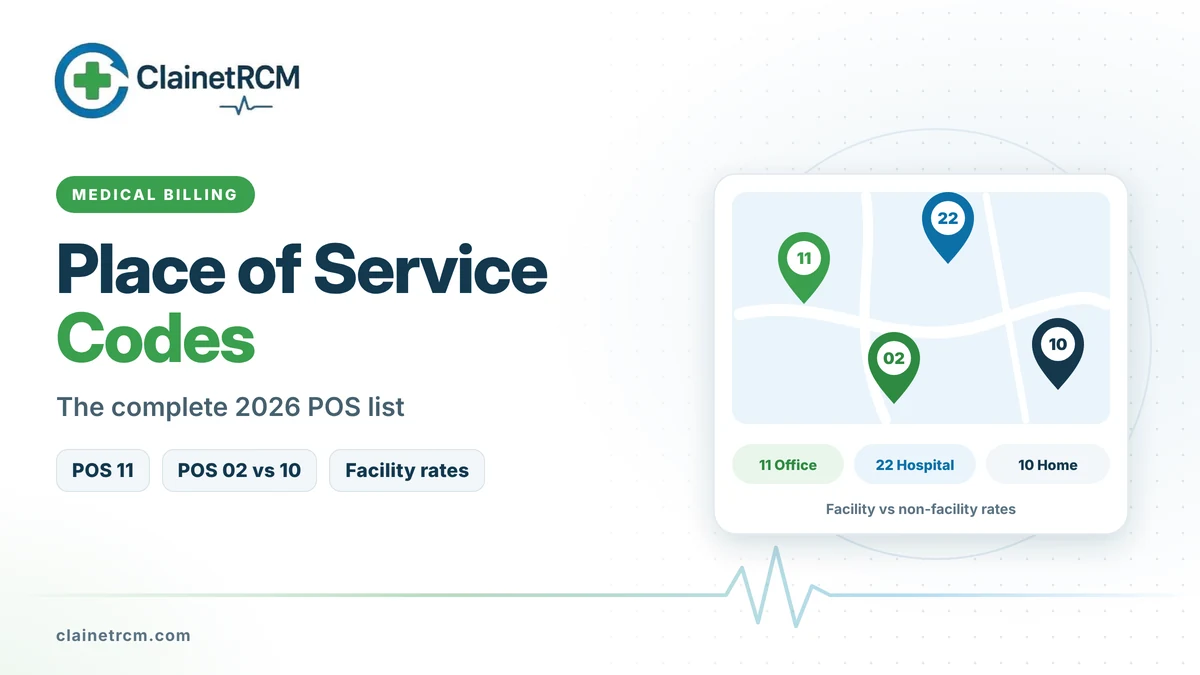
Quick answer: Place of service (POS) codes are two-digit codes from the CMS code set that tell a payer where a service was provided. They go on each line of a professional claim, in item 24B of the CMS-1500 or the matching field of the electronic 837P. The most common are POS 11 (office), POS 22 (on-campus outpatient hospital), POS 19 (off-campus outpatient hospital), POS 21 (inpatient hospital), POS 23 (emergency room) and the telehealth codes POS 02 and POS 10. Medicare pays many services at a higher non-facility rate in settings such as the office and a lower facility rate in hospital settings.
What Place of Service Codes Do
Each POS code tells the payer the setting where the patient received the service. That matters for three reasons:
- Payment. Many CPT codes have two Medicare fee schedule amounts. The non-facility rate includes the practice’s overhead. The facility rate is lower because the hospital or facility bills its own costs separately.
- Coverage. Some services are covered only in certain settings, and some payers require specific POS codes for programs such as opioid treatment or telehealth.
- Claim edits. Payers compare the POS with the procedure code, the provider type and other claims. A mismatch triggers a denial.
POS codes apply to professional claims. Institutional claims from hospitals and facilities use a type of bill on the UB-04 instead. See our guide to CMS-1500 claim basics and clean claims.
The Most Used Place of Service Codes
| POS | Name | Typical use | Medicare payment rate |
|---|---|---|---|
| 02 | Telehealth provided other than in patient’s home | Patient joins a telehealth visit from a clinic, hospital or other site | Facility |
| 10 | Telehealth provided in patient’s home | Patient joins a telehealth visit from home | Non-facility |
| 11 | Office | Physician-owned practice location | Non-facility |
| 12 | Home | In-person visit at the patient’s private residence | Non-facility |
| 13 | Assisted living facility | Visits at an assisted living residence | Non-facility |
| 19 | Off campus-outpatient hospital | Hospital-owned clinic away from the main campus | Facility |
| 20 | Urgent care facility | Freestanding urgent care center | Non-facility |
| 21 | Inpatient hospital | Admitted inpatients | Facility |
| 22 | On campus-outpatient hospital | Hospital outpatient departments on campus, including observation | Facility |
| 23 | Emergency room-hospital | Hospital emergency department | Facility |
| 24 | Ambulatory surgical center | Procedures in an ASC | Facility |
| 31 | Skilled nursing facility | Part A covered SNF stays | Facility |
| 32 | Nursing facility | Nursing home residents not in a Part A stay | Non-facility |
Complete CMS Place of Service Code List
CMS maintains the national POS code set, which currently has 52 assigned codes. Unlisted numbers are unassigned.
| POS | Name |
|---|---|
| 01 | Pharmacy |
| 02 | Telehealth provided other than in patient’s home |
| 03 | School |
| 04 | Homeless shelter |
| 05 | Indian Health Service free-standing facility |
| 06 | Indian Health Service provider-based facility |
| 07 | Tribal 638 free-standing facility |
| 08 | Tribal 638 provider-based facility |
| 09 | Prison/correctional facility |
| 10 | Telehealth provided in patient’s home |
| 11 | Office |
| 12 | Home |
| 13 | Assisted living facility |
| 14 | Group home |
| 15 | Mobile unit |
| 16 | Temporary lodging |
| 17 | Walk-in retail health clinic |
| 18 | Place of employment-worksite |
| 19 | Off campus-outpatient hospital |
| 20 | Urgent care facility |
| 21 | Inpatient hospital |
| 22 | On campus-outpatient hospital |
| 23 | Emergency room-hospital |
| 24 | Ambulatory surgical center |
| 25 | Birthing center |
| 26 | Military treatment facility |
| 27 | Outreach site/street |
| 31 | Skilled nursing facility |
| 32 | Nursing facility |
| 33 | Custodial care facility |
| 34 | Hospice |
| 41 | Ambulance-land |
| 42 | Ambulance-air or water |
| 49 | Independent clinic |
| 50 | Federally qualified health center |
| 51 | Inpatient psychiatric facility |
| 52 | Psychiatric facility-partial hospitalization |
| 53 | Community mental health center |
| 54 | Intermediate care facility/individuals with intellectual disabilities |
| 55 | Residential substance abuse treatment facility |
| 56 | Psychiatric residential treatment center |
| 57 | Non-residential substance abuse treatment facility |
| 58 | Non-residential opioid treatment facility |
| 60 | Mass immunization center |
| 61 | Comprehensive inpatient rehabilitation facility |
| 62 | Comprehensive outpatient rehabilitation facility |
| 65 | End-stage renal disease treatment facility |
| 66 | Programs of All-Inclusive Care for the Elderly (PACE) center |
| 71 | Public health clinic |
| 72 | Rural health clinic |
| 81 | Independent laboratory |
| 99 | Other place of service |
Facility vs Non-Facility Payment
The payment difference can be large. For a level 4 established patient visit, 99214, Medicare’s 2026 national rate is $135.61 at the non-facility rate and $84.50 at the facility rate. Bill a visit in a hospital-owned clinic as POS 11 instead of POS 19 or 22, and the claim is overpaid by more than $50, which becomes a refund when it is found.
Facility rates apply in hospital settings (POS 19, 21, 22 and 23), ambulatory surgical centers (24), skilled nursing facility stays (31), inpatient psychiatric and partial hospitalization settings (51 and 52) and similar facilities. The office (11), home (12), assisted living (13), urgent care centers (20), nursing facilities (32) and independent clinics (49) are paid at the non-facility rate.
Telehealth: POS 02 vs POS 10
Telehealth POS codes describe where the patient is, not where the clinician is:
- POS 10 when the patient is at home. Medicare pays POS 10 at the non-facility rate.
- POS 02 when the patient is anywhere other than home, such as a clinic, hospital or workplace. Medicare pays POS 02 at the facility rate.
Other telehealth billing rules:
- Modifier 95 identifies audio-video telehealth and modifier 93 identifies audio-only services. Medicare’s claims manual pairs these modifiers with POS 02 and 10, but the POS code, not the modifier, sets the Medicare payment rate.
- Commercial payers set their own POS and modifier rules for telehealth, so check each payer’s policy.
- Medicare telehealth flexibilities, including care in the patient’s home without geographic restrictions, have been extended through December 31, 2027.
Hospital Outpatient Departments: POS 19 vs POS 22
Physicians who work in hospital-owned clinics must use the hospital POS codes, even though the clinic feels like a regular office:
- POS 22 for departments on the hospital’s main campus, and for observation services
- POS 19 for provider-based departments located off campus
The hospital bills its facility fee on a UB-04, and the physician is paid the lower facility rate on the professional claim. Using POS 11 for these locations is one of the most frequently audited POS errors.
Newer and Less Familiar POS Codes
- POS 10: added in 2022 to separate telehealth in the patient’s home from other telehealth.
- POS 27, Outreach site/street: effective October 1, 2023, for services provided in non-permanent locations, such as street medicine programs.
- POS 66, PACE center: effective August 1, 2024, for Programs of All-Inclusive Care for the Elderly. It is used on Medicaid claims and does not apply to Medicare.
- POS 16, Temporary lodging; POS 17, Walk-in retail health clinic; POS 18, Place of employment-worksite: easy to overlook, and often coded as POS 11 by mistake.
Common POS Errors
- POS 11 for a hospital-owned clinic instead of POS 19 or 22
- POS 02 for a patient at home, which underpays the visit, or POS 10 for a patient at a facility, which overpays it
- POS 12 for an assisted living resident, which should be POS 13
- Inpatient POS 21 for an observation patient, which should be POS 22 or 19
- A POS that does not fit the service, such as a surgical procedure billed with POS 11 when it was done in an ASC (24)
- A POS that does not match the payer’s program rules, such as opioid treatment program claims without POS 58
Frequently Asked Questions
Place of service codes are two-digit codes from the CMS code set that identify where a service was provided. They are required on each line of a professional claim.
In item 24B, on each service line. On electronic claims, it goes in the matching place of service field of the 837P.
POS 10 means the patient received telehealth at home, and Medicare pays it at the non-facility rate. POS 02 means the patient was somewhere other than home, and Medicare pays it at the facility rate.
Professional services for observation patients use POS 22 (on-campus outpatient hospital) or POS 19 (off-campus outpatient hospital), not POS 21.
POS 11 is the office: a location, other than a hospital or other facility, where a health professional routinely provides examinations, diagnosis and treatment.
The CMS code set currently has 52 assigned codes, from 01 (pharmacy) to 99 (other place of service).
Final Thoughts
Place of service codes take seconds to enter and can change a payment by half. Map each of your locations to the correct POS once, build telehealth rules around the patient’s location and review hospital-based clinics carefully. Our medical billing services check POS and payer rules on every claim, and our guide on how to bill Medicare as a provider covers the basics of Medicare claims.
Get the Small Codes Right So the Big Payments Follow
Our billing team checks place of service, modifiers and payer rules on every claim, so you are paid at the right rate the first time.
Talk to a Billing Expert
Written by
ClainetRCM Billing Team
ClainetRCM is a Boston-based revenue cycle management company specializing in medical billing, coding, credentialing and denial management for healthcare providers across all 50 states. Our AAPC and AHIMA certified team works inside your existing EHR, files claims within 24 to 48 hours and reviews every AR bucket on a 14-day cycle.