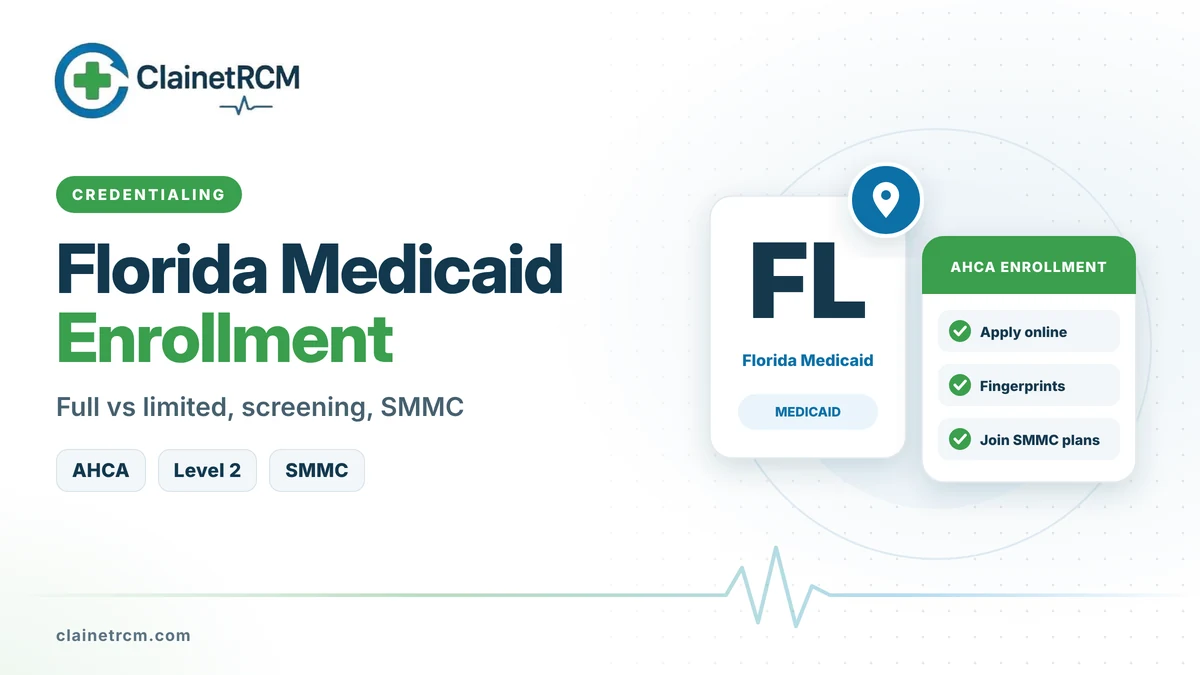
Florida Medicaid provider enrollment is the process the Agency for Health Care Administration (AHCA) uses to approve practitioners, groups and facilities to serve Florida Medicaid recipients. Because most recipients are enrolled in Statewide Medicaid Managed Care (SMMC) plans, enrollment is only half the job: you also need to credential and contract with the plans your patients use. This guide covers enrollment types, background screening, the health plans and the problems that most often slow approval.
Quick answer: Apply with AHCA online, choose full or limited enrollment, select the correct provider type and upload every document the application requests. Complete Level 2 fingerprint background screening through the Care Provider Background Screening Clearinghouse where required, track the application and answer any deficiency letter by its deadline. AHCA says processing ranges from about 15 to 90 days depending on the application type. Once active, you receive a Welcome Letter with your Florida Medicaid ID and, for full and limited enrollees, a PIN letter for the secure web portal. Then credential and contract with each SMMC plan.
Fully Enrolled vs Limited Enrolled
| Enrollment type | Who it fits | Can bill fee-for-service? | Can join SMMC plans? |
|---|---|---|---|
| Fully enrolled | Providers serving fee-for-service and managed care recipients | Yes | Yes |
| Limited enrolled | Providers serving recipients only through SMMC plans | No | Yes |
Choose limited enrollment only if you are sure you will never bill Florida Medicaid directly. If you might see fee-for-service recipients or bill services carved out of managed care, full enrollment avoids a second application later. Older managed-care-only records that show a “Registered” status are not enough: AHCA terminated unregistered provider IDs in 2024, and plans deny claims when the Medicaid ID is not in full or limited enrollment.
Florida Medicaid Provider Enrollment Step by Step
- Confirm your NPI data. Your NPI, legal name, taxonomy and practice address must match NPPES. AHCA now expects an active NPI on file for many provider types, including behavior analysts, whose claims have required one since March 27, 2026.
- Review the enrollment policy. AHCA’s Provider Enrollment Policy is adopted in Rule 59G-1.060, and the current version took effect April 8, 2026. It lists requirements by provider type, and AHCA’s interactive enrollment checklist shows the documents for your enrollment type and specialty.
- Complete the online application. Applications are filed through AHCA’s online enrollment wizard on the Florida Medicaid Web Portal, and all supporting documents must be uploaded before you can submit. AHCA is also rolling out a new provider enrollment system as part of its Medicaid modernization project, so check AHCA’s provider enrollment page for the current route before you start.
- Complete background screening. Florida requires Level 2 background screening, which uses fingerprints, for providers and for owners and managing employees where required. Results are shared through the Clearinghouse, so valid existing results can often be reused.
- Pay any required fee. Institutional provider types owe the federal application fee ($750 for 2026). Individual practitioners are generally exempt.
- Track the application. Use the enrollment status tool on the portal with your application tracking number. If screening results do not arrive within about two weeks, AHCA sends a deficiency letter, and applications left incomplete are closed for inactivity.
- Activate your account. After approval, use the Welcome Letter and PIN letter to set up the secure web portal account, and link treating providers to the group.
Credentialing With SMMC Plans
Florida’s Statewide Medicaid Managed Care program has three components: Managed Medical Assistance (MMA), Long-Term Care (LTC) and Dental. The current contracts, known as SMMC 3.0, began February 1, 2025. The health plans include Aetna Better Health, Community Care Plan, Florida Community Care, Humana Medical Plan, Molina Healthcare, Simply Healthcare, Sunshine Health and UnitedHealthcare, and availability varies by region. The Children’s Medical Services plan moved to Molina on October 1, 2026.
Each plan credentials and contracts separately. Most use CAQH data, so keep the profile complete and attested. Plans also expect an active Florida Medicaid ID before they finalize participation.
| Plan step | What you need | Tip |
|---|---|---|
| Request participation | Medicaid ID or pending application, NPI and TIN | Apply only in the regions where you practice |
| Credentialing | Complete CAQH profile, license and malpractice coverage | Re-attest CAQH every 120 days |
| Contracting | Signed agreement and rate schedule | Confirm the effective date in writing |
| Loading | Provider added to plan systems | Check the plan directory before billing |
Common Reasons Florida Applications Get Delayed
- Incomplete background screening. A missing owner or managing employee result holds the entire file.
- Data mismatches. A different name, address or taxonomy than NPPES or the license triggers follow-up.
- Wrong provider type or enrollment type. Choosing limited enrollment when you need full enrollment means reapplying.
- Missed deadlines. An unanswered deficiency letter can lead to denial or closure, and you must start a new application.
- Unlinked treating providers. Group claims deny when the rendering provider is not linked to the group.
- Plan credentialing started too late. Start SMMC credentialing while the Medicaid application is in process so both finish close together.
Revalidation and Ongoing Maintenance
AHCA must complete revalidation for every enrolled provider at least every five years under 42 CFR 455.414. Keep your contact information current in the secure web portal so you receive notices, update licenses before they expire and report ownership or location changes. Accurate account information also matters as AHCA moves providers into its new enrollment system.
Frequently Asked Questions
AHCA says processing ranges from about 15 to 90 days depending on the application type. Background screening, missing documents and site visits for higher-risk provider types add time, and SMMC plan credentialing runs on its own timeline.
Fully enrolled providers can bill Florida Medicaid fee-for-service and join SMMC plans. Limited enrolled providers can only participate through SMMC plans and cannot bill fee-for-service.
Many applicants do. Florida requires Level 2 background screening, which includes fingerprints, for providers and certain owners and managing employees. Results are stored in the Care Provider Background Screening Clearinghouse.
Yes. SMMC plans require network providers to be enrolled with AHCA, either through full enrollment or limited enrollment.
AHCA can deny the application or close it as incomplete, and you will need to submit a new one. Watch the portal and your email closely while the file is pending.
At least every five years. AHCA sends revalidation notices before the due date, so keep your contact information current.
Final Thoughts
Florida Medicaid provider enrollment moves fastest when the enrollment type, background screening and SMMC credentialing are planned together. Learn how we support Florida practices on our Florida page, compare another large state in our Texas Medicaid enrollment guide, or let our credentialing services team manage the process.
Let Us Handle Your Florida Medicaid Enrollment
We complete AHCA applications, coordinate Level 2 screening, track deficiencies and credential your providers with SMMC plans so claims pay from day one.
Start Florida Enrollment
Written by
ClainetRCM Billing Team
ClainetRCM is a Boston-based revenue cycle management company specializing in medical billing, coding, credentialing and denial management for healthcare providers across all 50 states. Our AAPC and AHIMA certified team works inside your existing EHR, files claims within 24 to 48 hours and reviews every AR bucket on a 14-day cycle.